1,267 posters, 47 videos, 13 topics, 4 sessions, 853 authors
ePostersLive by SciGen Technologies S.A. All rights reserved.
SOHO 2026 Annual Meeting
September 9 - 12, 2026 | George R. Brown Convention Center, Houston, Texas

MDS - 1034
Cooperative Effects of U2AF1-S34 and BCOR Mutations in Myeloid Neoplasms
Poster Presenter
Authors
Part of Topic
Myelodysplastic Syndromes (MDS)
COOPERATIVE EFFECTS OF U2AF1-S34 AND BCOR MUTATIONS IN MYELOID NEOPLASMS
A. ABUSHAMMA¹, A. MARUMO¹, Z. BRADY¹, S. Unlu¹, H. Gandicheruvu², V. VISCONTE¹ and J. MACIEJEWSKI¹
¹ Department of Translational Hematology and Oncology Research, Taussig Cancer Institute, Cleveland Clinic, Cleveland, Ohio, USA
² Department of Internal Medicine, Sinai Hospital of Baltimore, George Washington University School of Medicine and Health Sciences Regional Medical Campus, Baltimore, Maryland, USA
INTRODUCTION
-
U2AF1 mutations occur in approximately 7-11% of myeloid neoplasms and cluster at two zinc-finger hotspots, S34 and Q157.¹
-
Both hotspot mutations have been associated with different co-mutations and clinical characteristics.¹
-
In myelodysplastic syndromes (MDS), S34 mutations are predominant and are associated with worse overall survival and higher rates of leukemic transformation.¹˒²
-
Distinct hematopoietic phenotypes have been described in U2AF1 mutant mice.³ However, hotspot-level clinical data across real-world patients with myeloid neoplasms remain incompletely defined.
AIMS
-
The primary objective of this study is to investigate the clinical association and characteristics of U2AF1-S34 and Q157 mutations across myeloid neoplasms.
-
The secondary objective is to define the prognostic impact of cooperating mutations.
METHOD
Study Cohort
-
We analyzed 1,829 patients with myeloid neoplasms (CMML n=318, MDS n=1,186, MDS/MPN n=150, MPN n=27, AML n=148).
Mutation classification
-
U2AF1 mutations were classified as S34 or Q157.
Data analysis
-
Co-mutation frequencies were compared using Fisher's exact test.
-
Multivariable Cox proportional hazards regression was adjusted for age, ASXL1, TP53, TET2, HMA therapy, and CPSS-Mol risk score for the CMML cohort.
CONCLUSIONS
-
In this large cohort of myeloid neoplasms, S34 and Q157 exhibited markedly distinct co-mutation patterns: S34 with BCOR, Q157 with ASXL1.
-
Patients with S34/BCOR co-mutation represent a previously uncharacterized adverse-risk group in myeloid neoplasms (median OS 10.1 months).
RESULTS
-
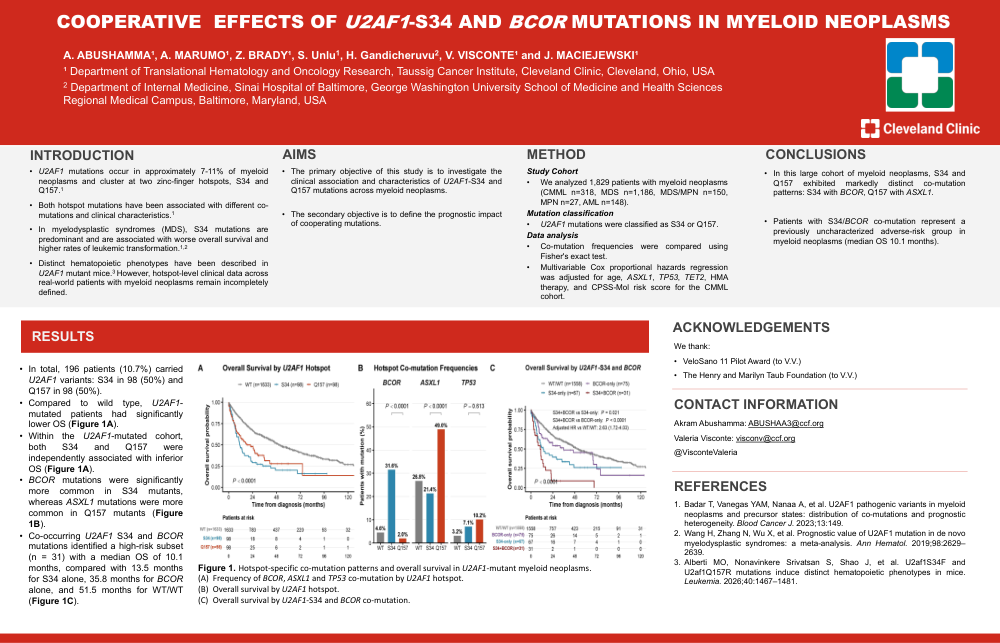
In total, 196 patients (10.7%) carried U2AF1 variants: S34 in 98 (50%) and Q157 in 98 (50%).
-
Compared to wild type, U2AF1-mutated patients had significantly lower OS (Figure 1A).
-
Within the U2AF1-mutated cohort, both S34 and Q157 were independently associated with inferior OS (Figure 1A).
-
BCOR mutations were significantly more common in S34 mutants, whereas ASXL1 mutations were more common in Q157 mutants (Figure 1B).
-
Co-occurring U2AF1 S34 and BCOR mutations identified a high-risk subset (n = 31) with a median OS of 10.1 months, compared with 13.5 months for S34 alone, 35.8 months for BCOR alone, and 51.5 months for WT/WT (Figure 1C).
Figure 1. Hotspot-specific co-mutation patterns and overall survival in U2AF1-mutant myeloid neoplasms.
(A) Frequency of BCOR, ASXL1 and TP53 co-mutation by U2AF1 hotspot.
(B) Overall survival by U2AF1 hotspot.
(C) Overall survival by U2AF1-S34 and BCOR co-mutation.
ACKNOWLEDGEMENTS
We thank:
-
VeloSano 11 Pilot Award (to V.V.)
-
The Henry and Marilyn Taub Foundation (to V.V.)
CONTACT INFORMATION
Akram Abushamma: ABUSHAA3@ccf.org
Valeria Visconte: visconv@ccf.org
@VisconteValeria
REFERENCES
-
Badar T, Vanegas YAM, Nanaa A, et al. U2AF1 pathogenic variants in myeloid neoplasms and precursor states: distribution of co-mutations and prognostic heterogeneity. Blood Cancer J. 2023;13:149.
-
Wang H, Zhang N, Wu X, et al. Prognostic value of U2AF1 mutation in de novo myelodysplastic syndromes: a meta-analysis. Ann Hematol. 2019;98:2629–2639.
-
Alberti MO, Nonavinkere Srivatsan S, Shao J, et al. U2af1S34F and U2af1Q157R mutations induce distinct hematopoietic phenotypes in mice. Leukemia. 2026;40:1467–1481.