1,267 posters, 47 videos, 13 topics, 4 sessions, 853 authors
ePostersLive by SciGen Technologies S.A. All rights reserved.
SOHO 2026 Annual Meeting
September 9 - 12, 2026 | George R. Brown Convention Center, Houston, Texas

MDS - 098
Artificial Intelligence in the Diagnosis of Severe Aplastic Anemia: A Systematic Review of Emerging Diagnostic Models
Poster Presenter
Authors
Part of Topic
Myelodysplastic Syndromes (MDS)
Background
Differentiating severe aplastic anemia (SAA) from other cytopenic disorders, particularly myelodysplastic syndromes (MDS), remains a major diagnostic challenge. Artificial intelligence (AI) has emerged as a promising tool to enhance diagnostic accuracy using multimodal data. Conventional diagnostic approaches rely heavily on invasive bone marrow examination and expert morphological interpretation, which may be limited by inter-observer variability and delayed access in some settings. Recent advances in machine learning and deep learning enable integration of laboratory, imaging, and clinical data, offering a non-invasive and scalable strategy to improve early diagnosis and clinical decision-making.
Methods
We conducted a systematic review of PubMed-indexed studies (2019–2026) evaluating AI-based diagnostic models in aplastic anemia and bone marrow failure syndromes. Eligible studies included those utilizing machine learning (ML) or deep learning (DL) applied to morphology, laboratory data, imaging, or integrated clinical-genomic variables. Extracted outcomes included diagnostic accuracy, sensitivity, specificity, and area under the curve (AUC).
Results
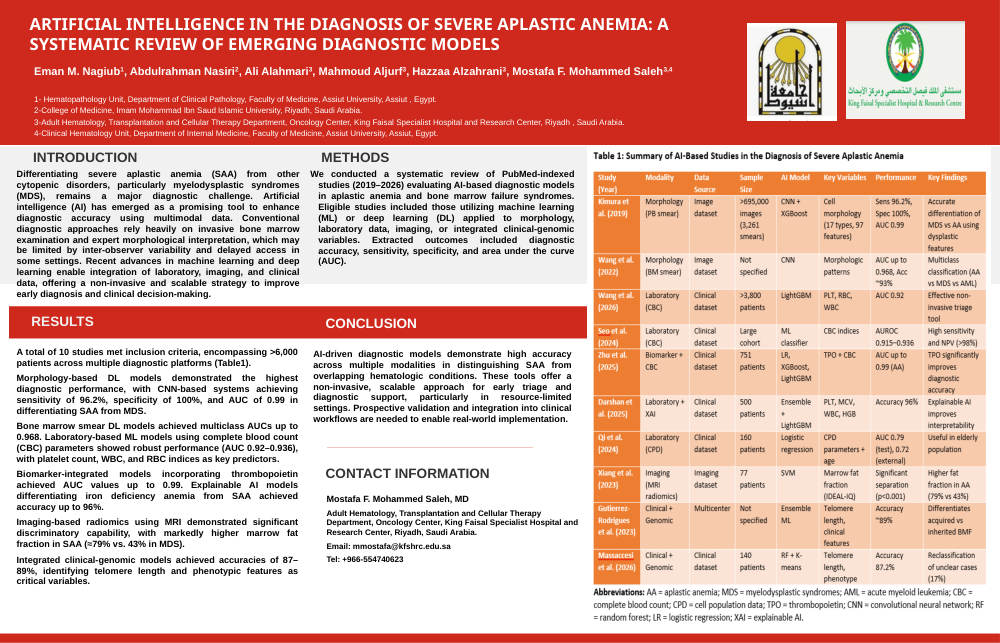
A total of 10 studies met inclusion criteria, encompassing >6,000 patients across multiple diagnostic platforms (Table1). Morphology-based DL models demonstrated the highest diagnostic performance, with CNN-based systems achieving sensitivity of 96.2%, specificity of 100%, and AUC of 0.99 in differentiating SAA from MDS. Bone marrow smear DL models achieved multiclass AUCs up to 0.968. Laboratory-based ML models using complete blood count (CBC) parameters showed robust performance (AUC 0.92–0.936), with platelet count, WBC, and RBC indices as key predictors. Biomarker-integrated models incorporating thrombopoietin achieved AUC values up to 0.99. Explainable AI models differentiating iron deficiency anemia from SAA achieved accuracy up to 96%. Imaging-based radiomics using MRI demonstrated significant discriminatory capability, with markedly higher marrow fat fraction in SAA (≈79% vs. 43% in MDS). Integrated clinical-genomic models achieved accuracies of 87–89%, identifying telomere length and phenotypic features as critical variables.
Conclusion
AI-driven diagnostic models demonstrate high accuracy across multiple modalities in distinguishing SAA from overlapping hematologic conditions. These tools offer a non-invasive, scalable approach for early triage and diagnostic support, particularly in resource-limited settings. Prospective validation and integration into clinical workflows are needed to enable real-world implementation.