1,267 posters, 47 videos, 13 topics, 4 sessions, 853 authors
ePostersLive by SciGen Technologies S.A. All rights reserved.
SOHO 2026 Annual Meeting
September 9 - 12, 2026 | George R. Brown Convention Center, Houston, Texas

CLL - 978
National Trends in Mortality Associated With Leukemias Complicated by Sepsis in U.S. Adults Aged =25 Years, 1999-2025
Poster Presenter
Authors
Part of Topic
Chronic Lymphocytic Leukemia (CLL)
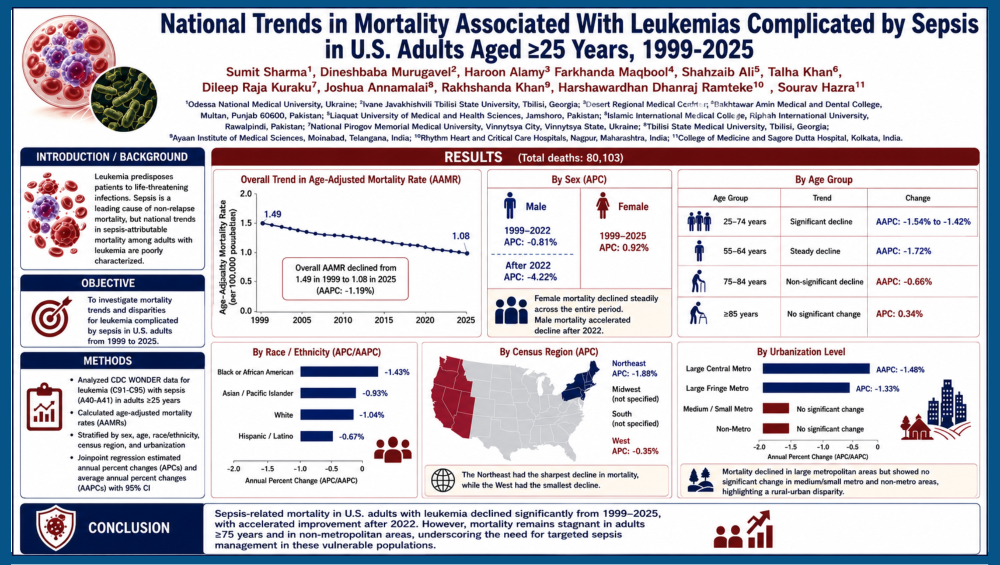
National Trends in Mortality Associated With Leukemias Complicated by Sepsis in U.S. Adults Aged ≥25 Years, 1999–2025
Introduction/Background:
Leukemia predisposes patients to life-threatening infections. Sepsis is a leading cause of non-malignant mortality among adults with leukemia, yet national trends in sepsis-attributable mortality among adults with leukemia are poorly characterized.
Objective:
To investigate mortality trends and disparities for leukemia complicated by sepsis in U.S. adults aged ≥25 years from 1999 to 2025.
Methods:
We analyzed CDC WONDER data for leukemia (C91–C95) with sepsis (A40–A41) in adults aged ≥25 years. Age-adjusted mortality rates were calculated and stratified by sex, age, race/ethnicity, census region, and urbanization level. Joinpoint regression estimated annual percent changes (APC) and average annual percent changes (AAPC) with 95% confidence intervals.
Results:
A total of 80,103 deaths were identified. Overall age-adjusted mortality decreased from 1.49 per 100,000 in 1999 to 1.08 per 100,000 in 2025 (AAPC −1.19%). Mortality declined significantly among males and females, with an accelerated decline among males after 2022. Younger age groups demonstrated significant or steady declines, while mortality among adults aged ≥85 years showed no significant change. Mortality declined across racial and ethnic groups, with the sharpest decline among Black or African American individuals. The Northeast experienced the sharpest regional decline, while the West had the smallest decline. Mortality decreased significantly in large metropolitan areas but showed no significant change in medium/small metropolitan or non-metropolitan areas.
Conclusion:
Sepsis-related mortality in U.S. adults with leukemia declined significantly from 1999–2025, with accelerated improvement after 2022. However, mortality remains stagnant in adults aged ≥75 years and in non-metropolitan areas, underscoring the need for targeted sepsis management in these vulnerable populations.