1,267 posters, 47 videos, 13 topics, 4 sessions, 853 authors
ePostersLive by SciGen Technologies S.A. All rights reserved.
SOHO 2026 Annual Meeting
September 9 - 12, 2026 | George R. Brown Convention Center, Houston, Texas

CLL - 074
Baseline Monocyte-Macrophage Exhaustion and NK-Cell Dysfunction Could Predict Response, Minimal Residual Disease, and Survival and Guide Treatment Choice in Newly Diagnosed Chronic Lymphocytic Leukemia Patients
Poster Presenter
Authors
Part of Topic
Chronic Lymphocytic Leukemia (CLL)
Introduction:
Even with new medication in CLL, there are many patients developed resistance. Immune evasion may result in apparent "MRD negativity" without long-lasting disease control and this could explained by monocyte–macrophage exhaustion and NK-cell malfunction.
Aim:
We assessed whether baseline monocyte/macrophage and NK-cell markers could guide treatment choice and predictor of response, MRD and progression-free survival (PFS) in newly diagnosed CLL patients treated with Ibrutinib (BTK inhibitors) or venetoclax (BCL-2 inhibitor).
Methods:
82 patients treatment-naïve CLL were enrolled with median age of 62 years old. Baseline peripheral blood monocytes/macrophages were assessed for CD163 (M2 polarization) and PD-L1 (immune checkpoint activity) by flow cytometry. NK cells were detected using CD107a (degranulation assay). Patients received Ibrutinib (n = 44) or venetoclax plus Obinutuzumab (n = 38) according to patients insurance eligibility. Treatment response, MRD status and PFS were recorded.
Results:
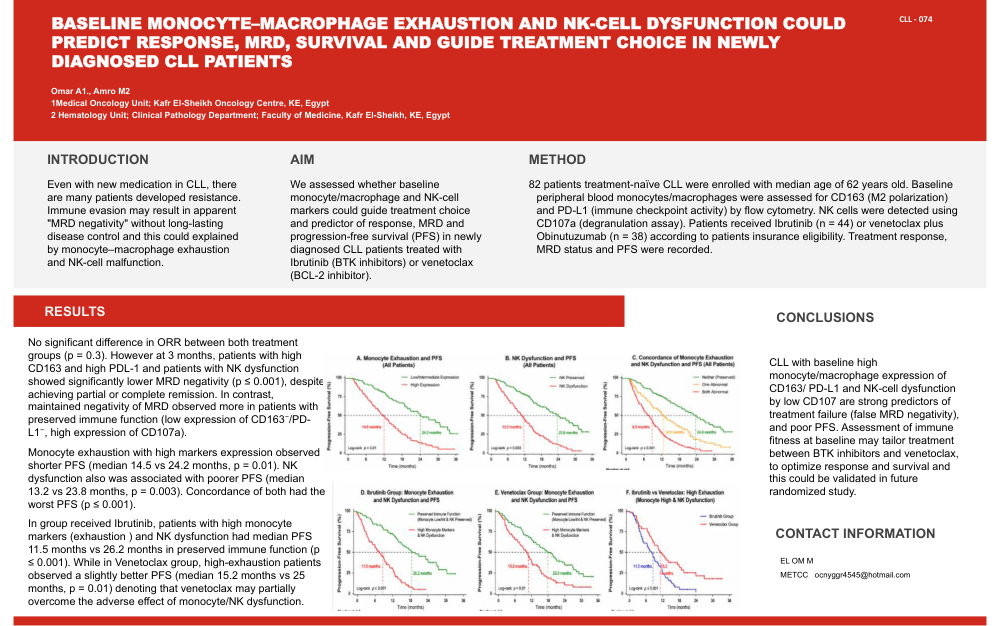
High monocyte/macrophage exhaustion categorized as CD163⁺ ≥50% (above cut off level for healthy individuals) and/or PD-L1 ≥10% (above cut off level for healthy individuals) was observed in 40%. NK-cell dysfunction detected as CD107a <20% degranulation (below cut off level for healthy individuals) was present in (36%). Concordance of monocyte exhaustion and NK dysfunction was presented in (27%).
High CD163⁺ and PD-L1 correlated with high lymphocyte counts (p = 0.01), high β2-microglobulin (p = 0.03), and unmutated IGHV (p = 0.01). NK dysfunction was significantly associated with old age (p = 0.05) and advanced Rai stage (p = 0.04).
No significant difference in ORR between both treatment groups (p = 0.3). However at 3 months, patients with high CD163 and high PDL-1 and patients with NK dysfunction showed significantly lower MRD negativity (p ≤ 0.001), despite achieving partial or complete remission. In contrast, maintained negativity of MRD observed more in patients with preserved immune function (low expression of CD163⁻/PD-L1⁻, high expression of CD107a).
Monocyte exhaustion with high markers expression observed shorter PFS (median 14.5 vs 24.2 months, p = 0.01). NK dysfunction also was associated with poorer PFS (median 13.2 vs 23.8 months, p = 0.003). Concordance of both had the worst PFS (p ≤ 0.001).
In group received Ibrutinib, patients with high monocyte markers (exhaustion ) and NK dysfunction had median PFS 11.5 months vs 26.2 months in preserved immune function (p ≤ 0.001). While in Venetoclax group, high-exhaustion patients observed a slightly better PFS (median 15.2 months vs 25 months, p = 0.01) denoting that venetoclax may partially overcome the adverse effect of monocyte/NK dysfunction.
Conclusions:
CLL with baseline high monocyte/macrophage expression of CD163/ PD-L1 and NK-cell dysfunction by low CD107 are strong predictors of treatment failure (false MRD negativity), and poor PFS. Assessment of immune fitness at baseline may tailor treatment between BTK inhibitors and venetoclax, to optimize response and survival and this could be validated in future randomized study.