1,267 posters, 47 videos, 13 topics, 4 sessions, 853 authors
ePostersLive by SciGen Technologies S.A. All rights reserved.
SOHO 2026 Annual Meeting
September 9 - 12, 2026 | George R. Brown Convention Center, Houston, Texas

CLL - 010
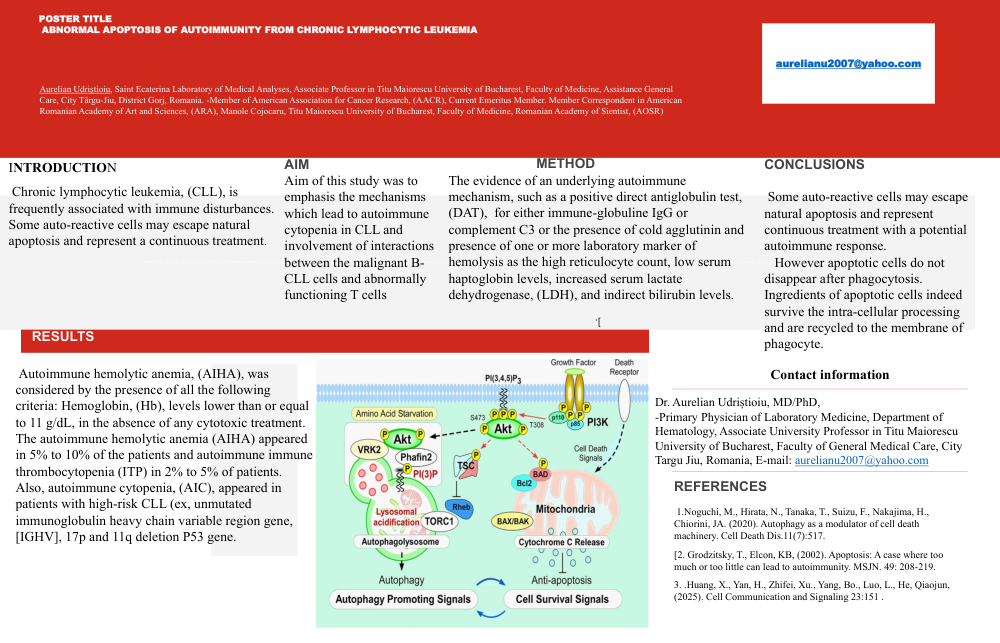
Abnormal Apoptosis of Autoimmunity From Chronic Lymphocytic Leukemia
Poster Presenter
Authors
Part of Topic
Chronic Lymphocytic Leukemia (CLL)
Abnormal Apoptosis of Autoimmunity from Chronic Lymphocytic Leukaemia
¹Aurelian Udristioiu, ¹Liviu Martin, ²Manole Cojocaru
¹Titu Maiorescu University of Bucharest, Faculty of, Medicine, General Medicine Assistance,
Department of Molecular Biology, City Târgu-Jiu, District Gorj, Romania,
² Titu Maiorescu University of Bucharest, Faculty of Medicine, Romanian Academy of Scientist, (AOSR), Romania
Abstract
Introduce
Apoptosis, in the scheduling of cell life, is a normal process different from cell necrosis, which occurs due to physical or chemical aggression. The decision to activate a suicide process is made based on intrinsic or extrinsic apoptotic messages. Extrinsic way inducers of apotheosis are ligands and cytokines for death receptors, (DR-Death receptors), on each cell surface. The intrinsic way inducers of apotheosis come from the mitochondria or nucleus. Proapoptotic signals, which promote or cause apoptosis, participate in a cascade that leads to the culmination cleavage of a set of proteins, resulting in the disassembly of the cells for apoptosis.
Aim
The scope of this review is to emphasise that massive apoptosis overloading the phagocytic capacity can may trigger an autoimmune reaction through the presentation of nucleosomes to the immune system.
Methods
A large cohort study of primary CLL examined samples from more than 100 patients for response to MDM2 inhibition and found a direct correlation between wild-type P53 status and MDM2 inhibitor, Nutlin-3 and MI-219, induced cytotoxicity across various CLL subtypes.
This response was not predicted by other biomarkers used clinically in CLL, including expression of ZAP70, expression of CD38 receptor on malignant B cells, un-mutated immunoglobulin variable genes, IGHV and mono-allelic ATM gene loss. In experimental models, disrupting the MDM2–p53 protein interaction restored p53 function and sensitized tumours to chemotherapy or radiotherapy.
Results
Pro-apoptotic signals apoptosis receptors, such as TNF-related apoptosis-inducing ligand, (TRAIL), Tumour Necrosis Factor, (TNF) and Fas receptor, also known as APO-1 or CD95 are the key adaptor proteins transmitting apoptotic signals mediated by the main death receptors, (DRs), known to induce autophagy. Also, autoimmune cytopenia, (AIC), appeared in patients with high-risk CLL (ex, unmutated immunoglobulin heavy chain variable region gene, [IGHV], 17p and 11q deletion).
Conclusions
Presented research are impact on the clinical management of patients and requires an attitude adjustment therapeutic adequate in a personalized medicine.
Keywords: apoptosis, death receptors, MDM2 protein, p53 gene, tumour necrosis factor (TNF).