1,267 posters, 47 videos, 13 topics, 4 sessions, 853 authors
ePostersLive by SciGen Technologies S.A. All rights reserved.
SOHO 2026 Annual Meeting
September 9 - 12, 2026 | George R. Brown Convention Center, Houston, Texas

CLL - 446
Comparative Assessment of MRD Detection and Immunological Effects in Relapsed CLL Patients Treated With Rituximab-Venetoclax in Real World: Insights From the “Dedalus" Protocol
Poster Presenter
Authors
Part of Topic
Chronic Lymphocytic Leukemia (CLL)
Comparative Assessment of MRD Detection and Immunological Effects in Relapsed CLL Patients Treated with Rituximab-Venetoclax in Real World: Insights from the "Dedalus" Protocol
Maria D’Amato¹, Claudia Baratè2, Clara Bono¹, Gaspare Tancredi¹, Francesca Guerrini¹, Edoardo Benedetti¹, Sara Galimberti¹
1 University of Pisa, Pisa, Italy
2 Grande Ospedale Metropolitano Niguarda, Milano, Italy
Introduction
The fixed-duration treatment Rituximab (R) - Venetoclax (Ven) has revolutionized chronic lymphocytic leukemia (CLL) therapy, achieving a 7-year overall survival rate of 69.6% and enabling measurable residual disease (MRD) eradication. Sensitive techniques are essential for accurate MRD evaluation and response assessment.
Aim
The "Dedalus" protocol evaluates MRD using flow cytometry (MFC) and nextgeneration sequencing (NGS) in relapsed/refractory CLL patients treated with fixed-duration RVen therapy, correlating MRD status with clinical and immunological outcomes.
Materials & Methods
22 patients analyzed using ERIC-compliant flow cytometry and the Lymphotrack NGS panel detecting IgH clonality with 10⁻⁵ sensitivity. Advanced ultrasound techniques used to assess response. Immunological profiles and MRD analyzed at 1, 6, 12, and 18 months or at treatment discontinuation
Results
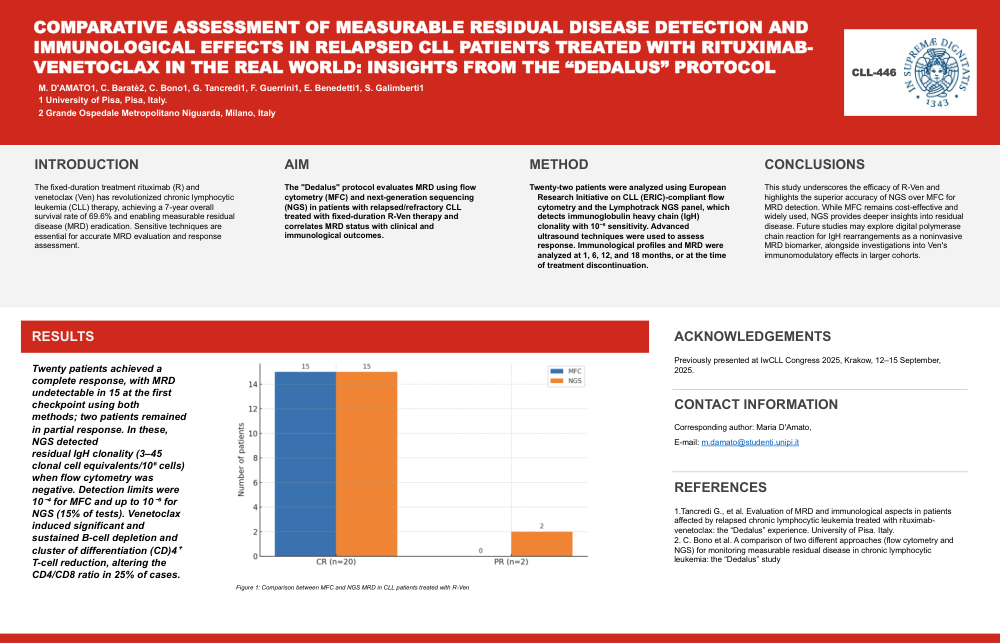
20 patients achieved complete response (CR), with MRD undetectable in 15 at first checkpoint by both methods; 2 patients remained in partial response (PR); in these, NGS detected residual IgH clonality (3-45 clonal cell equivalents/10⁶ cells) when flow cytometry was negative. Detection limits were 10⁻⁴ for MFC and up to 10⁻⁵ for NGS (15% of tests). Venetoclax induced significant and sustained B-cell depletion and CD4+ T-cell reduction, altering the CD4/CD8 ratio in 25% of cases
Conclusions
The study underscores the efficacy of R-Ven and highlights the superior accuracy of NGS over MFC in MRD detection. While MFC remains costeffective and widely used, NGS provides deeper insights into residual disease. Future studies may explore digital PCR for IgH rearrangements as a non-invasive MRD biomarker, alongside investigations into Ven's immunomodulatory effects in larger cohorts.
Reference
1.Tancredi G., et al. Evaluation of MRD and immunological aspects in patients affected by relapsed chronic lymphocytic leukemia treated with rituximab-venetoclax: the “Dedalus” experience. University of Pisa. Italy.
2. C. Bono et al. A comparison of two different approaches (flow cytometry and NGS) for monitoring measurable residual disease in chronic lymphocytic leukemia: the “Dedalus” study.