1,267 posters, 47 videos, 13 topics, 4 sessions, 853 authors
ePostersLive by SciGen Technologies S.A. All rights reserved.
SOHO 2026 Annual Meeting
September 9 - 12, 2026 | George R. Brown Convention Center, Houston, Texas

CLL - 419
Diagnostic Accuracy of Noncoding RNAs in Chronic Lymphocytic Leukemia: A Systematic Review and Meta-Analysis
Poster Presenter
Authors
Part of Topic
Chronic Lymphocytic Leukemia (CLL)
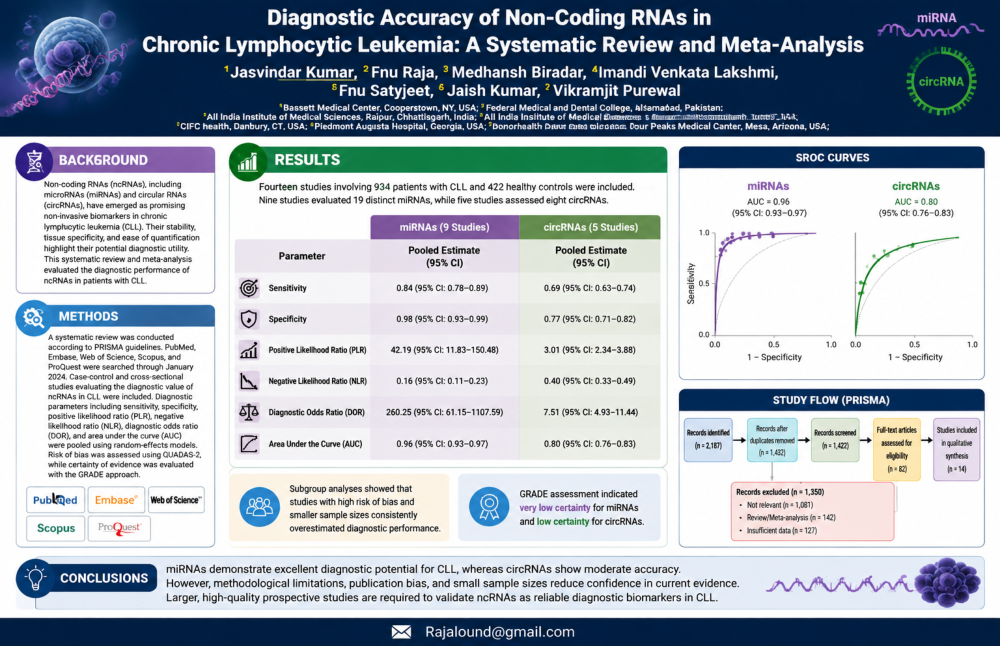
Diagnostic Accuracy of Non-Coding RNAs in Chronic Lymphocytic Leukemia: A Systematic Review and Meta-Analysis
1Jasvindar Kumar, 2Fnu Raja, 3Medhansh Biradar, 4Imandi Venkata Lakshmi, 5Fnu Satyjeet, 6Jaish Kumar, 7Vikramjit Purewal
1Bassett Medical Center, Cooperstown, NY, USA; 2Federal Medical and Dental College, Islamabad, Pakistan; 3All India Institute of Medical Sciences, Raipur, Chhattisgarh, India; 4All India Institute of Medical Sciences, Raipur, Chhattisgarh, India; 5CIFC health, Danbury, CT, USA; Piedmont Augusta Hospital, Georgia, USA; 7Honorhealth Four Peaks Medical Center, Mesa, Arizona,USA;
Background:
Non-coding RNAs (ncRNAs), including microRNAs (miRNAs) and circular RNAs (circRNAs), have emerged as promising non-invasive biomarkers in chronic lymphocytic leukemia (CLL). Their stability, tissue specificity, and ease of quantification highlight their potential diagnostic utility. This systematic review and meta-analysis evaluated the diagnostic performance of ncRNAs in patients with CLL.
Methods:
A systematic review was conducted according to PRISMA guidelines.PubMed, Embase, Web of Science, Scopus, and ProQuest were searched through January 2024. Case-control and cross-sectional studies evaluating the diagnostic value of ncRNAs in CLL were included. Diagnostic parameters including sensitivity, specificity, positive likelihood ratio (PLR), negative likelihood ratio (NLR), diagnostic odds ratio (DOR), and area under the curve (AUC) were pooled using random-effects models. Risk of bias was assessed using QUADAS-2, while certainty of evidence was evaluated with the GRADE approach.
Results:
Fourteen studies involving 934 patients with CLL and 422 healthy controls were included. Nine studies evaluated 19 distinct miRNAs, while five studies assessed eight circRNAs. Pooled analysis demonstrated excellent diagnostic performance for miRNAs, with sensitivity of 0.84 (95% CI: 0.78–0.89), specificity of 0.98 (95% CI: 0.93–0.99), PLR of 42.19 (95% CI: 11.83–150.48), NLR of 0.16 (95% CI: 0.11–0.23), DOR of 260.25 (95% CI: 61.15–1107.59), and AUC of 0.96 (95% CI: 0.93–0.97). CircRNAs demonstrated moderate diagnostic accuracy, with sensitivity of 0.69 (95% CI: 0.63–0.74), specificity of 0.77 (95% CI: 0.71–0.82), PLR of 3.01 (95% CI: 2.34–3.88), NLR of 0.40 (95% CI: 0.33–0.49), DOR of 7.51 (95% CI: 4.93–11.44), and AUC of 0.80 (95% CI: 0.76–0.83). Subgroup analyses showed that studies with high risk of bias and smaller sample sizes consistently overestimated diagnostic performance. GRADE assessment indicated very low certainty for miRNAs and low certainty for circRNAs.
Conclusions:
miRNAs demonstrate excellent diagnostic potential for CLL, whereas circRNAs show moderate accuracy. However, methodological limitations, publication bias, and small sample sizes reduce confidence in current evidence. Larger, high-quality prospective studies are required to validate ncRNAs as reliable diagnostic biomarkers in CLL.