1,267 posters, 47 videos, 13 topics, 4 sessions, 853 authors
ePostersLive by SciGen Technologies S.A. All rights reserved.
SOHO 2026 Annual Meeting
September 9 - 12, 2026 | George R. Brown Convention Center, Houston, Texas

CLL - 009
Application of CRISPR-Cas9 Technology in the Treatment of Chronic Lymphocytic Leukemia with P53 Gene Mutations
Poster Presenter
Authors
Part of Topic
Chronic Lymphocytic Leukemia (CLL)
Application of CRISPR–Cas9 Technology in the Treatment of Chronic Lymphocytic Leukemia with Mutations P53 gene
¹Aurelian Udristioiu, ²Manole Cojocaru
¹Titu Maiorescu University of Bucharest, Faculty of Medical Assistance-Targu Jiu, Romania, ²Titu Maiorescu University of Bucharest, Faculty of Medicine, Romanian Academy of Scientists, City Bucharest, Romania
Abstract
Aim
This study proposes the implementation of clustered regularly interspaced short palindromic repeats (CRISPR)–CRISPR-associated protein 9 (Cas9) technology for gene therapy targeting P53 genetic mutations in human lymphocytes affected from chronic lymphocytic leukemia, (CLL), offering new opportunities for effective treatment of this heterogeneous disease.
Method
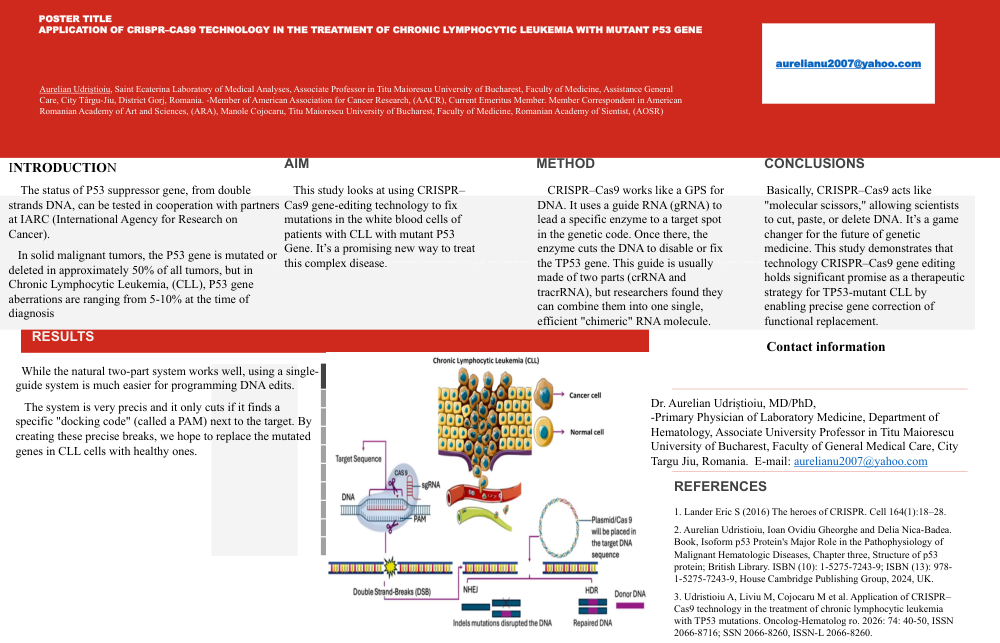
CRISPR–Cas9 technology employs a specific enzyme guided by a designed guide RNA (gRNA) to a DNA target. The Cas9 enzyme first introduces a cut at the target site and following this cleavage event, it can further replace the TP53 gene. The gRNA consists of CRISPR RNA (crRNA) and trans-activating CRISPR RNA, (tracrRNA), together sequences, being responsible for target recognition and Cas9 binding, respectively. Examination of the predicted secondary structure of the tracrRNA–crRNA duplex suggests that the features required for Cas9-catalyzed DNA cleavage at specific sites can be captured within a single chimeric RNA.
Results
Although the natural tracrRNA–crRNA mechanism operates efficiently, the use of a single RNA-guided Cas9 system is particularly attractive due to its potential for programmed DNA cleavage and genome editing. Importantly, Cas9 can bind and cleave a target sequence only if it is adjacent to a protospacer adjacent motif, PAM. Once the gRNA–Cas9 complex binds to the target DNA, Cas9 induces a double-strand break at the specified site, gene lesions, aiming to replace mutant TP53 genes in CLL cells through this technology.
Conclusions
CRISPR–Cas9 technology represents a powerful genetic engineering tool capable of inserting, deleting, or replacing DNA within an organism’s genome using these “molecular scissors.”
Keywords: CRISPR–Cas9, P53 gene, isoforms p53 protein, Single guide RNA, Trans-activator RNA.