816 posters, 24 topics, 3,314 authors, 1,012 institutions
ePostersLive by SciGen Technologies S.A. All rights reserved.
SAGES 2026 Annual Meeting Emerging Technology Session
March 25-28, 2026 | Tampa, FL, USA

ETP907
Comparative Evaluation of Fogging Propensity in Laparoscopes: Saberscope vs. Traditional Endoscopes Under Simulated Surgical Conditions
Poster Presenter
Authors
Affiliations
Part of Topic
Comparative Evaluation of Fogging: Single-Use Saberscope®️ vs. Traditional Reusable Laparoscopes
INTRODUCTION
Surgeons spend an estimated 40% of MIS operating time under suboptimal visual conditions, contributing to nearly 20% of surgical complications. Lens cleaning adds $132–$493 per procedure, averaging $312.53 based on 9.7 cleaning events per case. Visualization-related complications contribute an additional $251 per case. Combined, these issues result in over $2.2 billion in annual costs in the U.S. Poor visualization also disrupts workflow, increases surgeon fatigue, and hinders integration of emerging technologies such as artificial intelligence (AI)*
Intraoperative lens fogging is a persistent obstacle in minimally invasive surgery, degrading visualization, prolonging operative time, and increasing patient risk. Traditional reusable laparoscopes frequently fail to maintain clarity in high‑humidity, thermally dynamic environments. Prior findings show that traditional laparoscopes exhibited immediate and complete fogging upon exposure, with zero usability throughout the simulation period. This study expands on that work by evaluating fogging behavior across multiple temperature–humidity combinations using a controlled test chamber.
METHODS
OBJECTIVES
RESULTS
CONCLUSIONS
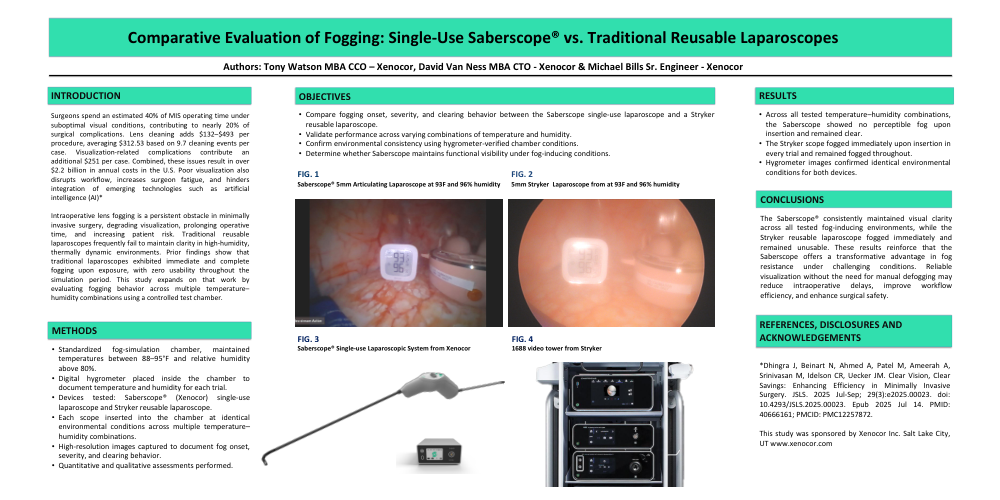
The Saberscope®️ consistently maintained visual clarity across all tested fog‑inducing environments, while the Stryker reusable laparoscope fogged immediately and remained unusable. These results reinforce that the Saberscope offers a transformative advantage in fog resistance under challenging conditions. Reliable visualization without the need for manual defogging may reduce intraoperative delays, improve workflow efficiency, and enhance surgical safety.
Xenocor Saberscope Laparoscope Stryker Olympus Karl Storz Nanoscope Arthrexn Single-use Disposable Endoscope MIS