816 posters, 24 topics, 3,314 authors, 1,012 institutions
ePostersLive by SciGen Technologies S.A. All rights reserved.
SAGES 2026 Annual Meeting Emerging Technology Session
March 25-28, 2026 | Tampa, FL, USA

ETP873
Qualitative Perspectives of Early Surgeon Users on the Value of the da Vinci 5 Surgical System
Poster Presenter
Authors
Derek Erstad, Zahra Fazal, Karlis Draulis, Feibi Zheng, Gretchen P Jackson, Christy Chai
Affiliations
Part of Topic
Qualitative Perspectives of Early Surgeon Users on the Value of the da Vinci 5 Surgical System
Derek Erstad MD1, Zahra Fazal MSc2, Karlis Draulis BS2, Feibi Zheng MD2, Gretchen P Jackson MD, PhD2,3, Christy Chai MD1
Objective of the Technology
Robotic-assisted surgery has become widely accepted as a minimally invasive approach, with the da Vinci surgical system used in over 16 million procedures globally. The da Vinci 5 (dV5) system, launched in 2024, introduced significant technological advances including Force Feedback to enhance surgical senses, greater surgeon autonomy, and advanced data analytics for continuous improvement. The purpose of this study is to assess the early experience and surgeon perceived value of dV5 in surgical practice.
Description of the Technology
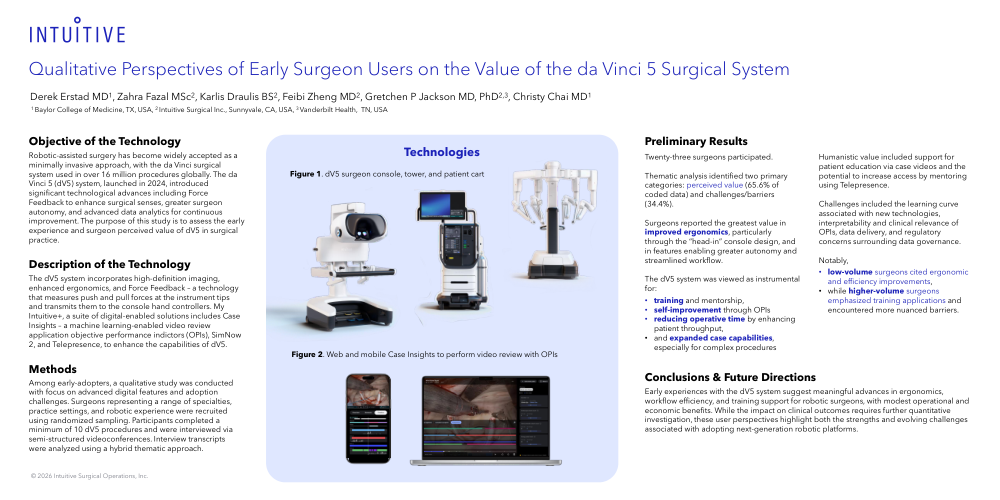
The dV5 system incorporates high-definition imaging, enhanced ergonomics, and Force Feedback – a technology that measures push and pull forces at the instrument tips and transmits them to the console hand controllers. My Intuitive+, a suite of digital-enabled solutions includes Case Insights – a machine learning-enabled video review application objective performance indictors (OPIs), SimNow 2, and Telepresence, to enhance the capabilities of dV5.
Methods
Among early-adopters, a qualitative study was conducted with focus on advanced digital features and adoption challenges. Surgeons representing a range of specialties, practice settings, and robotic experience were recruited using randomized sampling. Participants completed a minimum of 10 dV5 procedures and were interviewed via semi-structured videoconferences. Interview transcripts were analyzed using a hybrid thematic approach.
Preliminary Results
Twenty-three surgeons participated.
Thematic analysis identified two primary categories: perceived value (65.6% of coded data) and challenges/barriers (34.4%).
Surgeons reported the greatest value in improved ergonomics, particularly through the “head-in” console design, and in features enabling greater autonomy and streamlined workflow.
The dV5 system was viewed as instrumental for:
Humanistic value included support for patient education via case videos and the potential to increase access by mentoring using Telepresence.
Challenges included the learning curve associated with new technologies, interpretability and clinical relevance of OPIs, data delivery, and regulatory concerns surrounding data governance.
Notably,
Conclusions & Future Directions
Early experiences with the dV5 system suggest meaningful advances in ergonomics, workflow efficiency, and training support for robotic surgeons, with modest operational and economic benefits. While the impact on clinical outcomes requires further quantitative investigation, these user perspectives highlight both the strengths and evolving challenges associated with adopting next-generation robotic platforms.