816 posters, 24 topics, 3,314 authors, 1,012 institutions
ePostersLive by SciGen Technologies S.A. All rights reserved.
SAGES 2026 Annual Meeting Emerging Technology Session
March 25-28, 2026 | Tampa, FL, USA

ETP872
Harnessing AI and Video Analytics for Surgical Performance: The OR Black Box® Explorer Module as a Platform for Learning and Quality Improvement
Poster Presenter
Authors
Chibueze A Nwaiwu, Jose Rodriguez, Connie Gan, Boris Zevin, Jeanett Strandbygaard, Teodor Grantcharov
Affiliations
Department of Surgery, Stanford University School of Medicine, Stanford, CA, USA, Surgical Safety Technologies, Inc., Toronto, Ontario, Canada, Department of Surgery, Queen's University, Kingston, Ontario, Canada, Department of Obstetrics and Gynaecology, Rigshospitalet, Copenhagen, Denmark
Part of Topic
Harnessing AI and Video Analytics for Surgical Performance: The OR Black Box® Explorer™ Module as a Platform for Learning and Quality Improvement
Chibueze A Nwaiwu, MD; Jose Rodriguez, MD, MComm; Connie Gan, MD; Boris Zevin, MD, PhD; Jeanett Strandbygaard, MD, PhD; Teodor Grantcharov, MD, PhD
Objective:
To evaluate the utility of the OR Black Box Explorer Module—an AI-driven video analytics platform—in enhancing surgical education, coaching, and systems-level quality improvement (QI) across multiple international centers.
Project Overview:
Structured video review in minimally invasive surgery improves technical performance, operative outcomes, and learner satisfaction. These data support systematic integration of video analysis into surgical education, QI, and AI-enabled research.
Methods:
Multicenter descriptive implementation (North America and Europe)
Multicenter Descriptive Implementation (North America & Europe)
Deployment across residency and specialty programs.
Integration into academic half-days and plenary sessions.
Evaluation of engagement and self-assessment accuracy on entrustable professional activities (EPAs).
Stanford Prospective Cohort (ACS Clinical Congress 2025):
General surgery residents with structured video review rounds.
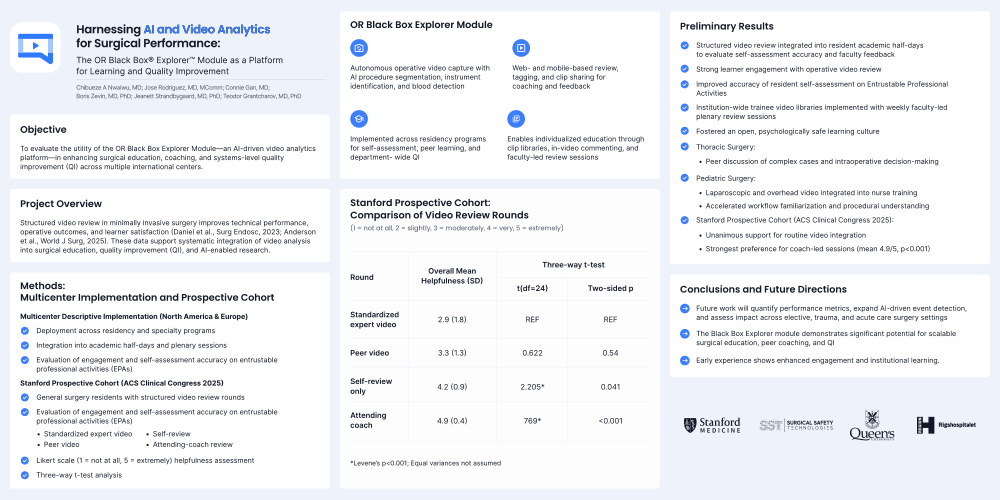
Evaluation of engagement and self-assessment accuracy on entrustable professional activities (EPAs): standardized expert video, peer video, self-review, attending-coach review
Likert scale (1 = not at all, 5 = extremely) helpfulness assessment
Three-way t-test analysis
OR Black Box Explorer Module:
Autonomous operative video capture with AI procedure segmentation, instrument identification, and blood detection
Web- and mobile-based review, tagging, and clip sharing for coaching and feedback.
Implemented across residency programs for self-assessment, peer learning, and department-wide QI.
Enables individualized education through clip libraries, in-video commenting, and faculty-led review sessions.
Preliminary Results:
Structured video review integrated into resident academic half-days to evaluate self-assessment accuracy and faculty feedback.
Higher learner engagement with operative video review.
Improved accuracy of resident self-assessment on Entrustable Professional Activities.
Institution-wide trainee video libraries implemented with weekly faculty led plenary review sessions.
Fostered an open, psychologically safe learning culture.
Thoracic Surgery: peer discussion of complex cases and intraoperative decision-making.
Pediatric Surgery: laparoscopic and overhead video integrated into nurse training, accelerated workflow familiarization and procedural understanding.
Stanford Prospective Cohort: unanimous support for routine video integration, strongest preference for coach-led sessions (mean 4.9/5, p<0.001).
Conclusions and Future Directions:
Future work will quantify performance metrics, expand AI-driven event detection, and assess impact across elective, trauma, and acute care surgery settings.
Explorer demonstrates significant potential for scalable surgical education, peer coaching, and QI.
Early experience shows enhanced engagement, efficiency, and institutional learning.