816 posters, 24 topics, 3,314 authors, 1,012 institutions
ePostersLive by SciGen Technologies S.A. All rights reserved.
SAGES 2026 Annual Meeting Emerging Technology Session
March 25-28, 2026 | Tampa, FL, USA

ETP905
Comparative In-Vitro Performance Evaluation of Barbed Sutures: V-Loc™ 180 Absorbable Wound Closure Device vs. STRATAFIX™ Spiral PDS Plus
Poster Presenter
Authors
Katerina Stojkova Atanasova, Joel Goncalves, John M Marini, Jim Hunt
Affiliations
Part of Topic
Barbed Suture Performance:V Loc ™ 180 v. STRATAFIX ™* Spiral PDS Plus Comparative In vitro Evaluation
Introduction
The adoption of robotic assisted surgery ( has significantly
advanced the field of minimally invasive procedures, providing
surgeons with enhanced precision, dexterity, and visualization These
technological enhancements have enabled more complex
interventions across a wide range of specialties, including
gastrointestinal (GI) and endoscopic surgery
Advancements in RAS have significantly increased the use of barbed
sutures for wound closure The performance of barbed sutures in
RAS closure relies on hundreds of tiny barbs that securely anchor
tissue and evenly distribute tension along the wound The barb
design, shape, and placement along the suture play a critical role in
defining the device and contributing to its performance ◊ 1 2
Objective
This study aims to compare and evaluate the barb design features of
the V Loc ™ 180 Absorbable Wound Closure Device (Fig 1 with
Ethicon’s STRATAFIX ™ barbed suture, focusing on their in vitro
performance and unique design characteristics Testing
methodologies adhere to industry standard best practices for
assessing key in vitro performance metrics of barbed devices
Methods
Barb geometry including cut angle, depth,
length, width, prominence, pitch, and
helicity were measured microscopically with
Keyence 7000 software measurement tools at 80X.
Device strength performance was evaluated using
mechanical testing with the Instron system Barb Holding
Force testing measures the strength of individual barbs under
controlled tensile force using media that mimics ex vivo
subcutaneous tissue Suture Tensile Strength testing
determines the force needed to break the suture strand
under sustained tension In vitro suture strength retention was
assessed by measuring the breaking force after incubation at
37 C for 2 and 3 weeks (Fig 2).
Results
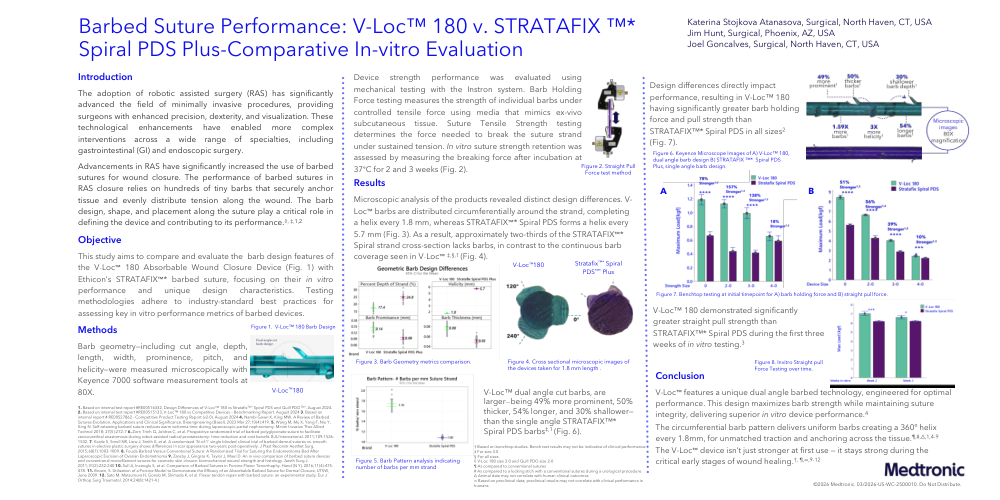
Microscopic analysis of the products revealed distinct design differences. V
Loc ™ barbs are distributed circumferentially around the strand, completing
a helix every 1.8 mm, whereas STRATAFIX ™* Spiral PDS forms a helix every
5.7 mm (Fig. 3). As a result, approximately two thirds of the STRATAFIX ™*
Spiral strand cross section lacks barbs, in contrast to the continuous barb
coverage seen in V Loc ™ § ,1 (Fig. 4).
V-Loc ™ dual angle cut barbs, are
larger being 49% more prominent, 50%
thicker, 54% longer, and 30% shallower
than the single angle STRATAFIX ™*
Spiral PDS barbs ‡,1 (Fig. 6).
Design differences directly impact
performance, resulting in V Loc ™ 180
having significantly greater barb holding
force and pull strength than
STRATAFIX ™* Spiral PDS in all sizes 2
(Fig. 7)
V-Loc ™ 180 demonstrated significantly
greater straight pull strength than
STRATAFIX ™* Spiral PDS during the first three
weeks of in vitro testing. 3
Conclusion
V-Loc ™ features a unique dual angle barbed technology, engineered for optimal
performance. This design maximizes barb strength while maintaining suture
integrity, delivering superior in vitro device performance. 4
The circumferential barb pattern delivers uniform barbs creating a 360º helix
every 1.8mm, for unmatched traction and anchoring across the tissue. ¶,#,Δ,1,4 9
The V Loc ™ device isn’t just stronger at first use it stays strong during the
critical early stages of wound healing. healing.†, ¶,∞,9 12