816 posters, 24 topics, 3,314 authors, 1,012 institutions
ePostersLive by SciGen Technologies S.A. All rights reserved.
SAGES 2026 Annual Meeting Emerging Technology Session
March 25-28, 2026 | Tampa, FL, USA

ETP901
Real-Time AI Classifier for Visual Obstruction Detection in Minimally Invasive Surgery Across Robotic Platforms
Poster Presenter
Authors
Amy Lorincz, Noée Ducros-Chabot, Rachel Cohen, Sukesh Adiga, Christopher Beckham, Karim Elrakhawy, Timothée Bernard, Wayne Poll, M. Carmen Mir
Affiliations
Department of Research and Development, vopemed, Faculty of Medicine, University of Montreal, Applied Sciences Mgmt., LLC, Department of Urology, Mount Sinai, School of Medicine
Part of Topic
Real-Time AI Classifier for Visual Obstruction Detection in Minimally Invasive Surgery (MIS) Across Robotic Platforms
Amy Lorincz, MSc¹*, Noée Ducros-Chabot¹, Rachel Cohen, MEng¹, Sukesh Adiga, PhD¹, Christopher Bechkam, PhD¹, Karim Elrakhawy¹,², Timothée Bernard, MEng¹, Wayne Poll, MD³, M. Carmen Mir, MD, PhD⁴
*amy@vope.ai
1. Dept. of R&D, Vope Medical, 2. Faculty of Medicine, University of Montreal, Montreal, Quebec, Canada, 3. Applied Sciences Mgmt., LLC, Columbus, OH, USA, 4. Department of Urology, Mount Sinai, School of Medicine, New York City, NY, USA
Background :
- Obstructions (smoke, blur, and fluid) during MIS can occur for up to 37% of time during surgery
- Identifying these can reduce the need for manual clinical annotation in downstream tasks and enable evaluation of the impact of visual obstructions
- We propose a real-time classifier to detect various obstructions during MIS.
Methods:
- MobileNet-based model was trained on 7 robotic laparoscopic prostatectomy videos, four from Intuitive’s da Vinci and three from Medtronic Hugo (6,564 frames)
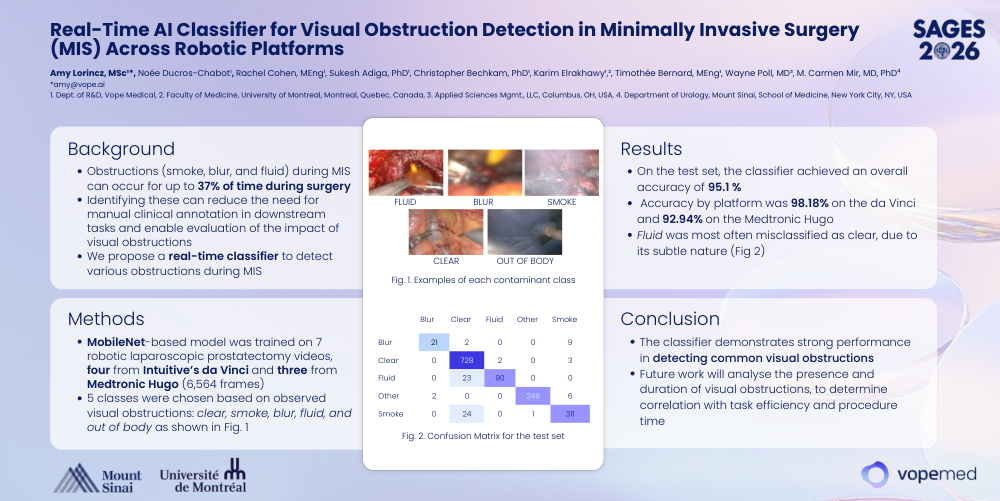
- 5 classes were chosen based on observed visual obstructions: clear, smoke, blur, fluid, and out of body as shown in Fig. 1.
Results:
- On the test set, the classifier achieved an overall accuracy of 95.1 %
- Accuracy by platform was 98.18% on the da Vinci and 92.94% on the Medtronic Hugo Fluid was most often misclassified as clear, due to its subtle nature (Fig 2)
Conclusion : The classifier demonstrates strong performance in detecting common visual obstructions. Future work will analyse the presence and duration of visual obstructions, to determine correlation with task efficiency and procedure time