816 posters, 24 topics, 3,314 authors, 1,012 institutions
ePostersLive by SciGen Technologies S.A. All rights reserved.
SAGES 2026 Annual Meeting Emerging Technology Session
March 25-28, 2026 | Tampa, FL, USA

ETP895
Inara: Patient Education, Engagement, and Monitoring
Poster Presenter
Authors
Affiliations
Part of Topic
Objective
Surgical patients face a significant information burden across the perioperative continuum. During consultation visits, clinicians must convey procedural details, risk-benefit discussions, and pre-operative instructions within time-constrained encounters. Evidence demonstrates that patients retain only a fraction of the information communicated during these visits, with recall declining further over subsequent days.¹ This gap between information delivered and information retained contributes to high volumes of follow-up calls to clinical staff, persistent preoperative anxiety, and in some cases, surgical non-attendance, which has been reported to exceed 35% in certain populations due to patient-related factors.² Standard educational materials such as printed brochures and discharge packets, while widely distributed, do not provide patients with the ability to ask questions, clarify concerns, or revisit information in a dynamic and responsive manner.
Following surgery, the accelerating adoption of Enhanced Recovery After Surgery (ERAS) protocols has meaningfully reduced hospital length of stay. However, earlier discharge has not been accompanied by a proportional decrease in readmission rates or emergency department utilization. A study of ERAS implementation in colorectal surgery demonstrated a reduction in length of stay from 7.0 to 5.3 days, yet 30-day readmission rates remained unchanged at approximately 17.6%–19.4%, with the authors explicitly recommending the integration of remote symptom monitoring into ERAS pathways.³ Additionally, estimated 81% of surgical patients receive no guidance on red-flag signs at discharge, and limited health literacy independently doubles the risk of postoperative complications following colorectal surgery (OR 2.03, p = 0.046).4,5
Despite these well-documented gaps on both sides of the operative encounter, no scalable solution currently exists that addresses the full perioperative continuum - providing patients with on-demand, personalized surgical guidance while simultaneously equipping clinicians with real-time visibility into patient concerns and recovery trajectories.
Description of Technology
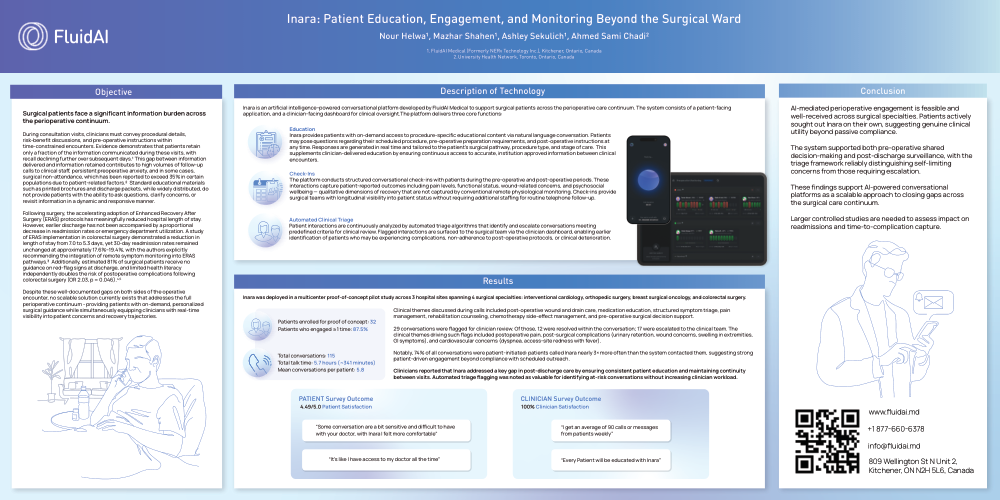
Inara is an artificial intelligence–powered conversational platform developed by FluidAI Medical to support surgical patients across the perioperative care continuum. The system consists of a patient-facing application, and a clinician-facing dashboard for clinical oversight. The platform delivers three core functions:
Education Inara provides patients with on-demand access to procedure-specific educational content via natural language conversation. Patients may pose questions regarding their scheduled procedure, pre-operative preparation requirements, and post-operative instructions at any time. Responses are generated in real time and tailored to the patient’s surgical pathway, procedure type, and stage of care. This supplements clinician-delivered education by ensuring continuous access to accurate, institution approved information between clinical encounters.
Check-Ins The platform conducts structured conversational check-ins with patients during the pre-operative and post-operative periods. These interactions capture patient-reported outcomes including pain levels, functional status, wound-related concerns, and psychosocial wellbeing — qualitative dimensions of recovery that are not captured by conventional remote physiological monitoring. Check-ins provide surgical teams with longitudinal visibility into patient status without requiring additional staffing for routine telephone follow-up.
Automated Clinical Triage Patient interactions are continuously analyzed by automated triage algorithms that identify and escalate conversations meeting predefined criteria for clinical review. Flagged interactions are surfaced to the surgical team via the clinician dashboard, enabling earlier identification of patients who may be experiencing complications, non-adherence to post-operative protocols, or clinical deterioration.
Results
Inara was deployed in a multicenter proof-of-concept pilot study across 3 hospital sites spanning 4 surgical specialties: interventional cardiology, orthopedic surgery, breast surgical oncology, and colorectal surgery.
Clinical themes discussed during calls included post-operative wound and drain care, medication education, structured symptom triage, pain management, rehabilitation counseling, chemotherapy side-effect management, and pre-operative surgical decision support.
29 conversations were flagged for clinician review. Of those, 12 were resolved within the conversation; 17 were escalated to the clinical team. The clinical themes driving such flags included postoperative pain, post-surgical complications (urinary retention, wound concerns, swelling in extremities, GI symptoms), and cardiovascular concerns (dyspnea, access-site redness with fever). Notably, 74% of all conversations were patient-initiated: patients called Inara nearly 3× more often than the system contacted them, suggesting strong patient-driven engagement beyond compliance with scheduled outreach.
Clinicians reported that Inara addressed a key gap in post-discharge care by ensuring consistent patient education and maintaining continuity between visits. Automated triage flagging was noted as valuable for identifying at-risk conversations without increasing clinician workload.
Conclusion
AI-mediated perioperative engagement is feasible and well-received across surgical specialties. Patients actively sought out Inara on their own, suggesting genuine clinical utility beyond passive compliance.
The system supported both pre-operative shared decision-making and post-discharge surveillance, with the triage framework reliably distinguishing self-limiting concerns from those requiring escalation.
These findings support AI-powered conversational platforms as a scalable approach to closing gaps across the surgical care continuum.
Larger controlled studies are needed to assess impact on readmissions and time-to-complication capture.