816 posters, 24 topics, 3,314 authors, 1,012 institutions
ePostersLive by SciGen Technologies S.A. All rights reserved.
SAGES 2026 Annual Meeting Emerging Technology Session
March 25-28, 2026 | Tampa, FL, USA

ETP884
Comparative Video Image Analysis of Complex Versus Simple Laparoscopic Cholecystectomy Using Artificial Intelligence
Poster Presenter
Part of Topic
Keywords: Artificial Intelligence, LapChole, Laparoscopic Cholecystectomy, Image Analysis across Cases with complex diseases, bile duct injury, multmodal pipeline, Critical View of Safety, Surgery Image Analysis, Intraoperative AI, YOLOv8, MedSAM
Title: Comparative Video Image Analysis of Complex Versus Simple Laparoscopic Cholecystectomy Using Artificial Intelligence
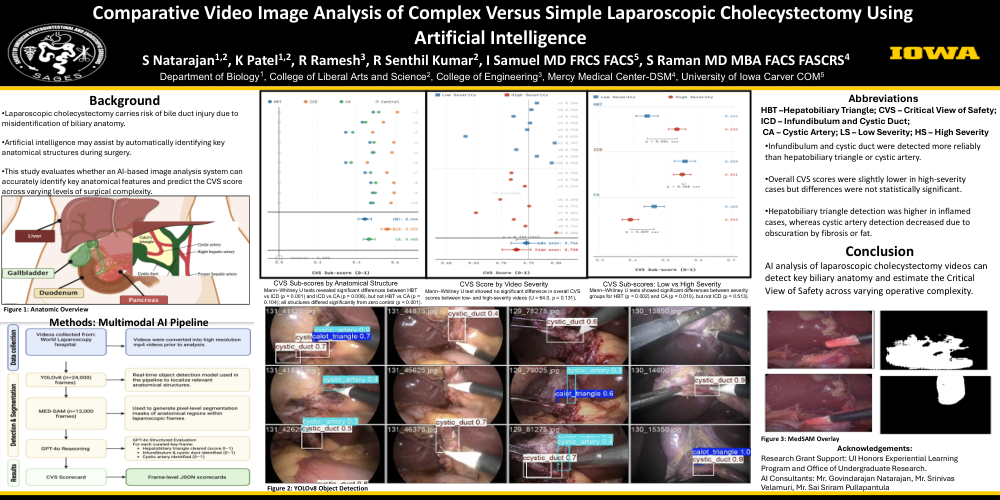
Background: Laparoscopic cholecystectomy carries risk of bile duct injury due to misidentification of biliary anatomy. Artificial intelligence may assist by automatically identifying key anatomical structures during surgery. This study evaluates whether an AI-based image analysis system can accurately identify key anatomical features and predict the CVS score across varying levels of surgical complexity.
Methods: A multimodal AI pipeline that analyzed frames/images of intraoperative laparoscopic cholecystectomy across different disease severities. YOLOv8 was used for object detection to locate key biliary structures. MedSAM was used to generate pixel-level anatomical masks and was used as a framework for CVS scores. Images were processed through OpenAI API to generate Critical View of Safety score cards and images were organized into high and low complexity of disease. Statistical analysis was conducted with the results.
Results: Infundibulum and cystic duct were detected more reliably than hepatobiliary triangle or cystic artery. Overall CVS scores were slightly lower in high‑severity cases but differences were not statistically significant. Hepatobiliary triangle detection was higher in inflamed cases, whereas cystic artery detection decreased due to obscuration by fibrosis or fat.
Conclusion: AI analysis of laparoscopic cholecystectomy videos can detect key biliary anatomy and estimate the Critical View of Safety across varying operative complexity.