816 posters, 24 topics, 3,314 authors, 1,012 institutions
ePostersLive by SciGen Technologies S.A. All rights reserved.
SAGES 2026 Annual Meeting Emerging Technology Session
March 25-28, 2026 | Tampa, FL, USA

ETP883
Fascia directed suture closure of 8 mm and 12 mm trocar sites avoids purchase of subcutaneous fat and muscle in morbidly obese patients undergoing bariatric surgery
Poster Presenter
Authors
Affiliations
Community Memorial Hospital Department of Surgical Education
Part of Topic
Fascia Directed Suture Closure of 8 mm and 12 mm Trocar Sites Avoids Purchase of Subcutaneous Fat and Muscle in Morbidly Obese Patients Undergoing Bariatric Surgery
Authors: Laura Roberson DO and Helmuth Billy MD; Community Memorial Hospital Department of Surgical Education
Introduction: Fascial closure of 12 mm trocar sites often leads to postoperative discomfort that leads to additional calls for pain management and patient discomfort. As a result, closure of 12 mm trocar sites is often avoided by surgeons during laparoscopic surgery in order to improve postoperative comfort and decrease patient calls for additional pain management. 12 mm trocar sites are associated with incisional and Richter's hernia that can be difficult to diagnose and can lead to postoperative complications including bowel obstruction and perforation. One of the common closure devices utilizes a cone and needle to place suture in the abdomen and retrieve it and close the fascia. These common devices do not exclude subcutaneous fat and muscle and can lead to significant postoperative discomfort that can limit patient movement and recovery.
Directed fascial closure allows for placement of a fascial closure suture directly at the level of the fascia and avoids/minimizes entrapment of subcutaneous tissue which is associated with postoperative pain. We studied the efficacy of closing 12 mm trocar sites using a unique device that directs a precise suture placement 12 mm, 8 mm, or 5 mm from the edge of the fascial defect avoiding compression and entrapment of subcutaneous tissue.
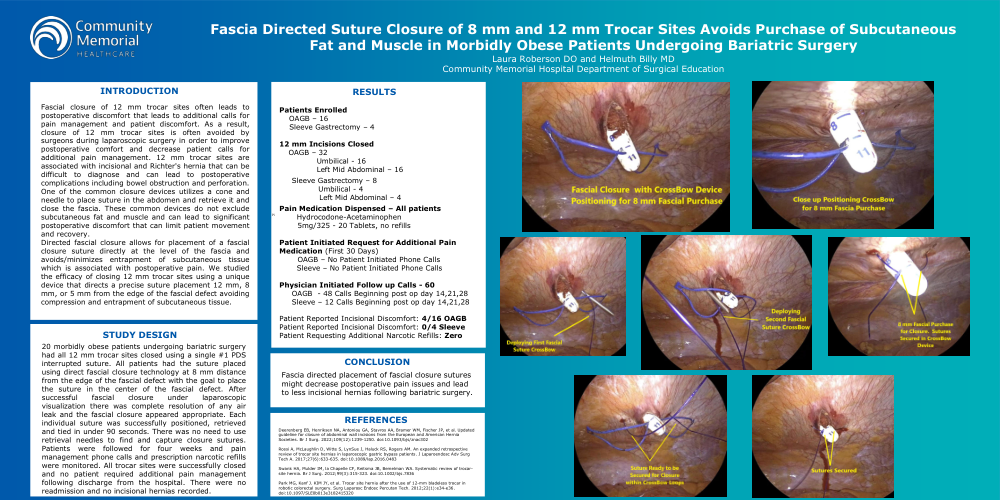
Study Design/Results: 20 morbidly obese patients undergoing bariatric surgery had all 12 mm trocar sites closed using a single #1 PDS interrupted suture. All patients had the suture placed using direct fascial closure technology at 8 mm distance from the edge of the fascial defect with the goal to place the suture in the center of the fascial defect. After successful fascial closure under laparoscopic visualization there was complete resolution of any air leak and the fascial closure appeared appropriate. Each individual suture was successfully positioned, retrieved and tied in under 90 seconds. There was no need to use retrieval needles to find and capture closure sutures. Patients were followed for four weeks and pain management phone calls and prescription narcotic refills were monitored. All trocar sites were successfully closed and no patient required additional pain management following discharge from the hospital. There were no readmission and no incisional hernias recorded.
Conclusions: Fascia directed placement of fascial closure sutures might decrease postoperative pain issues and lead to less incisional hernias following bariatric surgery.