816 posters, 24 topics, 3,314 authors, 1,012 institutions
ePostersLive by SciGen Technologies S.A. All rights reserved.
SAGES 2026 Annual Meeting Emerging Technology Session
March 25-28, 2026 | Tampa, FL, USA

ETP882
Conversational AI as a Virtual Examiner: Transforming Oral Board Preparation and Clinical Reasoning
Poster Presenter
Authors
Keith Obstein, Adria A Villafranca, Carly M Eckert, Kevin W Sexton
Affiliations
Part of Topic
Title
Conversational AI as a Virtual Examiner: Transforming Oral Board Preparation and Clinical Reasoning
Objective of the Technology
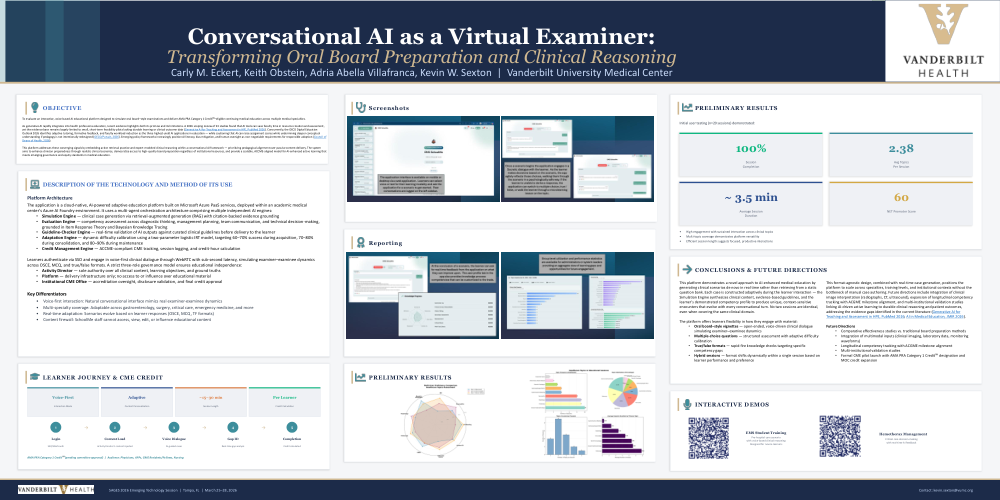
To evaluate an interactive, voice-based artificial intelligence (AI) educational platform designed to simulate oral board–style examinations across multiple medical specialties. The system aims to enhance clinician preparedness, support democratized access to high-quality training, and strengthen clinical reasoning through scalable, standardized simulation experiences.
Description of the Technology and Method of Its Use
Our AI system is built upon a secure, institutionally approved, infrastructure using OpenAI’s real-time voice model within an academic medical center’s Azure AI Foundry environment. Learners engage the AI through natural spoken dialogue, navigating realistic patient scenarios in diverse settings including outpatient clinics, emergency departments, operating rooms, and intensive care units.
The AI prompts participants to reason through diagnostic and management decisions, mirroring the flow of an oral examination, and providing structured, domain-specific feedback on patient care, medical knowledge, and decision-making. No new AI model development is performed under this study; rather, the research evaluates the educational use case of an existing, approved platform.
Pilot implementation has demonstrated adaptability across numerous topic domains including gastroenterology, critical care, internal medicine, and surgical decision-making. The system records de-identified interaction metadata—such as duration, message count, and learning objectives—to assess engagement and feasibility.
Preliminary Results
Initial user testing sessions (n=20) showed:
-
High engagement, with sustained interaction and session completion across a range of clinical topics in gastroenterology.
-
Average topics per session: 2.38 (many sessions cover multiple related topics)
-
Average session duration: 3.5 minutes
-
Total messages exchanged: 342 across all sessions
All sessions were conducted in secure institutional environments, with no patient data used or retained.
Conclusions and Future Directions
This technology demonstrates a novel application of established AI infrastructure for immersive, oral board–style training across specialties. It represents a feasible and scalable educational intervention that aligns with accepted practices in simulation-based medical education.
Next phases will assess learning outcomes compared to traditional preparation methods, refine specialty-specific content, and explore deployment for continuing professional development. By expanding access to standardized, conversational case simulation, this approach supports a pathway toward clinical excellence in healthcare education.