816 posters, 24 topics, 3,314 authors, 1,012 institutions
ePostersLive by SciGen Technologies S.A. All rights reserved.
SAGES 2026 Annual Meeting Emerging Technology Session
March 25-28, 2026 | Tampa, FL, USA

ETP879
Functional Biosensing for Early Detection of Anastomotic Complications Following Colorectal Resection
Poster Presenter
Authors
Affiliations
Part of Topic
Objective of the Technology or Device
Anastomotic leak (AL) following colorectal surgery remains a leading cause of morbidity and mortality, yet current detection methods identify leaks only after clinical deterioration has occurred. The goal of this technology is to provide continuous monitoring of tissue recovery parameters at the anastomotic site for early detection of leaks enabling improving patient’s outcomes and reducing healthcare costs.
Description of the Technology and Method of Its Use
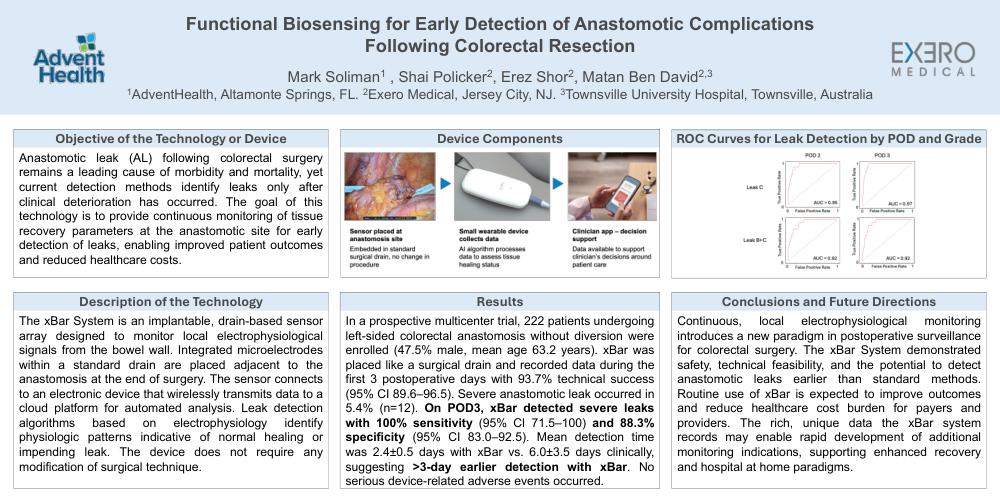
The xBar System is an implantable, drain-based sensor array designed to monitor local electrophysiological signals from the bowel wall. Integrated microelectrodes within a standard drain are placed adjacent to the anastomosis at the end of surgery. The sensor connects to an electronic device that wirelessly transmits data to a cloud platform for automated analysis. Leak detection algorithms based on electrophysiology identify physiologic patterns indicative of normal healing or impending leak. The device does not require any modification of surgical technique.
Preliminary Results
In a prospective, multicenter clinical trial 222 patients were enrolled (47.5% male, average age of 63.2 years, average BMI of 28.1). Patients underwent surgery with left sided anastomosis without diversion. The average height of the anastomosis above the anal verge was 13.8 (min 1cm, max 40cm). xBar was placed similarly to a standard surgical drain at the end of the surgery. During the first 3 post-op days, the device collected data with 93.7% technical success (95% CI 89.6%-96.5%). 5.4% (N=12) patients developed severe AL. At post-operative day 3 the device demonstrated overall severe leak detection sensitivity of 100.0% (95% CI 71.5%-100%) with specificity of 88.3% (95% CI 83.0%-92.5). The average time the clinical team required to detect a leak was 6.0 ±3.5 days, while xBar detected leaks after 2.4±0.5 days creating a potential reduction in time to detect a leak of more than 3 days, potentially allowing intervention before systemic sepsis ensues. No serious device-related adverse events occurred.
Conclusions / Future Directions
Continuous, local electrophysiological monitoring introduces a new paradigm in postoperative surveillance for colorectal surgery. The xBar System demonstrated safety, technical feasibility, and the potential to detect anastomotic leaks earlier than standard methods. Routine use of xBar is expected to improve outcomes and reduce healthcare cost burden for payers and providers. The rich, unique data the xBar system records may enable rapid development of additional monitoring indications, supporting enhanced recovery and hospital at home paradigms.