816 posters, 24 topics, 3,314 authors, 1,012 institutions
ePostersLive by SciGen Technologies S.A. All rights reserved.
SAGES 2026 Annual Meeting Emerging Technology Session
March 25-28, 2026 | Tampa, FL, USA

ETP876
ICG ILLUMINATED 40 FRENCH BOUGIE IMPROVES VISUALIZATION AND RETROGASTRIC DISSECTION OF 15 CM AND GREATER GASTRIC POUCH IN ONE ANASTOMOSIS GASTRIC BYPASS
Poster Presenter
Authors
Affiliations
Community Memorial Hospital Department of Surgical Education
Part of Topic
ICG Illuminated 40 French Bougie Improves Visualization and Retrogastric Dissection of 15 cm and Greater Gastric Pouch in One Anastomosis Gastric Bypass
Authors: Laura Roberson DO and Helmuth Billy MD; Community Memorial Hospital Department of Surgical Education
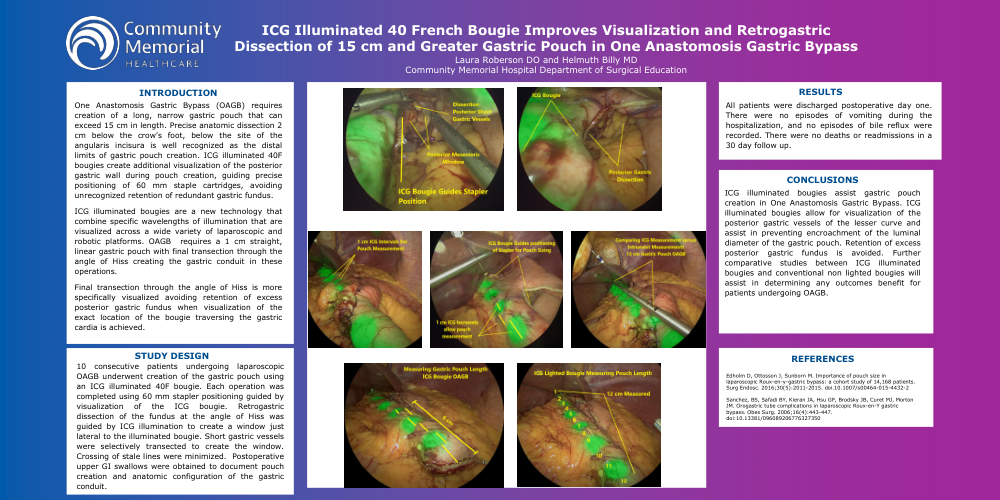
Introduction: One Anastomosis Gastric Bypass (OAGB) requires creation of a long, narrow gastric pouch that can exceed 15 cm in length. Precise anatomic dissection 2 cm below the crow’s foot, below the site of the angularis incisura is well recognized as the distal limits of gastric pouch creation. ICG illuminated 40F bougies create additional visualization of the posterior gastric wall during pouch creation, guiding precise positioning of 60 mm staple cartridges, avoiding unrecognized retention of redundant gastric fundus.
ICG illuminated bougies are a new technology that combine specific wavelengths of illumination that are visualized across a wide variety of laparoscopic and robotic platforms. OAGB requires a 1 cm straight, linear gastric pouch with final transection through the angle of Hiss creating the gastric conduit in these operations.
Final transection through the angle of Hiss is more specifically visualized avoiding retention of excess posterior gastric fundus when visualization of the exact location of the bougie traversing the gastric cardia is achieved.
Study Design: 10 consecutive patients undergoing laparoscopic OAGB underwent creation of the gastric pouch using an ICG illuminated 40F bougie. Each operation was completed using 60 mm stapler positioning guided by visualization of the ICG bougie. Retrogastric dissection of the fundus at the angle of Hiss was guided by ICG illumination to create a window just lateral to the illuminated bougie. Short gastric vessels were selectively transected to create the window. Crossing of stale lines were minimized. Postoperative upper GI swallows were obtained to document pouch creation and anatomic configuration of the gastric conduit.
Results: All patients were discharged postoperative day one. There were no episodes of vomiting during the hospitalization, and no episodes of bile reflux were recorded. There were no deaths or readmissions in a 30 day follow up.
Conclusions: ICG illuminated bougies assist gastric pouch creation in One Anastomosis Gastric Bypass. ICG illuminated bougies allow for visualization of the posterior gastric vessels of the lesser curve and assist in preventing encroachment of the luminal diameter of the gastric pouch. Retention of excess posterior gastric fundus is avoided. Further comparative studies between ICG illuminated bougies and conventional non lighted bougies will assist in determining any outcomes benefit for patients undergoing OAGB.