816 posters, 24 topics, 3,314 authors, 1,012 institutions
ePostersLive by SciGen Technologies S.A. All rights reserved.
SAGES 2026 Annual Meeting Emerging Technology Session
March 25-28, 2026 | Tampa, FL, USA

ETP874
Hybrid Image-Guided Biopsy of Mesenteric Lymph Nodes Using Advanced Overlay Techniques: A Collaborative Case Series
Poster Presenter
Authors
Shoichiro Urabe, Bradley B Pua, Art Sedrakyan, Jeffrey W Milsom
Affiliations
Section of Colorectal Surgery, Department of Surgery, Weill Cornell Medical College, Division of Interventional Radiology, Department of Radiology, Weill Cornell Medical College, Healthcare Policy and Research, Weill Cornell Medical College
Part of Topic
This study presents our initial experience with augmented reality–assisted biopsy of mesenteric lymph nodes.
Mesenteric lymph node biopsy is often challenging because the target is mobile and located close to important structures such as bowel and mesenteric vessels.
Because of these safety concerns, it can sometimes be difficult to obtain a definitive diagnosis using conventional techniques.
We hypothesized that augmented reality–based image guidance could help improve targeting accuracy.
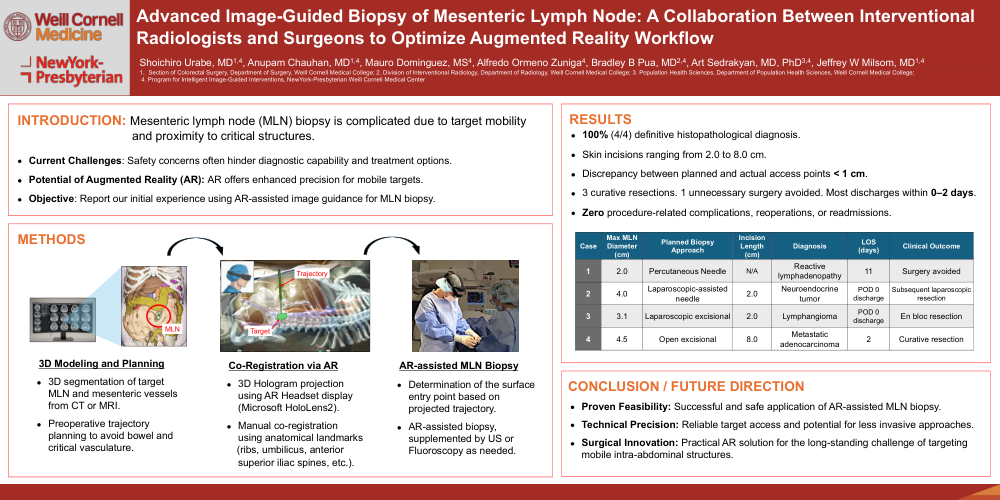
In this workflow, we first perform 3D segmentation of the mesenteric lymph node and surrounding vessels using CT or MRI data.
Then we create a preoperative trajectory plan to avoid the bowel and critical vasculature.
During the procedure, the 3D hologram is projected using an AR headset, the Microsoft HoloLens 2.
We perform manual co-registration using anatomical landmarks such as the ribs, umbilicus, and anterior superior iliac spines.
This allows us to determine the optimal skin entry point based on the projected trajectory.
Using this approach, we performed biopsy in four patients with mesenteric lymph nodes.
All cases achieved definitive histopathological diagnosis.
The difference between the planned and actual access point was less than one centimeter, indicating good targeting accuracy.
There were no procedure-related complications, reoperations, or readmissions.
Importantly, three patients underwent curative resection, and in one patient unnecessary surgery was avoided.
In conclusion, our early experience suggests that AR-assisted image guidance is feasible and safe for mesenteric lymph node biopsy.
This technology may provide a practical solution for targeting mobile intra-abdominal structures and could help enable less invasive diagnostic procedures.