875 posters, 25 topics, 3,440 authors, 1,061 institutions
ePostersLive by SciGen Technologies S.A. All rights reserved.
SAGES 2026 Annual Meeting Emerging Technology Session
March 25-28, 2026 | Tampa, FL, USA

P329
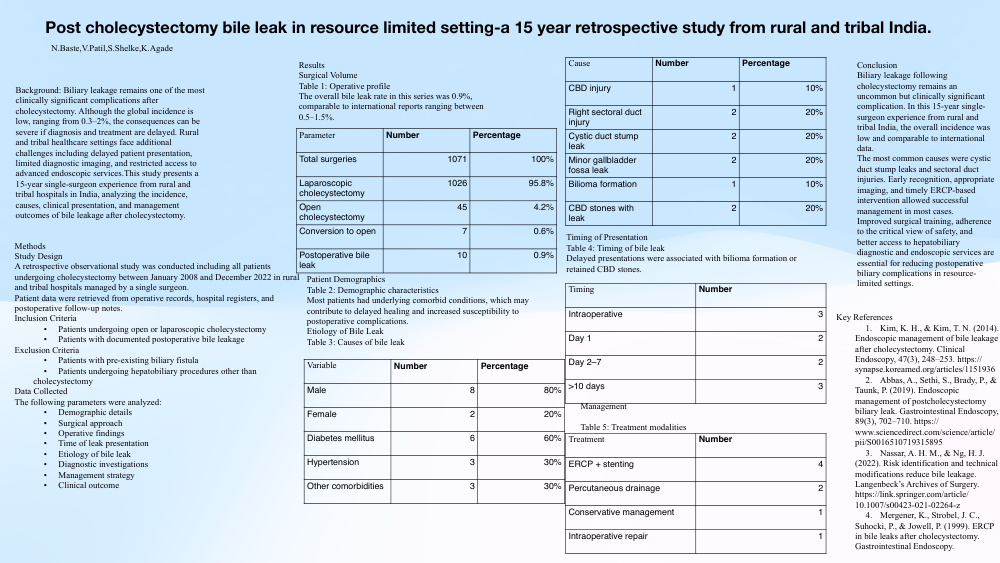
Post-Cholecystectomy Bile Leak in Resource-Limited Settings: A 15-Year Retrospective Study from Rural and Tribal India
Poster Presenter
Authors
Affiliations
Part of Topic
Biliary
Introduction
Cholecystectomy remains the definitive treatment for symptomatic gallstone disease and is one of the most frequently performed abdominal operations worldwide. The laparoscopic approach has largely replaced open cholecystectomy due to its advantages of reduced postoperative pain, shorter hospital stay, and faster recovery. However, laparoscopic cholecystectomy also introduced unique complications, most notably bile duct injuries and postoperative bile leakage.
The reported incidence of bile leakage after cholecystectomy varies between 0.3% and 2%, depending on surgeon experience, operative difficulty, and institutional resources. The most common sources of bile leakage include the cystic duct stump, ducts of Luschka, gallbladder bed, or injuries to the common bile duct or hepatic ducts.In large multicenter analyses, cystic duct stump leakage accounts for nearly 70–75% of postoperative bile leaks.
Bile leaks may present immediately after surgery or days later with abdominal pain, bilious drainage, fever, or bilioma formation. Early diagnosis and management are essential to prevent complications such as biliary peritonitis or sepsis. Imaging modalities such as ultrasonography, MRCP, and contrast-enhanced CT, along with therapeutic ERCP, play a crucial role in both diagnosis and treatment.
Endoscopic therapy has become the preferred first-line treatment for most postoperative bile leaks because sphincterotomy and biliary stenting reduce the transpapillary pressure gradient and promote leak closure. Several studies demonstrate success rates exceeding 85–90% with ERCP-based interventions.
Despite advances in minimally invasive surgery, rural and tribal healthcare systems face unique challenges. Patients frequently present with advanced disease or acute inflammation, and facilities for advanced biliary imaging or interventional endoscopy may be limited. Consequently, surgeons working in these environments must rely on careful operative technique, clinical judgment, and timely referral.
This study presents a 15-year single-surgeon experience from rural and tribal hospitals in India, analyzing the incidence, causes, clinical presentation, and management outcomes of bile leakage after cholecystectomy.
Methods
Study Design
A retrospective observational study was conducted including all patients undergoing cholecystectomy between January 2008 and December 2022 in rural and tribal hospitals managed by a single surgeon.
Patient data were retrieved from operative records, hospital registers, and postoperative follow-up notes.
Inclusion Criteria
•Patients undergoing open or laparoscopic cholecystectomy
•Patients with documented postoperative bile leakage
Exclusion Criteria
•Patients with pre-existing biliary fistula
•Patients undergoing hepatobiliary procedures other than cholecystectomy
Data Collected
The following parameters were analyzed:
•Demographic details
•Surgical approach
•Operative findings
•Time of leak presentation
•Etiology of bile leak
•Diagnostic investigations
•Management strategy
•Clinical outcome
Definitions
Bile leak:
Drain output of bile or imaging evidence of bile extravasation after cholecystectomy.
Timing classification
|
Category |
Definition |
|
Immediate |
Identified intraoperatively |
|
Early |
Within first 48 hours |
|
Intermediate |
Postoperative day 2–7 |
|
Delayed |
After postoperative day 7 |
Results
Surgical Volume
Table 1: Operative profile
|
Parameter |
Number |
Percentage |
|
Total surgeries |
1071 |
100% |
|
Laparoscopic cholecystectomy |
1026 |
95.8% |
|
Open cholecystectomy |
45 |
4.2% |
|
Conversion to open |
7 |
0.6% |
|
Postoperative bile leak |
10 |
0.9% |
The overall bile leak rate in this series was 0.9%, comparable to international reports ranging between 0.5–1.5%.
Patient Demographics
Table 2: Demographic characteristics
|
Variable |
Number |
Percentage |
|
Male |
8 |
80% |
|
Female |
2 |
20% |
|
Diabetes mellitus |
6 |
60% |
|
Hypertension |
3 |
30% |
|
Other comorbidities |
3 |
30% |
Most patients had underlying comorbid conditions, which may contribute to delayed healing and increased susceptibility to postoperative complications.
Etiology of Bile Leak
Table 3: Causes of bile leak
|
Cause |
Number |
Percentage |
|
CBD injury |
1 |
10% |
|
Right sectoral duct injury |
2 |
20% |
|
Cystic duct stump leak |
2 |
20% |
|
Minor gallbladder fossa leak |
2 |
20% |
|
Bilioma formation |
1 |
10% |
|
CBD stones with leak |
2 |
20% |
Cystic duct stump leaks remain the most common cause in most series.
Timing of Presentation
Table 4: Timing of bile leak
|
Timing |
Number |
|
Intraoperative |
3 |
|
Day 1 |
2 |
|
Day 2–7 |
2 |
|
>10 days |
3 |
Delayed presentations were associated with bilioma formation or retained CBD stones.
Management
Table 5: Treatment modalities
|
Treatment |
Number |
|
ERCP + stenting |
4 |
|
Percutaneous drainage |
2 |
|
Conservative management |
2 |
|
Intraoperative repair |
2 |
Discussion
The incidence of bile leakage in the present series (0.9%) falls within the range reported in major international studies. Although laparoscopic cholecystectomy significantly reduced postoperative morbidity compared with open surgery, bile duct injuries and leaks remain a concern.
Most leaks originate from the cystic duct stump or accessory bile ducts, particularly when clip placement is inadequate or when severe inflammation distorts anatomy.
A major contributing factor to bile duct injury is misidentification of biliary anatomy, particularly in cases of acute cholecystitis or dense adhesions.
The critical view of safety (CVS) remains the most important preventive technique during laparoscopic cholecystectomy.
ERCP has revolutionized the management of bile leaks. By reducing sphincter resistance and facilitating bile flow into the duodenum, stenting allows most minor leaks to heal spontaneously.
Several studies report closure rates of 85–95% following ERCP with sphincterotomy and stent placement.
In rural healthcare systems, limited access to advanced hepatobiliary centers can delay treatment. However, a structured approach involving early suspicion, imaging, and timely referral significantly improves outcomes.
⸻
Conclusion
Biliary leakage following cholecystectomy remains an uncommon but clinically significant complication. In this 15-year single-surgeon experience from rural and tribal India, the overall incidence was low and comparable to international data.
The most common causes were cystic duct stump leaks and sectoral duct injuries. Early recognition, appropriate imaging, and timely ERCP-based intervention allowed successful management in most cases.
Improved surgical training, adherence to the critical view of safety, and better access to hepatobiliary diagnostic and endoscopic services are essential for reducing postoperative biliary complications in resource-limited settings.
⸻
Key References
1.Kim, K. H., & Kim, T. N. (2014). Endoscopic management of bile leakage after cholecystectomy. Clinical Endoscopy, 47(3), 248–253. https://synapse.koreamed.org/articles/1151936
2.Abbas, A., Sethi, S., Brady, P., & Taunk, P. (2019). Endoscopic management of postcholecystectomy biliary leak. Gastrointestinal Endoscopy, 89(3), 702–710. https://www.sciencedirect.com/science/article/pii/S0016510719315895
3.Nassar, A. H. M., & Ng, H. J. (2022). Risk identification and technical modifications reduce bile leakage. Langenbeck’s Archives of Surgery. https://link.springer.com/article/10.1007/s00423-021-02264-z
4.Mergener, K., Strobel, J. C., Suhocki, P., & Jowell, P. (1999). ERCP in bile leaks after cholecystectomy. Gastrointestinal Endoscopy.
5.Desai, A., Twohig, P., Trujillo, S., & Dalal, S. (2021). Outcomes of ERCP for bile duct leaks. Endoscopy International Open.
6.Rauws, E. A. J., & Gouma, D. J. (2004). Management of bile duct injury. Best Practice & Research Clinical Gastroenterology.
7.Chinnery, G. E., Krige, J. E. J., & Bornman, P. C. (2013). Endoscopic management of bile leaks after laparoscopic cholecystectomy. South African Journal of Surgery.
8.Shaikh, I. A. A., Thomas, H., & Joga, K. (2009). Post-cholecystectomy cystic duct stump leak. Journal of Digestive Diseases.