816 posters, 24 topics, 3,314 authors, 1,012 institutions
ePostersLive by SciGen Technologies S.A. All rights reserved.
SAGES 2026 Annual Meeting Emerging Technology Session
March 25-28, 2026 | Tampa, FL, USA

P328
DOES PATHOLOGY AGREE WITH THE SURGEON? CONCORDANCE BETWEEN POSTOPERATIVE AND PATHOLOGICAL DIAGNOSIS IN CHOLECYSTECTOMY
Poster Presenter
Part of Topic
Biliary
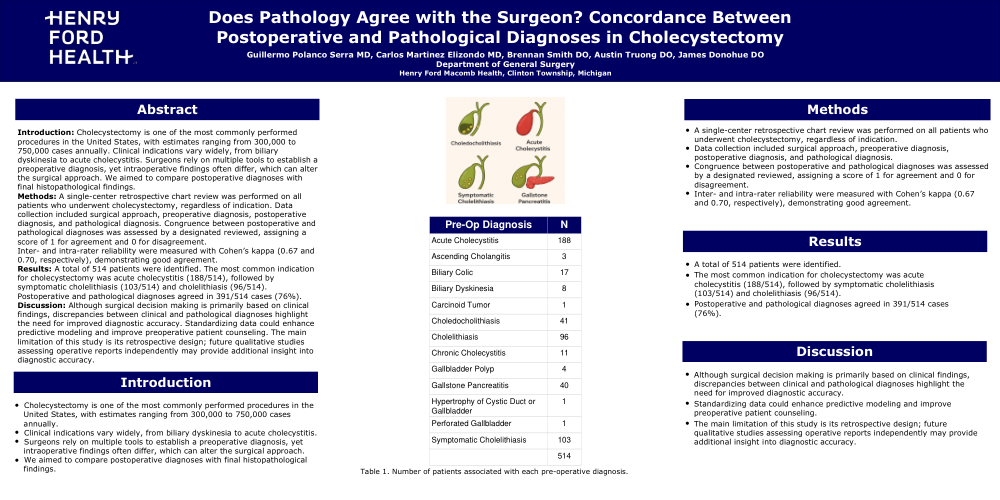
Introduction: Cholecystectomy is one of the most commonly performed procedures in the United States, with estimates ranging from 300,000 to 750,000 cases annually. Clinical indications vary widely, from biliary dyskinesia to acute cholecystitis. Surgeons rely on multiple tools to establish a preoperative diagnosis, yet intraoperative findings often differ, which can alter the surgical approach. We aimed to compare postoperative diagnoses with final histopathological findings. Methods: A single-center retrospective chart review was performed on all patients who underwent cholecystectomy, regardless of indication. Data collection included surgical approach, preoperative diagnosis, postoperative diagnosis, and pathological diagnosis. Congruence between postoperative and pathological diagnoses was assessed by a designated reviewed, assigning a score of 1 for agreement and 0 for disagreement. Inter- and intra-rater reliability were measured with Cohen’s kappa (0.67 and 0.70, respectively), demonstrating good agreement. Results: A total of 514 patients were identified. The most common indication for cholecystectomy was acute cholecystitis (188/514), followed by symptomatic cholelithiasis (103/514) and cholelithiasis (96/514). Postoperative and pathological diagnoses agreed in 391/514 cases (76%). Discussion: Although surgical decision making is primarily based on clinical findings, discrepancies between clinical and pathological diagnoses highlight the need for improved diagnostic accuracy. Standardizing data could enhance predictive modeling and improve preoperative patient counseling. The main limitation of this study is its retrospective design; future qualitative studies assessing operative reports independently may provide additional insight into diagnostic accuracy.