119 posters, 6 topics, 524 authors, 243 institutions
ePostersLive by SciGen Technologies S.A. All rights reserved.
RCR Global AI Conference 2026
29-30 June, 2026 | QEII Centre, Westminster

136
Using Virtual Simulated Patients to Teach Consent for Invasive Radiological Procedures: An AI-Enhanced Educational Innovation
Poster Presenter
Authors
Affiliations
Part of Topic
AI Education and research: examples of proof of concept or AI in development, technical advances, teaching approaches or pre-clinical testing
Purpose
To evaluate the feasibility and educational value of using AI-driven virtual patients (ChatGPT-
based) to teach and assess consent-taking skills for radiological procedures among medical and
radiology students.
Methods and materials
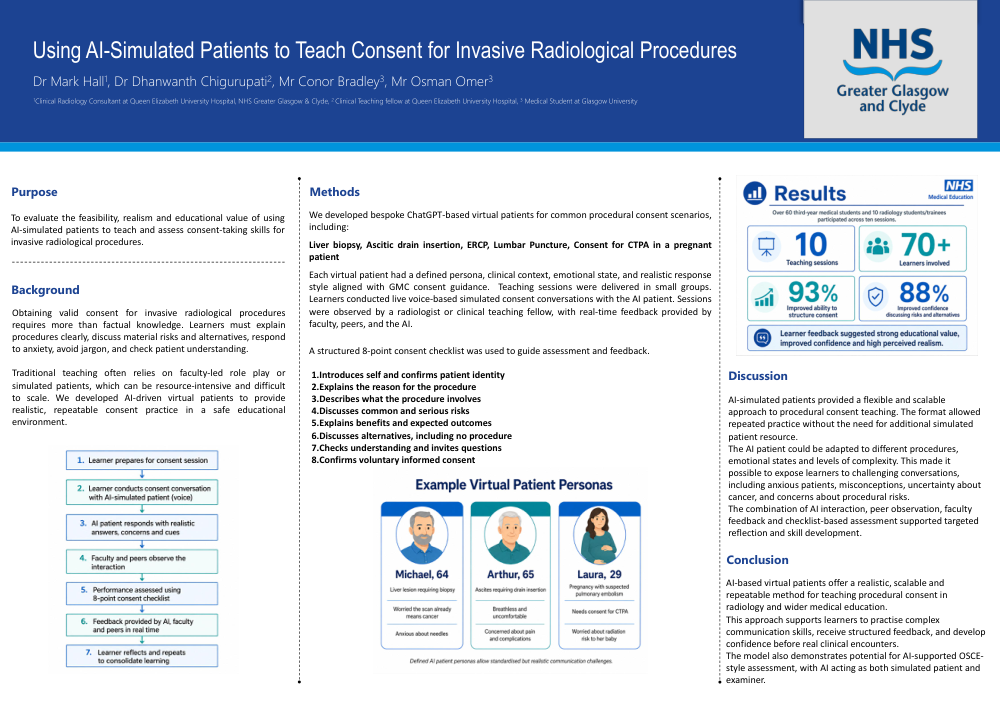
We developed our own GPTs to play AI-simulated patient for liver biopsy, ascitic drain insertion,
ERCP, colonoscopy, and endoscopy. Each virtual patient had a distinct persona, clinical context,
and realistic responses aligned with GMC consent guidance. Sessions were delivered in small-
group settings (n = 8), allowing students and registrars to conduct live simulated consent
conversations with voice. AI responded as a patient would and provided prompts were necessary.
Sessions were observed, and feedback was given in real time by the observing radiologist or clinical
teaching fellow and directly by the AI, supported by a structured 8-point consent checklist. Post-
session anonymous feedback was collected via questionnaire.
Results
Across ten teaching sessions, involving over 60 third-year medical and 10 radiology students, the
AI-simulated consent scenarios were rated highly for educational value and realism. 93% of
students agreed the sessions improved their ability to structure a consent conversation, with 88%
reporting greater confidence discussing risks and alternatives. Verbatim feedback described the
virtual patients as “surprisingly human” and “more challenging than OSCE actors.” Common
themes included difficulty managing emotional cues, gaps in knowledge of rare risks, and the
importance of avoiding jargon. Facilitators observed a marked improvement in students’ ability to
explain procedures clearly, address patient concerns, and check understanding. Peer observation
and use of a structured 8-point checklist supported targeted feedback and reflection. The novel use
of AI providing standardised feedback proved popular. The format allowed repeated practice
without additional faculty burden and was adaptable to in-person and remote teaching
environments.
Conclusion
AI-based virtual patients offer a scalable, flexible, and realistic method to teach procedural consent.
They are particularly valuable for exposing learners to challenging patient interactions in a safe,
repeatable format. Our experience supports the wider adoption of AI-simulated patients in
radiology and medical education curricula. It also demonstraed the possibility of using an AI
simulated OSCE station for exams with AI as both the patient and the OSCE eaxminer.
AI category: AI Education and research: examples of proof of concept or AI in development, technical advances, teaching
approaches or pre-clinical testing