119 posters, 6 topics, 524 authors, 243 institutions
ePostersLive by SciGen Technologies S.A. All rights reserved.
RCR Global AI Conference 2026
29-30 June, 2026 | QEII Centre, Westminster

107
Assessing the Educational Value of an AI Tutor in FRCR 2B Short Case Preparation Using Longitudinal Performance Analytics
Part of Topic
AI Education and research: examples of proof of concept or AI in development, technical advances, teaching approaches or pre-clinical testing
Assessing the Educational Value of an AI Tutor in FRCR 2B Short Case Preparation Using Longitudinal Performance Analytics
Girija Agarwal¹, Naila Hamrioui²,³, Paymon Zomorodian²,⁴
¹ Imperial College Healthcare NHS Trust ² RadBytes ³ Warrington and Halton Teaching Hospitals NHS Foundation Trust ⁴ Mersey and West Lancashire Teaching Hospitals NHS Trust
Key message
Cubey use was associated with a statistically significant, modest improvement in FRCR 2B short case scores over time. Learners who improved more also interacted with the AI tutor more frequently per case.
7,944
scored cases analysed
152
users included
β = 0.000301
score increase per case; p = 0.013
3.41 vs 2.96
interactions per case in higher-vs low-improvement users; p < 0.05
93.8%
survey respondents felt Cubey improved performance
BACKGROUND
FRCR 2B short cases preparation relies on repeated practice, feedback and calibration against exam-style marking criteria for radiograph interpretation. However, access to timely senior feedback can be variable.
AI-supported tutoring may offer a scalable way to provide structured feedback, helping learners identify weaknesses, refine reporting style, and benchmark progress against exam-style criteria.
Cubeyis an AI-supported radiology tutor within the RadBytesplatform. It provides structured feedback on anonymisededucational short cases and assigns scores using standardisedFRCR 2B marking criteria.
AIM
To evaluate whether interaction with the CubeyAI tutor is associated with measurable improvement in user performance for short case radiograph reporting and whether engagement behaviour differs between higher-and lower-improvement learners.
METHODS
A longitudinal retrospective analysis was conducted using anonymisedinteraction data from users of theCubeyFRCR 2B short case platform.
Only cases receiving a formal AI-assigned score (1–5) were included.
Performance was analysedusing a linear mixed-effects model with score as the dependent variable, case order as a fixed effect, and user as a random intercept.
Individual learning slopes were also calculated to classify users as higher-improvement or low-/non-improvement.
The number of messages exchanged between the learner and Cubey, i.e. the number of “interactions” was treated as a marker of engagement. Total interactions per case were compared between these groups using a t-test to assess differences in engagement behaviour.
RESULTS: COHORT AND ENGAGEMENT
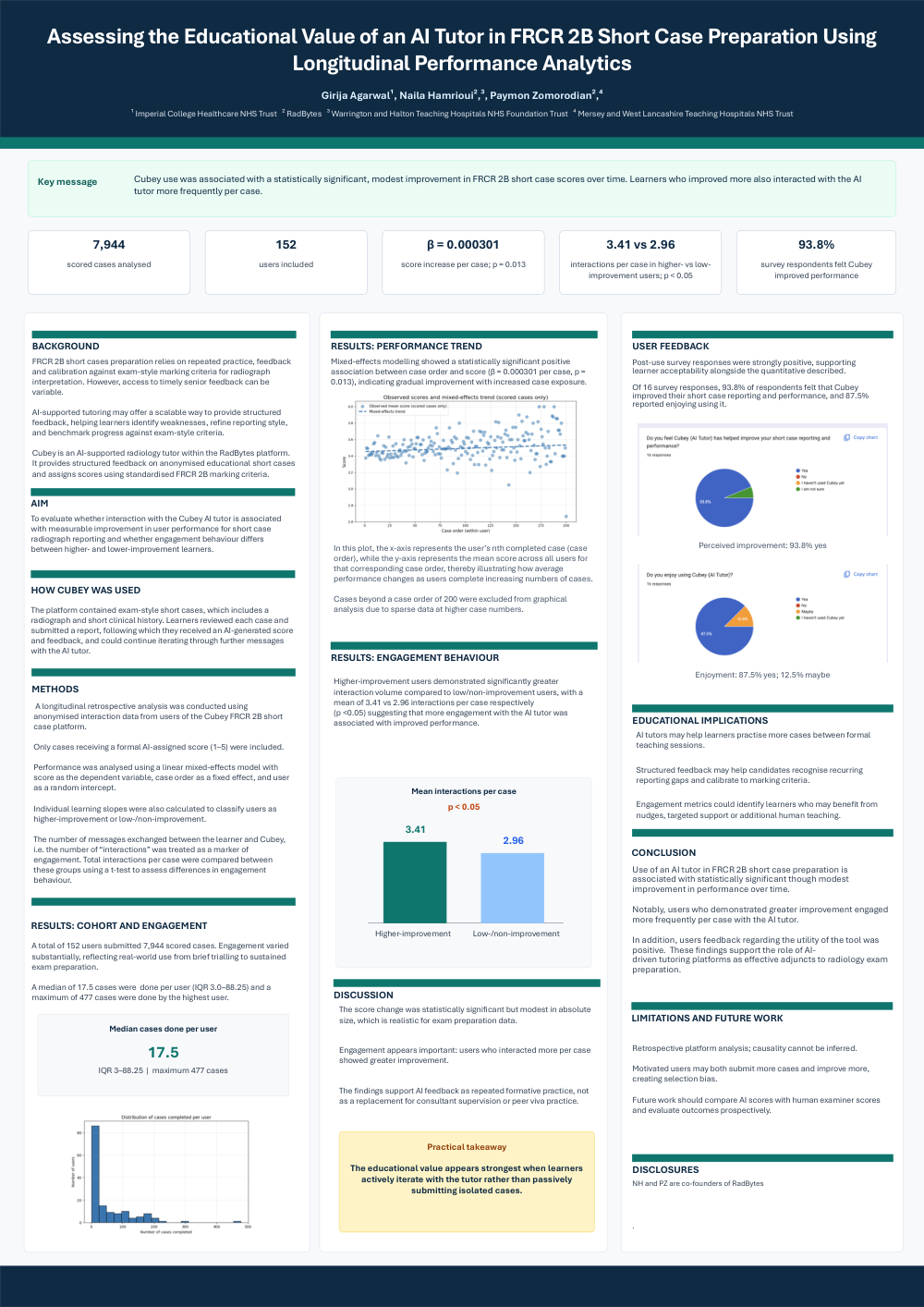
A total of 152 userssubmitted7,944 scored cases. Engagement varied substantially, reflecting real-world use from brief trialling to sustained exam preparation.
A median of 17.5 cases were done per user (IQR 3.0–88.25) and a maximum of 477 cases were done by the highest user.
HOW CUBEY WAS USED
The platform contained exam-style short cases, which includes a radiograph and short clinical history. Learners reviewed each case and submitted a report, following which they received an AI-generated score and feedback, and could continue iterating through further messages with the AI tutor.
RESULTS: PERFORMANCE TREND
Mixed-effects modelling showed a statistically significant positive association between case order and score (β = 0.000301per case, p = 0.013), indicating gradual improvement with increased case exposure.
In this plot, the x-axis represents the user’s nth completed case (case order), while the y-axis represents the mean score across all users for that corresponding case order, thereby illustrating how average performance changes as users complete increasing numbers of cases.
Cases beyond a case order of 200 were excluded from graphical analysis due to sparse data at higher case numbers.
RESULTS: ENGAGEMENT BEHAVIOUR
Higher-improvement usersdemonstratedsignificantly greater interaction volume compared to low/non-improvement users, with a mean of 3.41 vs 2.96 interactions per case respectively (p<0.05)suggesting thatmoreengagement with the AI tutor was associated with improved performance.
DISCUSSION
The score change was statistically significant but modest in absolute size, which is realistic for exam preparation data.
Engagement appears important: users who interacted more per case showed greater improvement.
The findings support AI feedback as repeated formative practice, not as a replacement for consultant supervision or peer viva practice.
Practical takeaway
The educational value appears strongest when learners actively iterate with the tutor rather than passively submitting isolated cases.
USER FEEDBACK
Post-use survey responses were strongly positive, supporting learner acceptability alongside the quantitative described.
Of 16 survey responses, 93.8% of respondents felt that Cubey improved their short case reporting and performance, and 87.5% reported enjoying using it.
EDUCATIONAL IMPLICATIONS
AI tutors may help learners practise more cases between formal teaching sessions.
Structured feedback may help candidates recognise recurring reporting gaps and calibrate to marking criteria.
Engagement metrics could identify learners who may benefit from nudges, targeted support or additional human teaching.
CONCLUSION
Use of an AItutorin FRCR 2B short case preparation is associated with statistically significant though modest improvement in performance over time.
Notably, users whodemonstratedgreater improvement engaged morefrequentlyper casewith theAI tutor.
In addition, usersfeedbackregardingthe utility of the tool was positive.These findings support the role of AI-driventutoringplatforms as effective adjuncts to radiology exam preparation.
LIMITATIONS AND FUTURE WORK
Retrospective platform analysis; causality cannot be inferred.
Motivated users may both submit more cases and improve more, creating selection bias.
Future work should compare AI scores with human examiner scores and evaluate outcomes prospectively.
DISCLOSURES
NH and PZ are co-founders of RadBytes