119 posters, 6 topics, 524 authors, 243 institutions
ePostersLive by SciGen Technologies S.A. All rights reserved.
RCR Global AI Conference 2026
29-30 June, 2026 | QEII Centre, Westminster

114
Generation of CT Coronary Angiography educational website material using AI drafting and GitHub Pages hosting
Poster Presenter
Part of Topic
AI Education and research: examples of proof of concept or AI in development, technical advances, teaching approaches or pre-clinical testing
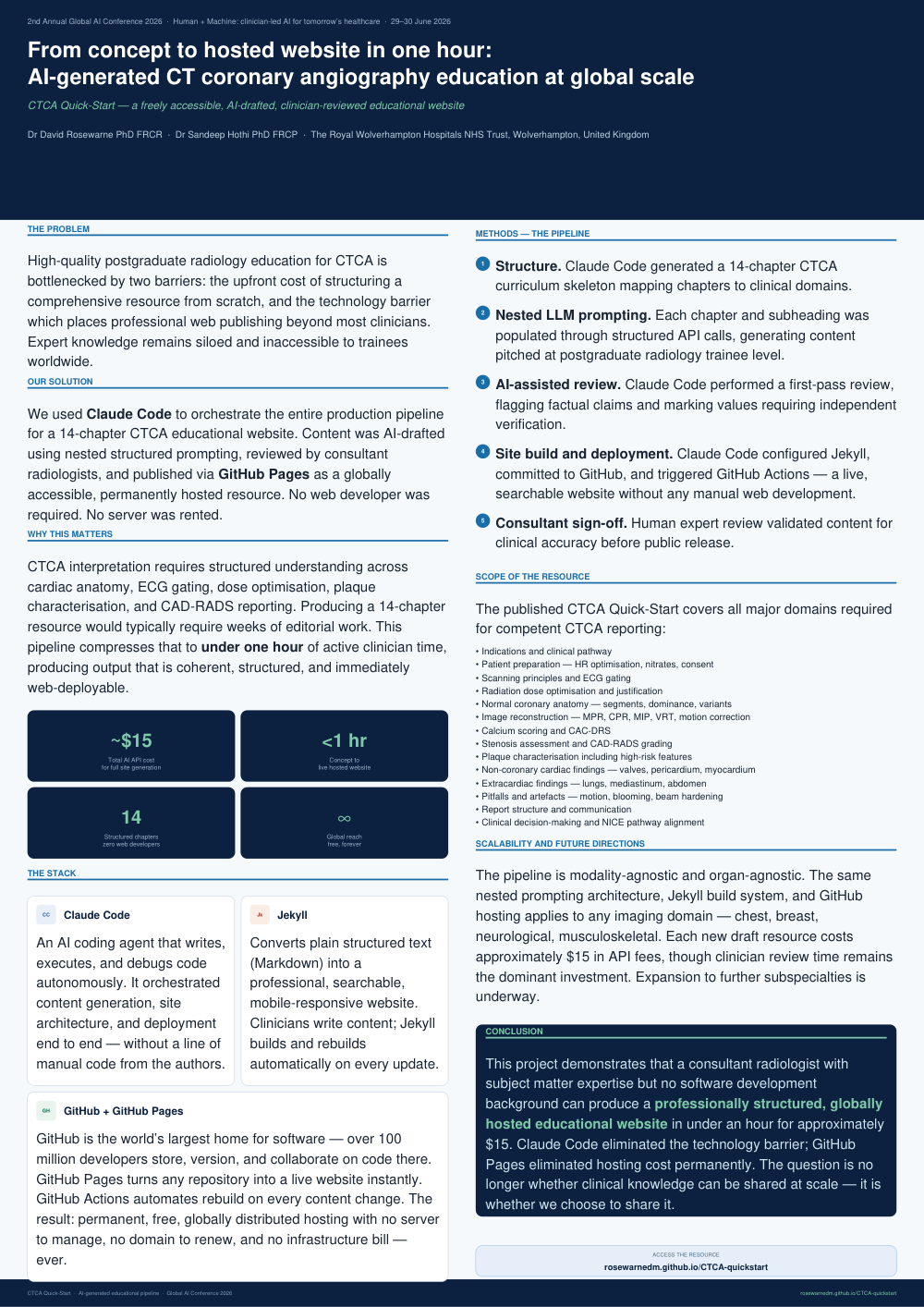
From concept to hosted website in one hour: AI-generated CT coronary angiography education at global scale
CTCA Quick-Start — a freely accessible, AI-drafted, clinician-reviewed educational website
Dr David Rosewarne PhD FRCR · Dr Sandeep Hothi PhD FRCP · The Royal Wolverhampton Hospitals NHS Trust, Wolverhampton, United Kingdom
2nd Annual Global AI Conference 2026 · Human + Machine: clinician-led AI for tomorrow's healthcare · 29–30 June 2026
The Problem
High-quality postgraduate radiology education for CTCA is bottlenecked by two barriers: the upfront cost of structuring a comprehensive resource from scratch, and the technology barrier which places professional web publishing beyond most clinicians. Expert knowledge remains siloed and inaccessible to trainees worldwide.
Our Solution
We used Claude Code to orchestrate the entire production pipeline for a 14-chapter CTCA educational website. Content was AI-drafted using nested structured prompting, reviewed by consultant radiologists, and published via GitHub Pagesas a globally accessible, permanently hosted resource. No web developer was required. No server was rented.
Why This Matters
CTCA interpretation requires structured understanding across cardiac anatomy, ECG gating, dose optimisation, plaque characterisation, and CAD-RADS reporting. Producing a 14-chapter resource would typically require weeks of editorial work. This pipeline compresses that to under one hour of active clinician time, producing output that is coherent, structured, and immediately web-deployable.
Key Metrics
| ~$15 | Total AI API cost for full site generation |
| <1 hr | Concept to live hosted website |
| 14 | Structured chapters, zero web developers |
| ∞ | Global reach — free, forever |
The Stack
Claude Code
An AI coding agent that writes, executes, and debugs code autonomously. It orchestrated content generation, site architecture, and deployment end to end — without a line of manual code from the authors.
Jekyll
Converts plain structured text (Markdown) into a professional, searchable, mobile-responsive website. Clinicians write content; Jekyll builds and rebuilds automatically on every update.
GitHub + GitHub Pages
GitHub is the world's largest home for software — over 100 million developers store, version, and collaborate on code there. GitHub Pages turns any repository into a live website instantly. GitHub Actions automates rebuild on every content change. The result: permanent, free, globally distributed hosting with no server to manage, no domain to renew, and no infrastructure bill — ever.
Methods — The Pipeline
- Structure. Claude Code generated a 14-chapter CTCA curriculum skeleton mapping chapters to clinical domains.
- Nested LLM prompting. Each chapter and subheading was populated through structured API calls, generating content pitched at postgraduate radiology trainee level.
- AI-assisted review. Claude Code performed a first-pass review, flagging factual claims and marking values requiring independent verification.
- Site build and deployment. Claude Code configured Jekyll, committed to GitHub, and triggered GitHub Actions — a live, searchable website without any manual web development.
- Consultant sign-off. Human expert review validated content for clinical accuracy before public release.
Scope of the Resource
The published CTCA Quick-Start covers all major domains required for competent CTCA reporting:
- Indications and clinical pathway
- Patient preparation — HR optimisation, nitrates, consent
- Scanning principles and ECG gating
- Radiation dose optimisation and justification
- Normal coronary anatomy — segments, dominance, variants
- Image reconstruction — MPR, CPR, MIP, VRT, motion correction
- Calcium scoring and CAC-DRS
- Stenosis assessment and CAD-RADS grading
- Plaque characterisation including high-risk features
- Non-coronary cardiac findings — valves, pericardium, myocardium
- Extracardiac findings — lungs, mediastinum, abdomen
- Pitfalls and artefacts — motion, blooming, beam hardening
- Report structure and communication
- Clinical decision-making and NICE pathway alignment
Scalability and Future Directions
The pipeline is modality-agnostic and organ-agnostic. The same nested prompting architecture, Jekyll build system, and GitHub hosting applies to any imaging domain — chest, breast, neurological, musculoskeletal. Each new draft resource costs approximately $15 in API fees, though clinician review time remains the dominant investment. Expansion to further subspecialties is underway.
Conclusion
This project demonstrates that a consultant radiologist with subject matter expertise but no software development background can produce a professionally structured, globally hosted educational website in under an hour for approximately $15. Claude Code eliminated the technology barrier; GitHub Pages eliminated hosting cost permanently. The question is no longer whether clinical knowledge can be shared at scale — it is whether we choose to share it.
Access the resource: rosewarnedm.github.io/CTCA-quickstart