2,281 posters, 63 videos, 56 audios, 43 topics, 18 sessions, 6,174 authors, 2,323 institutions
ePostersLive by SciGen Technologies S.A. All rights reserved.
RCOG World Congress 2025
June 23 - 25, 2025 | ExCeL London, UK
EP.0053
Prenatal Diagnosis of Pfeiffer Syndrome: Whole Exome Sequencing in a Rare Case
Part of Topic
Advances in prenatal diagnosis
Audio
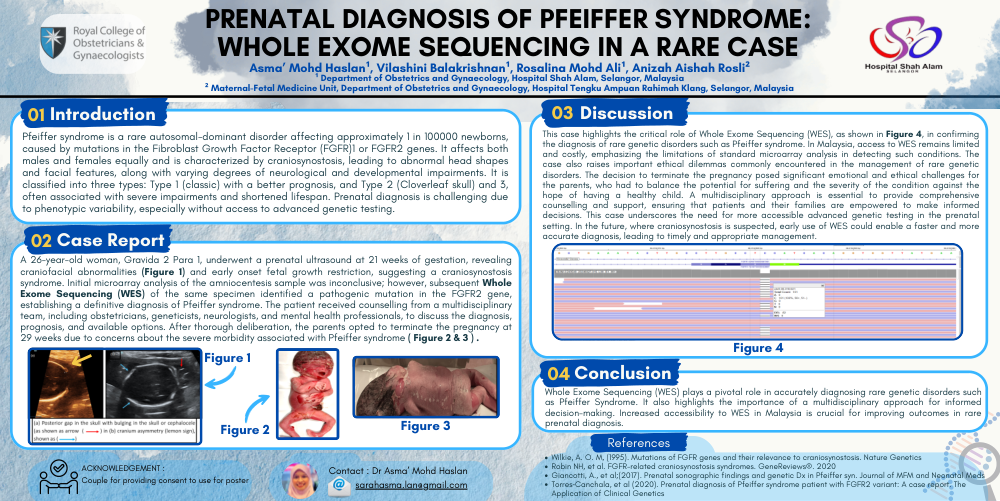
PRENATAL DIAGNOSIS OF PFEIFFER SYNDROME: WHOLE EXOME SEQUENCING IN A RARE CASE
Asma’ Mohd Haslan¹, Vilashini Balakrishnan¹, Rosalina Mohd Ali¹, Anizah Aishah Rosli²
¹ Department of Obstetrics and Gynaecology, Hospital Shah Alam, Selangor, Malaysia
² Maternal-Fetal Medicine Unit, Department of Obstetrics and Gynaecology, Hospital Tengku Ampuan Rahimah Klang, Selangor, Malaysia
Introduction : Pfeiffer syndrome is a rare autosomal-dominant disorder affecting approximately 1 in 100000 newborns, caused by mutations in the Fibroblast Growth Factor Receptor (FGFR)1 or FGFR2 genes. It affects both males and females equally and is characterized by craniosynostosis, leading to abnormal head shapes and facial features, along with varying degrees of neurological and developmental impairments. It is classified into three types: Type 1 (classic) with a better prognosis, and Type 2 (Cloverleaf skull) and 3, often associated with severe impairments and shortened lifespan. Prenatal diagnosis is challenging due to phenotypic variability, especially without access to advanced genetic testing.
Case Report : A 26-year-old woman, Gravida 2 Para 1, underwent a prenatal ultrasound at 21 weeks of gestation, revealing craniofacial abnormalities (Figure 1) and early onset fetal growth restriction, suggesting a craniosynostosis syndrome. Initial microarray analysis of the amniocentesis sample was inconclusive; however, subsequent Whole Exome Sequencing (WES) of the same specimen identified a pathogenic mutation in the FGFR2 gene, establishing a definitive diagnosis of Pfeiffer syndrome. The patient received counselling from a multidisciplinary team, including obstetricians, geneticists, neurologists, and mental health professionals, to discuss the diagnosis, prognosis, and available options. After thorough deliberation, the parents opted to terminate the pregnancy at 29 weeks due to concerns about the severe morbidity associated with Pfeiffer syndrome ( Figure 2 & 3 ) .
Discussion :This case highlights the critical role of Whole Exome Sequencing (WES), as shown in Figure 4, in confirming the diagnosis of rare genetic disorders such as Pfeiffer syndrome. In Malaysia, access to WES remains limited and costly, emphasizing the limitations of standard microarray analysis in detecting such conditions. The case also raises important ethical dilemmas commonly encountered in the management of rare genetic disorders. The decision to terminate the pregnancy posed significant emotional and ethical challenges for the parents, who had to balance the potential for suffering and the severity of the condition against the hope of having a healthy child. A multidisciplinary approach is essential to provide comprehensive counselling and support, ensuring that patients and their families are empowered to make informed decisions. This case underscores the need for more accessible advanced genetic testing in the prenatal setting. In the future, where craniosynostosis is suspected, early use of WES could enable a faster and more accurate diagnosis, leading to timely and appropriate management.
Conclusion : Whole Exome Sequencing (WES) plays a pivotal role in accurately diagnosing rare genetic disorders such as Pfeiffer Syndrome. It also highlights the importance of a multidisciplinary approach for informed decision-making. Increased accessibility to WES in Malaysia is crucial for improving outcomes in rare prenatal diagnosis.
References :
- Wilkie, A. O. M, (1995). Mutations of FGFR genes and their relevance to craniosynostosis. Nature Genetics
- Robin NH, et al. FGFR-related craniosynostosis syndromes. GeneReviews®. 2020
- Giancotti, A., et al;(2017). Prenatal sonographic findings and genetic Dx in Pfeiffer syn. Journal of MFM and Neonatal Meds
- Torres‑Canchala, et al (2020). Prenatal diagnosis of Pfeiffer syndrome patient with FGFR2 variant: A case report. The Application of Clinical Genetics
IntroIntroductiond
uction