2,281 posters, 63 videos, 56 audios, 43 topics, 18 sessions, 6,174 authors, 2,323 institutions
ePostersLive by SciGen Technologies S.A. All rights reserved.
RCOG World Congress 2025
June 23 - 25, 2025 | ExCeL London, UK
EP.0046
The Role of Recombination in Embryonic Aneuploidy Across Chromosomes
Poster Presenter
Authors
Muhammad Ikhsan, Sioban SenGupta, Nikolas Maniatis, Philip Zahariev
Affiliations
Part of Topic
Advances in prenatal diagnosis
The Role of Recombination in Embryonic Aneuploidy Across Chromosomes
Muhammad Ikhsan1,2, Philip Zahariev3, Nikolas Maniatis3, Sioban SenGupta1
Introduction
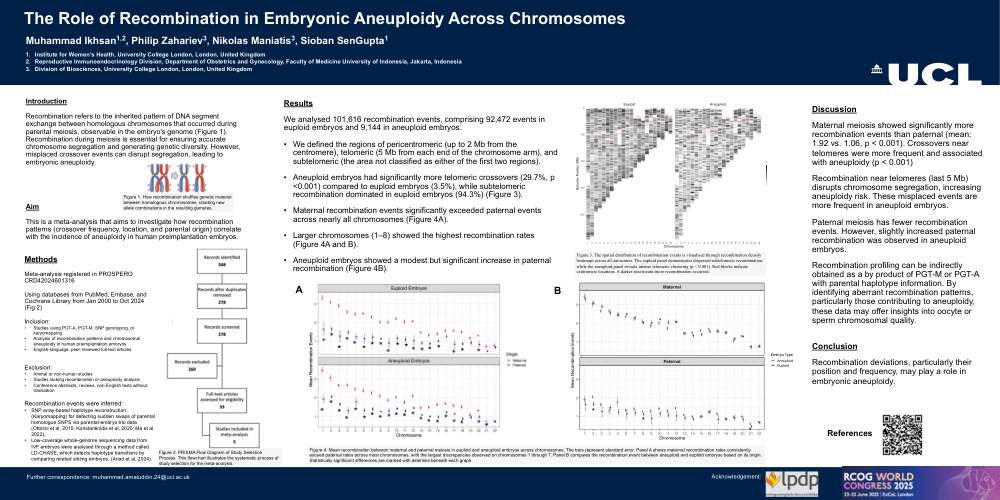
Recombination refers to the inherited pattern of DNA segment exchange between homologous chromosomes that occurred during parental meiosis, observable in the embryo's genome (Figure 1). Recombination during meiosis is essential for ensuring accurate chromosome segregation and generating genetic diversity. However, misplaced crossover events can disrupt segregation, leading to embryonic aneuploidy.
Aim
This is a meta-analysis that aims to investigate how recombination patterns (crossover frequency, location, and parental origin) correlate with the incidence of aneuploidy in human preimplantation embryosMethods
Meta-analysis registered in PROSPERO CRD42024601316
Using databases from PubMed, Embase, and Cochrane Library from Jan 2000 to Oct 2024 (Fig 2)
Inclusion:
Exclusion:
Recombination events were inferred:
Results
We analysed 101,616 recombination events, comprising 92,472 events in euploid embryos and 9,144 in aneuploid embryos:
Discussion
Maternal meiosis showed significantly more recombination events than paternal (mean: 1.92 vs. 1.06, p < 0.001). Crossovers near telomeres were more frequent and associated with aneuploidy (p < 0.001)
Recombination near telomeres (last 5 Mb) disrupts chromosome segregation, increasing aneuploidy risk. These misplaced events are more frequent in aneuploid embryos.
Paternal meiosis has fewer recombination events. However, slightly increased paternal recombination was observed in aneuploid embryos.
Recombination profiling can be indirectly obtained as a by product of PGT-M or PGT-A with parental haplotype information. By identifying aberrant recombination patterns, particularly those contributing to aneuploidy, these data may offer insights into oocyte or sperm chromosomal quality.
Conclusion
Recombination deviations, particularly their position and frequency, may play a role in embryonic aneuploidy.