2,281 posters, 63 videos, 56 audios, 43 topics, 18 sessions, 6,174 authors, 2,323 institutions
ePostersLive by SciGen Technologies S.A. All rights reserved.
RCOG World Congress 2025
June 23 - 25, 2025 | ExCeL London, UK
EP.0048
Rate of Homocysteinemia among women with MTHFR 677 and MTHFR 1298 Mutations.
Poster Presenter
Authors
Srwa Khalid, Rozhgar Khailany, Ahmed Hoger, Farhang Ali, Yousif Yahya
Affiliations
Part of Topic
Advances in prenatal diagnosis
Introduction:
Homocysteine, a byproduct of methionine metabolism, relies on vitamin B12, B6, and folic acid for regulation. Disruptions in this metabolic pathway lead to elevated homocysteine levels, termed homocysteinemia. While pregnancy typically lowers homocysteine levels, elevations are associated with adverse outcomes, including early and late miscarriage due to heightened thrombogenic activity. Additional complications include preeclampsia, preterm birth, placental abruption, fetal growth restriction, gestational diabetes, placental hematoma, and premature rupture of membranes.
Objective:
This study aimed to determine the prevalence of MTHFR gene mutations (C677T and A1298C) among pregnant women, assess the rate of homocysteinemia in mutation carriers, and explore its correlation with age, homocysteine levels, and adverse pregnancy outcomes.
Study Design and Methods:
This was a cohort study involving 921 pregnant women who underwent genetic testing in Erbil (Kurdistan region/ Iraq) to identify MTHFR gene mutations and simultaneous measurement of plasma homocysteine levels. Associations between genetic variants, homocysteine levels, maternal age, and pregnancy outcomes were analyzed.
Results:
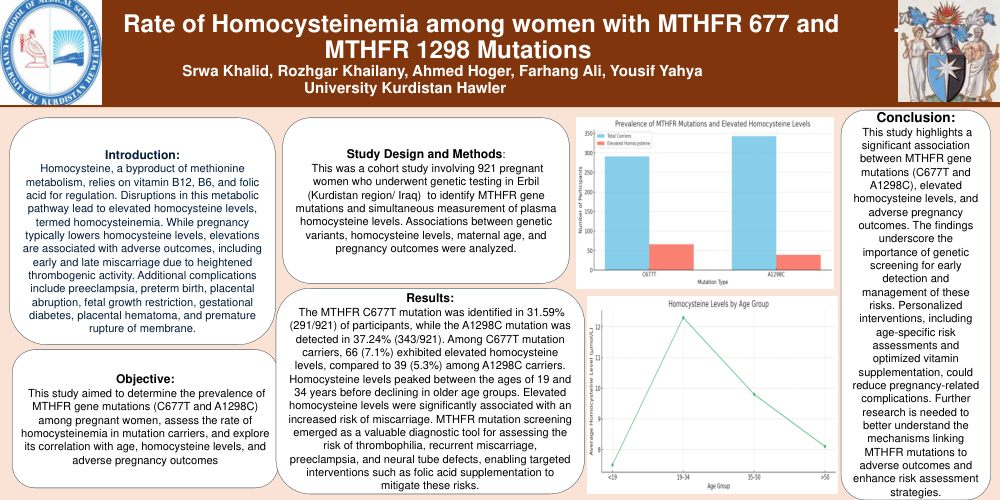
The MTHFR C677T mutation was identified in 31.59% (291/921) of participants, while the A1298C mutation was detected in 37.24% (343/921). Among C677T mutation carriers, 66 (7.1%) exhibited elevated homocysteine levels, compared to 39 (5.3%) among A1298C carriers. Homocysteine levels peaked between the ages of 19 and 34 years before declining in older age groups. Elevated homocysteine levels were significantly associated with an increased risk of miscarriage. MTHFR mutation screening emerged as a valuable diagnostic tool for assessing the risk of thrombophilia, recurrent miscarriage, preeclampsia, and neural tube defects, enabling targeted interventions such as folic acid supplementation to mitigate these risks.
Conclusion:
This study highlights a significant association between MTHFR gene mutations (C677T and A1298C), elevated homocysteine levels, and adverse pregnancy outcomes. The findings underscore the importance of genetic screening for early detection and management of these risks. Personalized interventions, including age-specific risk assessments and optimized vitamin supplementation, could reduce pregnancy-related complications. Further research is needed to better understand the mechanisms linking MTHFR mutations to adverse outcomes and enhance risk assessment strategies.