2,281 posters, 63 videos, 56 audios, 43 topics, 18 sessions, 6,174 authors, 2,323 institutions
ePostersLive by SciGen Technologies S.A. All rights reserved.
RCOG World Congress 2025
June 23 - 25, 2025 | ExCeL London, UK
EP.0052
Hydramnios and the Double-Bubble Sign: Diagnosing Duodenal Atresia in a Resource-Limited Setting
Poster Presenter
Authors
Rini Lusiantary, Essy Octavia, Nirwan Nugraha, Herlambang Herlambang
Affiliations
General Practitioner, Department of Obstetrics and Gynaecology, Raden Mattaher General Hospital, Specialist in Obstetrics and Gynaecology, Department of Obstetrics and Gynaecology, Raden Mattaher General Hospital, Maternal-Fetal Medicine Subspecialist, Fetomaternal Division, Department of Obstetrics and Gynaecology, Faculty of Medicine and Health Science, Universitas Jambi / Raden Mattaher General Hospital
Part of Topic
Advances in prenatal diagnosis
Video
Hydramnios and the Double-Bubble Sign: Diagnosing Duodenal Atresia in a Resource-Limited Setting
Rini Lusiantary1*, Essy Octavia2, Nirwan Nugraha2, Herlambang Herlambang3
1General practitioner, Department of Obstetrics and Gynaecology, Raden Mattaher General Hospital, Jambi, Indonesia.
2Specialist in Obstetrics and Gynaecology, Department of Obstetrics and Gynaecology, Raden Mattaher General Hospital, Jambi, Indonesia.
3Maternal-Fetal Medicine Subspecialist, Fetomaternal Division, Department of Obstetrics and Gynaecology, Faculty of Medicine and Health Science, Universitas Jambi / Raden Mattaher General Hospital, Jambi, Indonesia
Objective :
This case from Jambi Province, Indonesia, highlights the importance of prenatal detection of duodenal atresia using the double-bubble sign and the challenges in a resource-limited setting, where advanced diagnostic capabilities are not always accessible.
Case Report
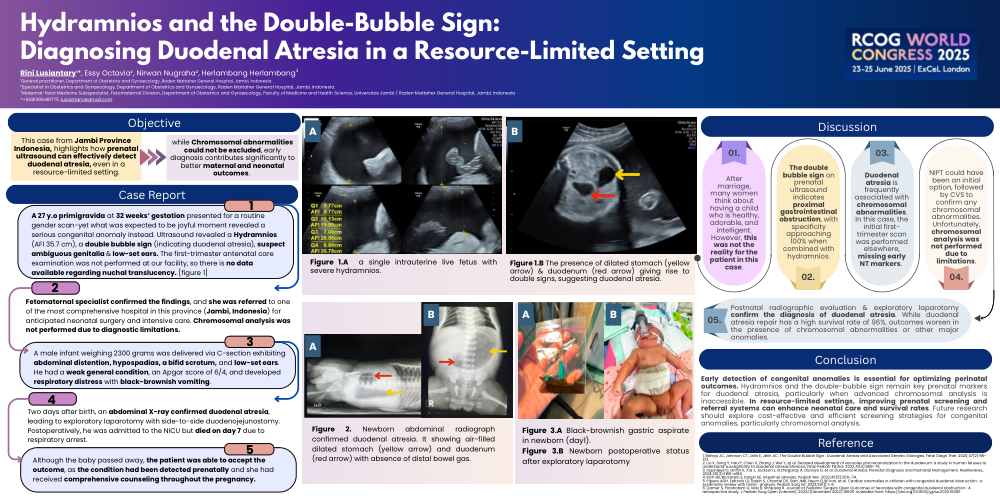
After marriage, many women think about having a child who is healthy, adorable, and intelligent. However, this was not the reality for the patient in this case. A 27-year-old primigravida at 32 weeks' gestation presented with severe abdominal distension. Ultrasound revealed a Hydramnios (AFI 35.7 cm), a double bubble sign (indicating duodenal atresia), suspect ambiguous genitalia & low-set ears.
Fetomaternal specialist confirmed the findings, and she was referred to one of the most comprehensive hospital in this province (Jambi) for anticipated neonatal surgery and intensive care. Chromosomal analysis was not performed due to diagnostic limitations.A male infant weighing 2300 grams was delivered via cesarean section, exhibiting abdominal distension, hypospadias, and a bifid scrotum.A male infant weighing 2300 grams was delivered via C-section exhibiting abdominal distention, hypospadias, a bifid scrotum, and low-set ears. He had a weak general condition, an Apgar score of 6/4, and developed respiratory distresswith black-brownish vomiting.
Two days after birth, an abdominal X-ray confirmed duodenal atresia, leading to exploratory laparotomy with side-to-side duodenojejunostomy. Postoperatively, he was admitted to the NICU but died on day 7 due to respiratory arrest.Although the baby passed away, the patient was able to accept the outcome, as the condition had been detected prenatally and she had received comprehensive counseling throughout the pregnancy.
Discussion
Prenatal ultrasound plays a crucial role in the early diagnosis of duodenal atresia, particularly in resource-limited settings where genetic testing is inaccessible. The double bubble sign on prenatal ultrasound indicates proximal gastrointestinal obstruction, with specificity approaching 100% when combined with hydramnios. Duodenal atresia is frequently associated with chromosomal abnormalities. In this case, the initial first-trimester scan was performed elsewhere, missing early NT markers. NIPT could have been an initial option, followed by CVS to confirm any chromosomal abnormalities. Unfortunately, chromosomal analysis was not performed due to limitations. Postnatal radiographic evaluation & exploratory laparotomy confirm the diagnosis of duodenal atresia. While duodenal atresia repair has a high survival rate of 96%, outcomes worsen in the presence of chromosomal abnormalities or other major anomalies.
Chromosomal analysis was not performed due to diagnostic limitations. Duodenal atresia is frequently linked to congenital anomalies, making genetic evaluation valuable for prognostication and counseling. This case highlights the importance of early ultrasound for prenatal diagnosis, particularly in identifying gastrointestinal obstructions. Strengthening prenatal screening protocols and multidisciplinary management may improve perinatal outcomes in similar cases.
Conclusions
Early detection of congenital anomalies is essential for optimizing perinatal outcomes. Hydramnios and the double-bubble sign remain key prenatal markers for duodenal atresia, particularly when advanced chromosomal analysis is inaccessible. In resource-limited settings, improving prenatal screening and referral systems can enhance neonatal care and survival rates. Future research should explore cost-effective and efficient screening strategies for congenital anomalies, particularly chromosomal analysis.
Keywords: Hydramnios; duodenal atresia; double-bubble sign; prenatal diagnosis