2,281 posters, 63 videos, 56 audios, 43 topics, 18 sessions, 6,174 authors, 2,323 institutions
ePostersLive by SciGen Technologies S.A. All rights reserved.
RCOG World Congress 2025
June 23 - 25, 2025 | ExCeL London, UK
EP.0397
Two Cavities, One Solution: Endometrial Ablation Using Lina Librata in Uterine Didelphys
Poster Presenter
Authors
Affiliations
Part of Topic
Endometriosis & uterine disorders
Background
- Müllerian duct anomaliesresult from incomplete development, canalisation or fusion of the pairedMüllerian during embryogenesis (12-16 weeks’ gestation)
- Prevalence in general population is estimated at 0.5-5%, and is higher in patients with infertility or recurrence pregnancy loss [1]
- Uterine didelphys is a rare anomaly characterised by complete lack of Müllerian duct fusion, resulting in two uteri, two cervices and often a longitudinal vaginal septum
- Associated complications include dysmenorrhea, menstrual abnormalities and reproductive implications including subfertility and recurrent miscarriages.
- Adverse obstetric include preterm delivery, fetal malpresentation, caesarean section and fetal growth restriction
- Endometrial ablation in uterine anomalies requires caution due to distorted anatomy and risk of incomplete ablation
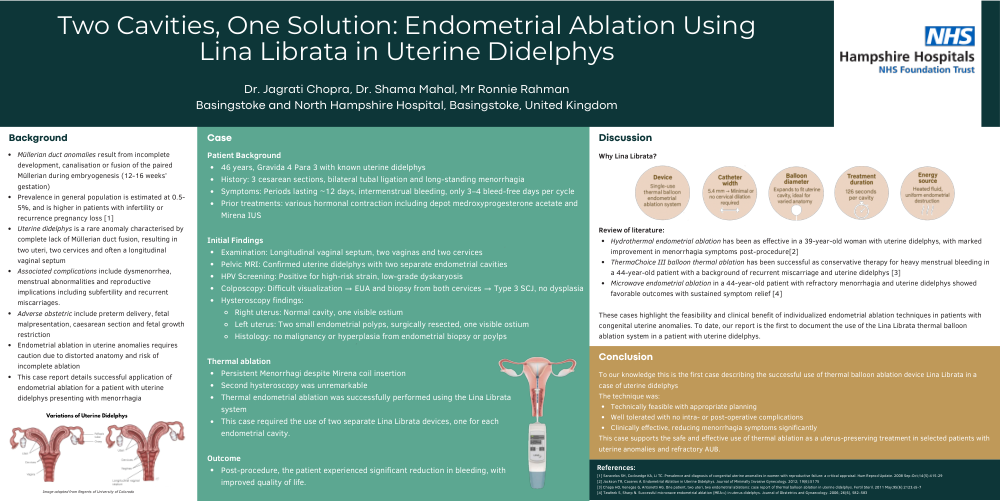
This case report details successful application of endometrial ablation for a patient with uterine didelphys presenting with menorrhagia
Case
Patient Background
- 46 years, Gravida 4 Para 3 with knownuterine didelphys
- History: 3 cesarean sections, bilateral tubal ligation and long-standingmenorrhagia
- Symptoms: Periods lasting ~12 days, intermenstrual bleeding,only 3–4 bleed-free days per cycle
Prior treatments: various hormonal contraction including depot medroxyprogesterone acetate and Mirena IUS
Initial Findings
- Examination: Longitudinal vaginal septum, two vaginas and two cervices
- Pelvic MRI: Confirmed uterine didelphys with two separate endometrial cavities
- HPV Screening: Positive for high-risk strain, low-grade dyskaryosis
- Colposcopy: Difficult visualization → EUA and biopsy from both cervices → Type 3 SCJ, no dysplasia
- Hysteroscopy findings:
- Right uterus: Normal cavity, one visible ostium
- Left uterus: Two small endometrial polyps, surgically resected, one visible ostium
- Histology: no malignancy or hyperplasia from endometrial biopsy or poylps
Thermalablation
- Persistent Menorrhagi despite Mirenacoil insertion
- Thermalendometrial ablation was successfullyperformed usingthe Lina Librata system
- This case required the use of two separate Lina Librata devices, one for each endometrialcavity.
- Outcome
- Secondhysteroscopy was unremarkable
- Post-procedure, the patient experienced significant reductionin bleeding, with improved quality oflife.
Discussion
Why Lina Librata?
- Device: Single-use thermal balloon endometrial ablation system
- Balloon diameter: Expands to fit uterine cavity, ideal for varied anatomy
- Catheter width: 5.4 mm → Minimal or no cervical dilation required
- Treatment duration: 126 seconds per cavity
- Energy source: Heated fluid, uniform endometrial destruction
Review of literature:
- Hydrothermal endometrial ablation has been as effective in a 39-year-old woman with uterine didelphys, with marked improvement in menorrhagia symptoms post-procedure[2]
- ThermaChoice III balloon thermal ablation has been successful as conservative therapy for heavy menstrual bleeding in a 44-year-old patient with a background of recurrent miscarriage and uterine didelphys [3]
- Microwave endometrial ablation in a 44-year-old patient with refractory menorrhagia and uterine didelphys showed favorable outcomes with sustained symptom relief [4]
These cases highlight the feasibility and clinical benefit of individualized endometrial ablation techniques in patients with congenital uterine anomalies. To date, our report is the first to document the use of the Lina Librata thermal balloon ablation system in a patient with uterine didelphys.
Conclusion
To our knowledge this is the first case describing the successful use of thermal balloon ablation device Lina Librata in a case of uterine didelphys
The technique was:
- Technically feasible with appropriate planning
- Well tolerated with no intra- or post-operative complications
- Clinically effective, reducing menorrhagia symptoms significantly
This case supports the safe and effective use of thermal ablation as a uterus-preserving treatment in selected patients with uterine anomalies and refractory AUB.