2,281 posters, 63 videos, 56 audios, 43 topics, 18 sessions, 6,174 authors, 2,323 institutions
ePostersLive by SciGen Technologies S.A. All rights reserved.
RCOG World Congress 2025
June 23 - 25, 2025 | ExCeL London, UK
EP.0318
Randomised double blind controlled trial of purified fatty acids for endometriosis-associated pain
Poster Presenter
Authors
Affiliations
Part of Topic
Endometriosis & uterine disorders
A pilot randomised double blind controlled trial of the efficacy of purified fatty acids for the treatment of women with endometriosis-associated pain (PurFECT)
Background
Endometriosis affects 6~10% of women and is associated with debilitating pelvic pain and infertility [1]. It costs the UK ~£2.8 billion annually in loss of productivity. It is currently managed by surgery or medically by ovarian suppression. However, ~75% symptoms recur after surgery and available medical treatments have undesirable side effects and are contraceptive [2]. Omega-3 purified fatty acids (PUFA) have been shown in animal models to reduce factors that thought to lead to endometriosis-associated pain (EAP), have minimal side effects, and no effects on fertility [3]. We performed a two-arm, pilot parallel randomised controlled trial (RCT) to inform the planning of a future multicentre large RCT to evaluate the efficacy of PUFA in the management of EAP.
Methods
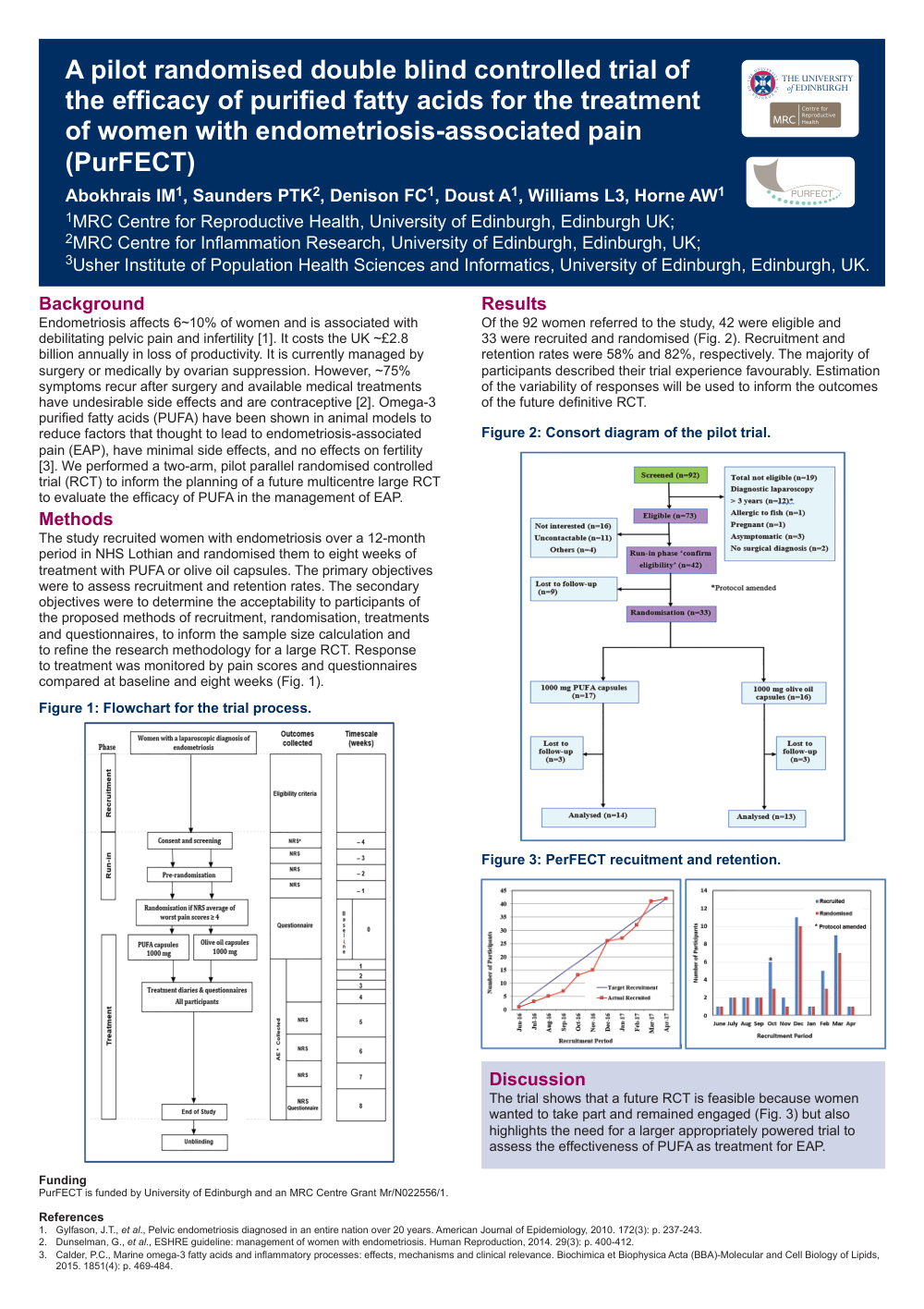
The study recruited women with endometriosis over a 12-month period in NHS Lothian and randomised them to eight weeks of treatment with PUFA or olive oil capsules. The primary objectives were to assess recruitment and retention rates. The secondary objectives were to determine the acceptability to participants of the proposed methods of recruitment, randomisation, treatments and questionnaires, to inform the sample size calculation and to refine the research methodology for a large RCT. Response to treatment was monitored by pain scores and questionnaires compared at baseline and eight weeks (Fig. 1).
Results
Of the 92 women referred to the study, 42 were eligible and 33 were recruited and randomised (Fig. 2). Recruitment and retention rates were 58% and 82%, respectively. The majority of participants described their trial experience favourably. Estimation of the variability of responses will be used to inform the outcomes of the future definitive RCT
Discussion
The trial shows that a future RCT is feasible because women wanted to take part and remained engaged (Fig. 3) but also highlights the need for a larger appropriately powered trial to assess the effectiveness of PUFA as treatment for EAP