2,281 posters, 63 videos, 56 audios, 43 topics, 18 sessions, 6,174 authors, 2,323 institutions
ePostersLive by SciGen Technologies S.A. All rights reserved.
RCOG World Congress 2025
June 23 - 25, 2025 | ExCeL London, UK
EP.0322
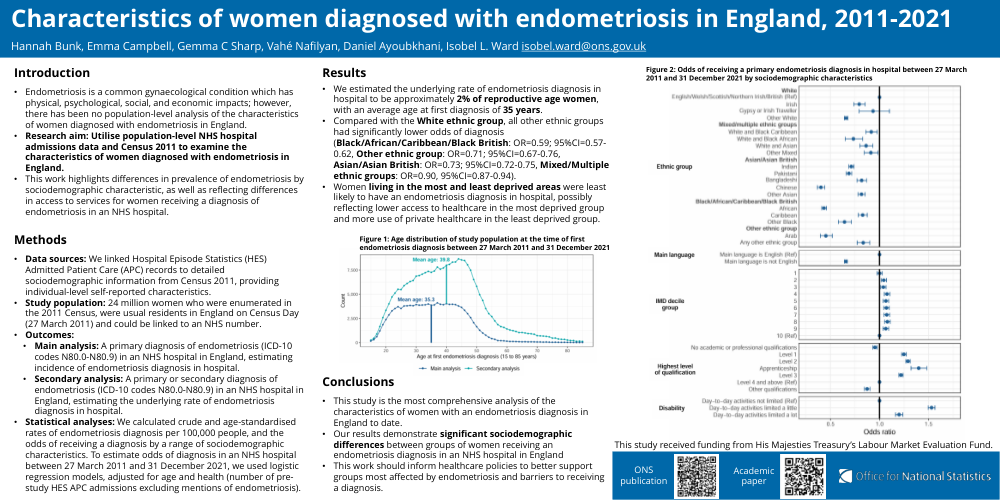
Characteristics of women diagnosed with endometriosis in England, 2011-2021
Part of Topic
Endometriosis & uterine disorders
Characteristics of women diagnosed with endometriosis in England, 2011-2021
Introduction
•Endometriosis is a common gynaecological condition which has physical, psychological, social, and economic impacts; however, there has been no population-level analysis of the characteristics of women diagnosed with endometriosis in England.
•Research aim: Utilise population-level NHS hospital admissions data and Census 2011 to examine the characteristics of women diagnosed with endometriosis in England.
•This work highlights differences in prevalence of endometriosis by sociodemographic characteristic, as well as reflecting differences in access to services for women receiving a diagnosis of endometriosis in an NHS hospital.
Methods
•Data sources: We linked Hospital Episode Statistics (HES) Admitted Patient Care (APC) records to detailed sociodemographic information from Census 2011, providing individual-level self-reported characteristics.
•Study population: 24 million women who were enumerated in the 2011 Census, were usual residents in England on Census Day (27 March 2011) and could be linked to an NHS number.
•Outcomes:
•Main analysis: A primary diagnosis of endometriosis (ICD-10 codes N80.0-N80.9) in an NHS hospital in England, estimating incidence of endometriosis diagnosis in hospital.
•Secondary analysis: A primary or secondary diagnosis of endometriosis (ICD-10 codes N80.0-N80.9) in an NHS hospital in England, estimating the underlying rate of endometriosis diagnosis in hospital.
Statistical analyses: We calculated crude and age-standardised rates of endometriosis diagnosis per 100,000 people, and the odds of receiving a diagnosis by a range of sociodemographic characteristics. To estimate odds of diagnosis in an NHS hospital between 27 March 2011 and 31 December 2021, we used logistic regression models, adjusted for age and health (number of pre-study HES APC admissions excluding mentions of endometriosis).
Results
•We estimated the underlying rate of endometriosis diagnosis in hospital to be approximately 2% of reproductive age women, with an average age at first diagnosis of 35 years.
•Compared with the White ethnic group, all other ethnic groups had significantly lower odds of diagnosis (Black/African/Caribbean/Black British: OR=0.59; 95%CI=0.57-0.62, Other ethnic group: OR=0.71; 95%CI=0.67-0.76, Asian/Asian British: OR=0.73; 95%CI=0.72-0.75, Mixed/Multiple ethnic groups: OR=0.90, 95%CI=0.87-0.94).
•Women living in the most and least deprived areas were least likely to have an endometriosis diagnosis in hospital, possibly reflecting lower access to healthcare in the most deprived group and more use of private healthcare in the least deprived group.
Conclusions
•This study is the most comprehensive analysis of the characteristics of women with an endometriosis diagnosis in England to date.
•Our results demonstrate significant sociodemographic differences between groups of women receiving an endometriosis diagnosis in an NHS hospital in England
•This work should inform healthcare policies to better support groups most affected by endometriosis and barriers to receiving a diagnosis.