2,281 posters, 63 videos, 56 audios, 43 topics, 18 sessions, 6,174 authors, 2,323 institutions
ePostersLive by SciGen Technologies S.A. All rights reserved.
RCOG World Congress 2025
June 23 - 25, 2025 | ExCeL London, UK
EP.0396
How Deep Can Deep Infiltrating Endometriosis Get? A Case Report from U.A.E
Poster Presenter
Authors
Affiliations
Part of Topic
Endometriosis & uterine disorders
Background
Endometriosis is a chronic inflammatory disease where functional endometrial tissue (glands and stroma) are present outside the uterus, which are estrogen dependent. As of 2023, The WHO estimates that "endometriosis affects roughly 10% (190 million) women in reproductive age group globally” [1]. However, the exact prevalence is unknown due to underdiagnoses, delay in seeking treatment, the normalisation of painful periods. Endometriosis is a multifaceted disease that may present with chronic pelvic pain, dysmenorrhea, dyspareunia, dysuria, dyschezia, or discovered during workup for infertility. It commonly affects the ovaries, pelvic peritoneum, and rectovaginal septum. “Deep infiltrating endometriosis (DIE), in approximately 14% cases of endometriosis, occurs when lesions infiltrate more than 5 mm deep to the peritoneum and may affect the uterosacral ligaments, pelvic side walls, vagina, bowel, bladder, or ureter” [2]. Another rare variant of DIE is in major pelvic nerves causing sciatic neuropathy or lumbo-sacral plexopathy.
Case Report
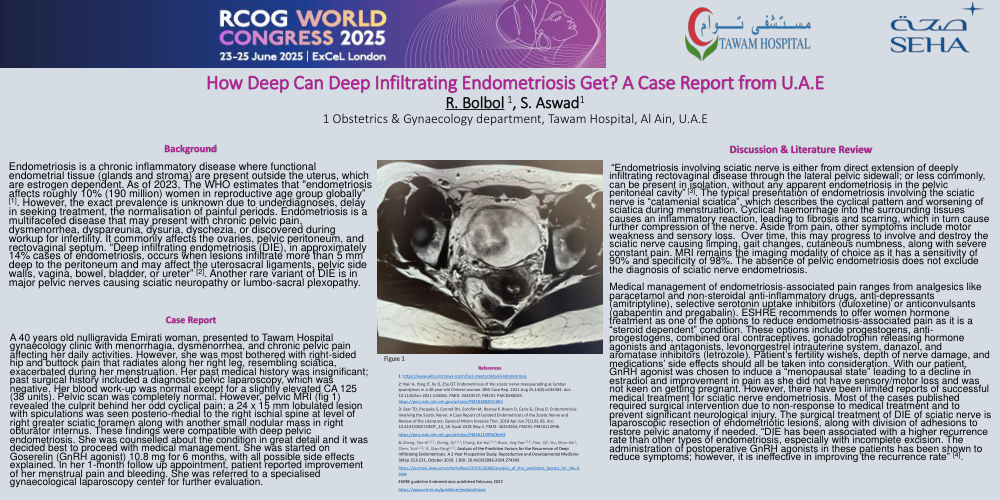
A 40 years old nulligravida Emirati woman, presented to Tawam Hospital gynaecology clinic with menorrhagia, dysmenorrhea, and chronic pelvic pain affecting her daily activities. However, she was most bothered with right-sided hip and buttock pain that radiates along her right leg, resembling sciatica, exacerbated during her menstruation. Her past medical history was insignificant; past surgical history included a diagnostic pelvic laparoscopy, which was negative. Her blood work-up was normal except for a slightly elevated CA 125 (38 units). Pelvic scan was completely normal. However, pelvic MRI (fig 1) revealed the culprit behind her odd cyclical pain; a 24 x 15 mm lobulated lesion with spiculations was seen posterio-medial to the right ischial spine at level of right greater sciatic foramen along with another small nodular mass in right obturator internus. These findings were compatible with deep pelvic endometriosis. She was counselled about the condition in great detail and it was decided best to proceed with medical management. She was started on Goserelin (GnRH agonist) 10.8 mg for 6 months, with all possible side effects explained. In her 1-month follow up appointment, patient reported improvement of her menstrual pain and bleeding. She was referred to a specialised gynaecological laparoscopy center for further evaluation.
Discussion & Literature Review
“Endometriosis involving sciatic nerve is either from direct extension of deeply infiltrating rectovaginal disease through the lateral pelvic sidewall; or less commonly, can be present in isolation, without any apparent endometriosis in the pelvic peritoneal cavity” [3]. The typical presentation of endometriosis involving the sciatic nerve is “catamenial sciatica”, which describes the cyclical pattern and worsening of sciatica during menstruation. Cyclical haemorrhage into the surrounding tissues causes an inflammatory reaction, leading to fibrosis and scarring, which in turn cause further compression of the nerve. Aside from pain, other symptoms include motor weakness and sensory loss. Over time, this may progress to involve and destroy the sciatic nerve causing limping, gait changes, cutaneous numbness, along with severe constant pain. MRI remains the imaging modality of choice as it has a sensitivity of 90% and specificity of 98%. The absence of pelvic endometriosis does not exclude the diagnosis of sciatic nerve endometriosis.
Medical management of endometriosis-associated pain ranges from analgesics like paracetamol and non-steroidal anti-inflammatory drugs, anti-depressants (amitriptyline), selective serotonin uptake inhibitors (duloxetine) or anticonvulsants (gabapentin and pregabalin). ESHRE recommends to offer women hormone treatment as one of the options to reduce endometriosis-associated pain as it is a “steroid dependent” condition. These options include progestogens, anti-progestogens, combined oral contraceptives, gonadotrophin releasing hormone agonists and antagonists, levonorgestrel intrauterine system, danazol, and aromatase inhibitors (letrozole). Patient’s fertility wishes, depth of nerve damage, and medications’ side effects should all be taken into consideration. With our patient, GnRH agonist was chosen to induce a “menopausal state” leading to a decline in estradiol and improvement in pain as she did not have sensory/motor loss and was not keen on getting pregnant. However, there have been limited reports of successful medical treatment for sciatic nerve endometriosis. Most of the cases published required surgical intervention due to non-response to medical treatment and to prevent significant neurological injury. The surgical treatment of DIE of sciatic nerve is laparoscopic resection of endometriotic lesions, along with division of adhesions to restore pelvic anatomy if needed. “DIE has been associated with a higher recurrence rate than other types of endometriosis, especially with incomplete excision. The administration of postoperative GnRH agonists in these patients has been shown to reduce symptoms; however, it is ineffective in improving the recurrence rate” [4].