2,281 posters, 63 videos, 56 audios, 43 topics, 18 sessions, 6,174 authors, 2,323 institutions
ePostersLive by SciGen Technologies S.A. All rights reserved.
RCOG World Congress 2025
June 23 - 25, 2025 | ExCeL London, UK
EP.0393
Raised CA19-9 in Endometriosis: A Case Report and Literature Review
Poster Presenter
Part of Topic
Endometriosis & uterine disorders
Raised CA19-9 in Endometriosis: A Case Report and Literature Review
C Downing1, M Kaur1, H Staley1, D Marcus1
Objective: This case report discusses a patient with deep infiltrative endometriosis (DIE) associated with an isolated increase in CA19-9.
A review of the literature was conducted to explore the role of CA19-9 in diagnosing and prognosticating endometriosis, and to assess its potential in differentiating between gynaecological malignancies and endometriosis.
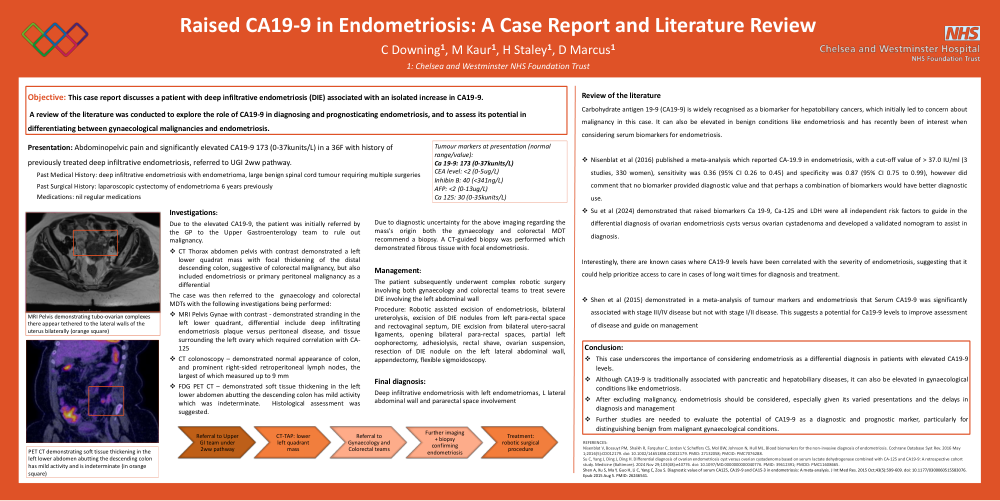
Presentation: Abdominopelvic pain and significantly elevated CA19-9 173 (0-37kunits/L) in a 36F with history of previously treated deep infiltrative endometriosis, referred to UGI 2ww pathway.
Past Medical History: deep infiltrative endometriosis with endometrioma, large benign spinal cord tumour requiring multiple surgeries
Past Surgical History: laparoscopic cystectomy
Investigations:
Due to the elevated CA19-9, the patient was initially referred by the GP to the Upper Gastroenterology team to rule out malignancy.
The case was then referred to the gynaecology and colorectal MDTs with the following investigations being performed:
Due to diagnostic uncertainty for the above imaging regarding the mass's origin both the gynaecology and colorectal MDT recommend a biopsy. A CT-guided biopsy was performed which demonstrated fibrous tissue with focal endometriosis.
Management:
The patient subsequently underwent complex robotic surgery involving both gynaecology and colorectal teams to treat severe DIE involving the left abdominal wall
Procedure: Robotic assisted excision of endometriosis, bilateral ureterolysis, excision of DIE nodules from left para-rectal space and rectovaginal septum, DIE excision from bilateral utero-sacral ligaments, opening bilateral para-rectal spaces, partial left oophorectomy, adhesiolysis, rectal shave, ovarian suspension, resection of DIE nodule on the left lateral abdominal wall, appendectomy, flexible sigmoidoscopy.
Final diagnosis:
Deep infiltrative endometriosis with left endometriomas, L lateral abdominal wall and pararectal space involvement
Review of the literature
Carbohydrate antigen 19-9 (CA19-9) is widely recognised as a biomarker for hepatobiliary cancers, which initially led to concern about malignancy in this case. It can also be elevated in benign conditions like endometriosis and has recently been of interest when considering serum biomarkers for endometriosis.
Interestingly, there are known cases where CA19-9 levels have been correlated with the severity of endometriosis, suggesting that it could help prioritize access to care in cases of long wait times for diagnosis and treatment.
Conclusion: