2,281 posters, 63 videos, 56 audios, 43 topics, 18 sessions, 6,174 authors, 2,323 institutions
ePostersLive by SciGen Technologies S.A. All rights reserved.
RCOG World Congress 2025
June 23 - 25, 2025 | ExCeL London, UK
EP.0392
Caesarean scar endometriosis: A case report of extra-pelvic endometriosis
Part of Topic
Endometriosis & uterine disorders
Caesarean scar endometriosis: A case report of extra-pelvic endometriosis
Objective: To document clinical presentation and imaging features in a case of caesarean scar endometriosis (CSE), the most common form of abdominal wall endometriosis (AWE)
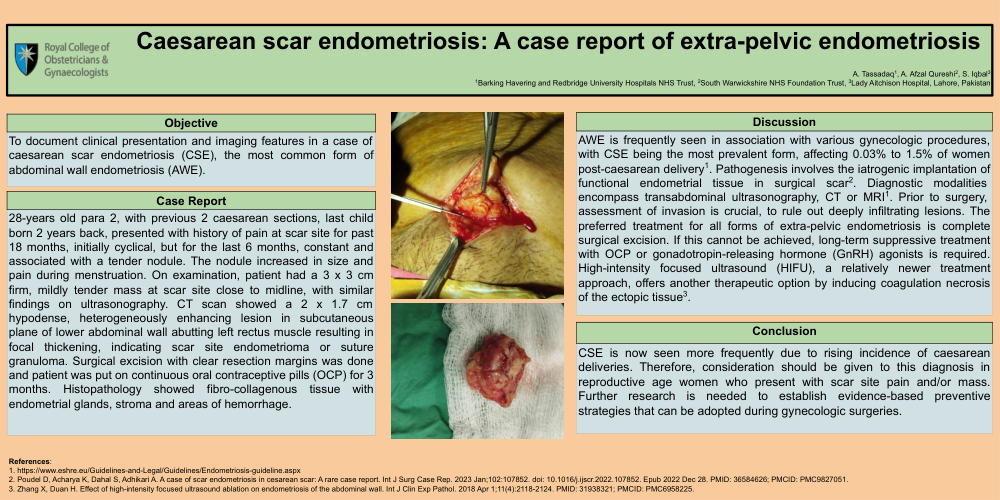
Case report: 28-years old para 2, with previous 2 caesarean sections, last child born 2 years back, presented with history of pain at scar site for past 18 months, initially cyclical, but for the last 6 months, constant and associated with a tender nodule. The nodule increased in size and pain during menstruation. On examination, patient had a 3 x 3 cm firm, mildly tender mass at scar site close to midline, with similar findings on ultrasonography. CT scan showed a 2 x 1.7 cm hypodense, heterogeneously enhancing lesion in subcutaneous plane of lower abdominal wall abutting left rectus muscle resulting in focal thickening, indicating scar site endometrioma or suture granuloma. Surgical excision with clear resection margins was done and patient was put on continuous oral contraceptive pills (OCP) for 3 months. Histopathology showed fibro-collagenous tissue with endometrial glands, stroma and areas of hemorrhage.
Discussion: AWE is frequently seen in association with various gynecologic procedures, with CSE being the most prevalent form, affecting 0.03% to 1.5% of women post-caesarean delivery. Pathogenesis involves the iatrogenic implantation of functional endometrial tissue in surgical scar. Diagnostic modalities encompass transabdominal ultrasonography, CT or MRI. Prior to surgery, assessment of invasion is crucial, to rule out deeply infiltrating lesions. The preferred treatment for all forms of extra-pelvic endometriosis is complete surgical excision. If this cannot be achieved, long-term suppressive treatment with OCP or gonadotropin-releasing hormone (GnRH) agonists is required. High-intensity focused ultrasound (HIFU), a relatively newer treatment approach, offers another therapeutic option by inducing coagulation necrosis of the ectopic tissue.
Conclusion: CSE is now seen more frequently due to rising incidence of caesarean deliveries. Therefore, consideration should be given to this diagnosis in reproductive age women who present with scar site pain and/or mass. Further research is needed to establish evidence-based preventive strategies that can be adopted during gynecologic surgeries.