2,281 posters, 63 videos, 56 audios, 43 topics, 18 sessions, 6,174 authors, 2,323 institutions
ePostersLive by SciGen Technologies S.A. All rights reserved.
RCOG World Congress 2025
June 23 - 25, 2025 | ExCeL London, UK
EP.0390
De Novo Endometriosis after Laparoscopic Supracervical Hysterectomy with Morcellation : a case report
Poster Presenter
Authors
Affiliations
Part of Topic
Endometriosis & uterine disorders
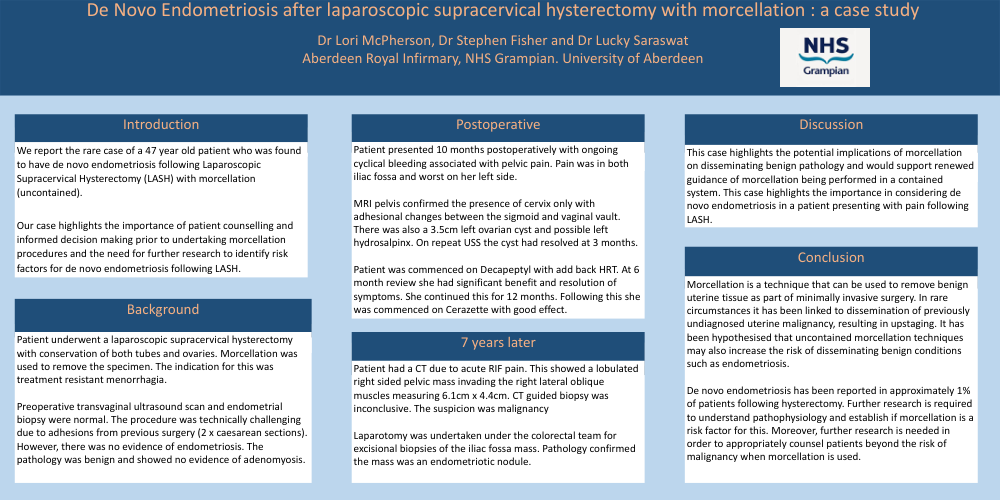
De Novo Endometriosis after laparoscopic supracervical hysterectomy with morcellation : a case study
Introduction:
We report the rare case of a 47 year old patient who was found to have de novo endometriosis following Laparoscopic Supracervical Hysterectomy (LASH) with morcellation (uncontained). Our case highlights the importance of patient counselling and informed decision making prior to undertaking morcellation procedures and the need for further research to identify risk factors for de novo endometriosis following LASH.
Background:
Patient underwent a laparoscopic supracervical hysterectomy with conservation of both tubes and ovaries. Morcellation was used to remove the specimen. The indication for this was treatment resistant menorrhagia. Preoperative transvaginal ultrasound scan and endometrial biopsy were normal. The procedure was technically challenging due to adhesions from previous surgery (2 x caesarean sections). However, there was no evidence of endometriosis. The pathology was benign and showed no evidence of adenomyosis.
Postoperative:
Patient presented 10 months postoperatively with ongoing cyclical bleeding associated with pelvic pain. Pain was in both iliac fossa and worst on her left side. MRI pelvis confirmed the presence of cervix only with adhesional changes between the sigmoid and vaginal vault. There was also a 3.5cm left ovarian cyst and possible left hydrosalpinx. On repeat USS the cyst had resolved at 3 months. Patient was commenced on Decapeptyl with add back HRT. At 6 month review she had significant benefit and resolution of symptoms. She continued this for 12 months. Following this she was commenced on Cerazette with good effect.
7 years later:
Patient had a CT due to acute RIF pain. This showed a lobulated right sided pelvic mass invading the right lateral oblique muscles measuring 6.1cm x 4.4cm. CT guided biopsy was inconclusive. The suspicion was malignancy. Laparotomy was undertaken under the colorectal team for excisional biopsies of the iliac fossa mass. Pathology confirmed the mass was an endometriotic nodule.
Discussion:
This case highlights the potential implications of morcellation on disseminating benign pathology and would support renewed guidance of morcellation being performed in a contained system. This case highlights the importance in considering de novo endometriosis in a patient presenting with pain following LASH.
Conclusion:
Morcellation is a technique that can be used to remove benign uterine tissue as part of minimally invasive surgery. In rare circumstances it has been linked to dissemination of previously undiagnosed uterine malignancy, resulting in upstaging. It has been hypothesised that uncontained morcellation techniques may also increase the risk of disseminating benign conditions such as endometriosis. De novo endometriosis has been reported in approximately 1% of patients following hysterectomy. Further research is required to understand pathophysiology and establish if morcellation is a risk factor for this. Moreover, further research is needed in order to appropriately counsel patients beyond the risk of malignancy when morcellation is used.