2,281 posters, 63 videos, 56 audios, 43 topics, 18 sessions, 6,174 authors, 2,323 institutions
ePostersLive by SciGen Technologies S.A. All rights reserved.
RCOG World Congress 2025
June 23 - 25, 2025 | ExCeL London, UK
EP.0387
Exploring Ablation Techniques in Cutaneous Endometriosis: Microwave and Radiofrequency Treatment Case Report
Poster Presenter
Part of Topic
Endometriosis & uterine disorders
Exploring Ablation Techniques in Cutaneous Endometriosis: Microwave and Radiofrequency Treatment Case Report
Introduction
Endometriosis is a chronic gynaecological condition defined by the presence of endometrial-like tissue outside the uterine cavity, commonly affecting pelvic structures. Extrapelvic manifestations are rare and can present diagnostic challenges due to their atypical features. Cutaneous endometriosis, seen in less than 1% of cases, is often under-recognised. It can be classified into primary (spontaneous) or secondary (scar-associated), the latter typically arising in surgical scars following caesarean sections, laparoscopies, or hysterectomies. The proposed mechanism involves direct implantation of endometrial cells during surgery, followed by hormone-driven proliferation.
Patients usually present with a tender, cyclical abdominal wall mass. While surgical excision is the conventional treatment, we present two cases managed with minimally invasive alternatives, microwave and radiofrequency ablation, highlighting their potential benefits in symptom resolution and recovery.
Clinical presentation
Case 1: Microwave Ablation for Recurrent Subcutaneous Endometriosis
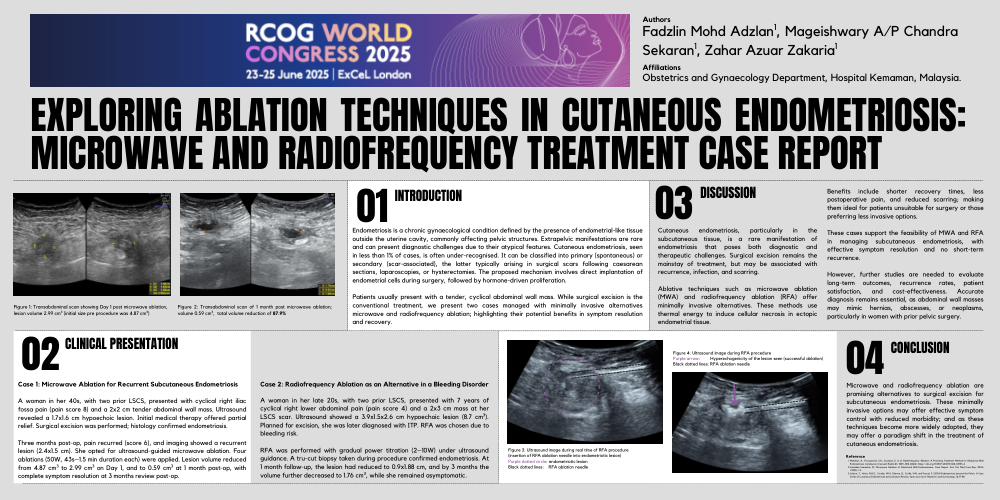
A woman in her 40s, with two prior LSCS, presented with cyclical right iliac fossa pain (pain score 8) and a 2x2 cm tender abdominal wall mass. Ultrasound revealed a 1.7x1.6 cm hypoechoic lesion. Initial medical therapy offered partial relief. Surgical excision was performed; histology confirmed endometriosis.
Three months post-op, pain recurred (score 6), and imaging showed a recurrent lesion (2.4x1.5 cm). She opted for ultrasound-guided microwave ablation. Four ablations (50W, 43s–1.5 min duration each) were applied. Lesion volume reduced from 4.87 cm³ to 2.99 cm³ on Day 1, and to 0.59 cm³ at 1 month post-op, with complete symptom resolution at 3 months review post-op.
Case 2: Radiofrequency Ablation as an Alternative in a Bleeding Disorder
A woman in her late 20s, with two prior LSCS, presented with 7 years of cyclical right lower abdominal pain (pain score 4) and a 2x3 cm mass at her LSCS scar. Ultrasound showed a 3.9x1.5x2.6 cm hypoechoic lesion (8.7 cm³). Planned for excision, she was later diagnosed with ITP. RFA was chosen due to bleeding risk.
RFA was performed with gradual power titration (2–10W) under ultrasound guidance. A tru-cut biopsy taken during procedure confirmed endometriosis. At 1 month follow-up, the lesion had reduced to 0.9x1.88 cm, and by 3 months the volume further decreased to 1.76 cm³, while she remained asymptomatic.
Discussion
Cutaneous endometriosis, particularly in the subcutaneous tissue, is a rare manifestation of endometriosis that poses both diagnostic and therapeutic challenges. Surgical excision remains the mainstay of treatment, but may be associated with recurrence, infection, and scarring.
Ablative techniques such as microwave ablation (MWA) and radiofrequency ablation (RFA) offer minimally invasive alternatives. These methods use thermal energy to induce cellular necrosis in ectopic endometrial tissue. Benefits include shorter recovery times, less postoperative pain, and reduced scarring, making them ideal for patients unsuitable for surgery or those preferring less invasive options.
These cases support the feasibility of MWA and RFA in managing subcutaneous endometriosis, with effective symptom resolution and no short-term recurrence.
However, further studies are needed to evaluate long-term outcomes, recurrence rates, patient satisfaction, and cost-effectiveness. Accurate diagnosis remains essential, as abdominal wall masses may mimic hernias, abscesses, or neoplasms, particularly in women with prior pelvic surgery.
Conclusion
Microwave and radiofrequency ablation are promising alternatives to surgical excision for subcutaneous endometriosis. These minimally invasive options may offer effective symptom control with reduced morbidity, and as these techniques become more widely adopted, they may offer a paradigm shift in the treatment of cutaneous endometriosis.
Reference
- Mahdavi, A., Forouzannia, S.A., Goudarzi, E. et al. Radiofrequency Ablation: A Promising Treatment Method for Abdominal Wall Endometriosis. Cardiovasc Intervent Radiol 47, 1009–1014 (2024). https://doi.org/10.1007/s00270-024-03755-4
- González-Comadran M, Microwave Ablation of Abdominal Wall Endometrioma: Case Report. Ann Clin Med Case Rep. 2024; V12(13): 1-5
- Isidore, T., Anita, N.O.G., Coralie, M.M., Etienne, B., Cyrille, N.N. and Pascal, F. (2024) Endometriosis beyond the Pelvis: A Case Series of Cutaneous Endometriosis and Literature Review. Open Journal of Obstetrics and Gynecology, 14,77-88.