2,281 posters, 63 videos, 56 audios, 43 topics, 18 sessions, 6,174 authors, 2,323 institutions
ePostersLive by SciGen Technologies S.A. All rights reserved.
RCOG World Congress 2025
June 23 - 25, 2025 | ExCeL London, UK
EP.0383
Clinically Presents Like Endometriosis, Surgically Looks Like Endometriosis- But Is It Endometriosis?
Poster Presenter
Authors
Affiliations
Part of Topic
Endometriosis & uterine disorders
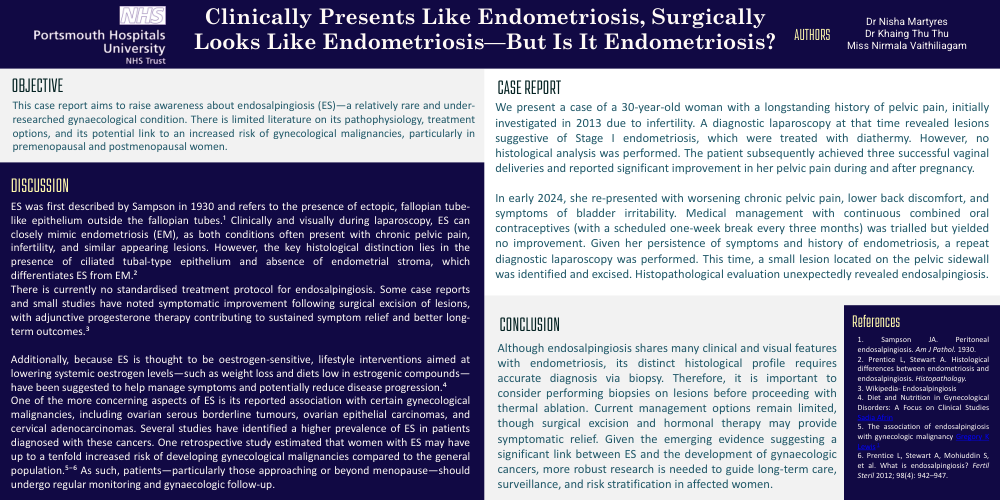
Clinically Presents Like Endometriosis, Surgically Looks Like Endometriosis—But Is It Endometriosis?
N. Martyres, K.T. Thu, N. Vaithilingam
Objective
This case report aims to raise awareness about endosalpingiosis (ES)—a relatively rare and under-researched gynaecological condition. There is limited literature on its pathophysiology, treatment options, and its potential link to an increased risk of gynecological malignancies, particularly in premenopausal and postmenopausal women.
Case Report
We present a case of a 30-year-old woman with a longstanding history of pelvic pain, initially investigated in 2013 due to infertility. A diagnostic laparoscopy at that time revealed lesions suggestive of Stage I endometriosis, which were treated with diathermy. However, no histological analysis was performed. The patient subsequently achieved three successful vaginal deliveries and reported significant improvement in her pelvic pain during and after pregnancy.
In early 2024, she re-presented with worsening chronic pelvic pain, lower back discomfort, and symptoms of bladder irritability. Medical management with continuous combined oral contraceptives (with a scheduled one-week break every three months) was trialled but yielded no improvement. Given her persistence of symptoms and history of endometriosis, a repeat diagnostic laparoscopy was performed.
This time, a small lesion located on the pelvic sidewall were identified and excised. Histopathological evaluation unexpectedly revealed endosalpingiosis.
Discussion
ES was first described by Sampson in 1930 and refers to the presence of ectopic, fallopian tube-like epithelium outside the fallopian tubes.¹ Clinically and visually during laparoscopy, ES can closely mimic endometriosis (EM), as both conditions often present with chronic pelvic pain, infertility, and similar appearing lesions. However, the key histological distinction lies in the presence of ciliated tubal-type epithelium and absence of endometrial stroma, which differentiates ES from EM.²
There is currently no standardised treatment protocol for endosalpingiosis. Some case reports and small studies have noted symptomatic improvement following surgical excision of lesions, with adjunctive progesterone therapy contributing to sustained symptom relief and better long-term outcomes.³
Additionally, because ES is thought to be oestrogen-sensitive, lifestyle interventions aimed at lowering systemic oestrogen levels—such as weight loss and diets low in estrogenic compounds—have been suggested to help manage symptoms and potentially reduce disease progression.⁴
One of the more concerning aspects of ES is its reported association with certain gynecological malignancies, including ovarian serous borderline tumours, ovarian epithelial carcinomas, and cervical adenocarcinomas. Several studies have identified a higher prevalence of ES in patients diagnosed with these cancers. One retrospective study estimated that women with ES may have up to a tenfold increased risk of developing gynecological malignancies compared to the general population.⁵⁻⁶ As such, patients—particularly those approaching or beyond menopause—should undergo regular monitoring and gynaecologic follow-up.
Conclusion
Although endosalpingiosis shares many clinical and visual features with endometriosis, its distinct histological profile requires accurate diagnosis via biopsy. Therefore, it is important to consider performing biopsies on lesions before proceeding with thermal ablation. Current management options remain limited, though surgical excision and hormonal therapy may provide symptomatic relief. Given the emerging evidence suggesting a significant link between ES and the development of gynaecologic cancers, more robust research is urgently needed to guide long-term care, surveillance, and risk stratification in affected women.
References
- Sampson JA. Peritoneal endosalpingiosis. Am J Pathol. 1930.
- Prentice L, Stewart A. Histological differences between endometriosis and endosalpingiosis. Histopathology.
- Wikipedia- Endosalpingiosis
- Diet and Nutrition in Gynecological Disorders: A Focus on Clinical Studies Sadia Afrin
- The association of endosalpingiosis with gynecologic malignancy Gregory K Lewis 1
- Prentice L, Stewart A, Mohiuddin S, et al. What is endosalpingiosis? Fertil Steril 2012; 98(4): 942–947.