2,281 posters, 63 videos, 56 audios, 43 topics, 18 sessions, 6,174 authors, 2,323 institutions
ePostersLive by SciGen Technologies S.A. All rights reserved.
RCOG World Congress 2025
June 23 - 25, 2025 | ExCeL London, UK
EP.0375
Laparoscopic Resection of a Urachal Cyst Presenting as a Deep Infiltrating Endometriosis
Poster Presenter
Authors
Affiliations
Part of Topic
Endometriosis & uterine disorders
Laparoscopic Resection of a Urachal Cyst Presenting as
Deep Infiltrating Endometriosis
Royal Hampsire County Hospital, Winchester
Alice Stickland, Yovisha Vijayakumar, Keith Louden
Background
•The prevalence of urinary tract endometriosis (UTE) affects 20-52.5% of women with deep endometriosis.1,2
•The bladder accounts for 85% of sites affected by UTE.3
Presentation
•42-year-old nulliparous patient presented with longstanding heavy menstrual bleeding and cyclical pelvic pain.
•She had associated cyclical dysuria, dyskezia and deep dyspareunia.
Investigations
•She was investigated with ultrasound and MRI in our endometriosis centre.
•This suggested extensive endometriosis and an 8mm intravesical nodule.
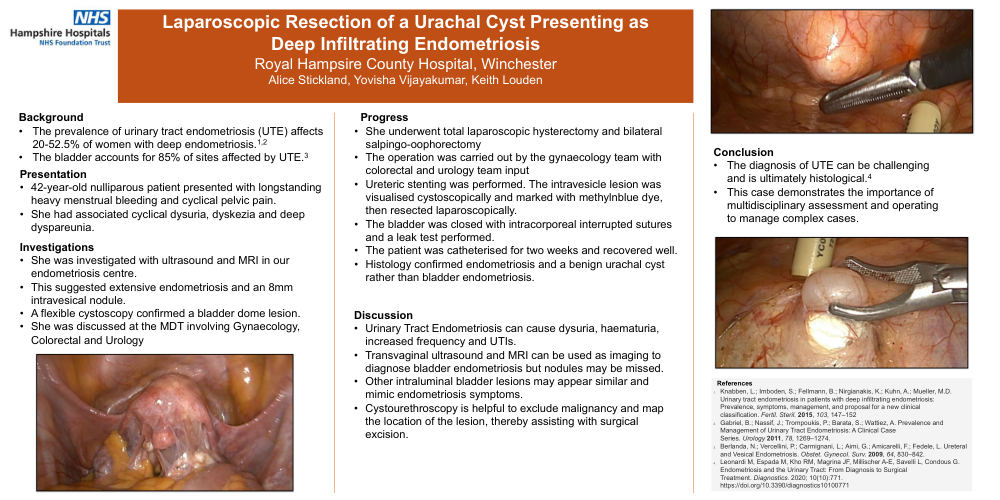
•A flexible cystoscopy confirmed a bladder dome lesion.
•She was discussed at the MDT involving Gynaecology, Colorectal and Urology
Progress
•She underwent total laparoscopic hysterectomy and bilateral salpingo-oophorectomy
•The operation was carried out by the gynaecology team with colorectal and urology team input
•Ureteric stenting was performed. The intravesicle lesion was visualised cystoscopically and marked with methylnblue dye, then resected laparoscopically.
•The bladder was closed with intracorporeal interrupted sutures and a leak test performed.
•The patient was catheterised for two weeks and recovered well.
•Histology confirmed endometriosis and a benign urachal cyst rather than bladder endometriosis.
Discussion
•Urinary Tract Endometriosis can cause dysuria, haematuria, increased frequency and UTIs.
•Transvaginal ultrasound and MRI can be used as imaging to diagnose bladder endometriosis but nodules may be missed.
•Other intraluminal bladder lesions may appear similar and mimic endometriosis symptoms.
•Cystourethroscopy is helpful to exclude malignancy and map the location of the lesion, thereby assisting with surgical excision.
Conclusion
•The diagnosis of UTE can be challenging and is ultimately histological.4
•This case demonstrates the importance of multidisciplinary assessment and operating to manage complex cases.