2,281 posters, 63 videos, 56 audios, 43 topics, 18 sessions, 6,174 authors, 2,323 institutions
ePostersLive by SciGen Technologies S.A. All rights reserved.
RCOG World Congress 2025
June 23 - 25, 2025 | ExCeL London, UK
EP.0373
A case report on Caesarean scar endometriosis: Diagnosis and Management
Poster Presenter
Part of Topic
Endometriosis & uterine disorders
Title
A case report on Caesarean scar endometriosis: Diagnosis and Management
Authors and affiliation
R.Edema1, H. Elhossamy1, L. Badr1, Z.Pervaiz1
1. Dudley Group NHS Foundation Trust, Dudley, United Kingdom
INTRODUCTION/BACKGROUND Endometriosis in a caesarean section scar is rare with an incidence of 0.08%. It is quite challenging to diagnose, and a histopathological diagnosis is necessary. Abdominal wall Endometriosis (AWE) is one of the most common locations outside the pelvis, mostly due to previous surgical scarsfrom obstetrical and gynaecological surgeries like caesarean sections, hysterectomy, episiotomy, and tubal ligations. It can be in the skin, subcutaneous tissue, rectus sheath or muscle, below the peritoneum or in the uterus. CSE may cause long-term discomfort involving cyclic lower abdominal pain. Some studies have highlighted that scar endometriosis happens following surgical procedures where the uterine cavity is opened, accidental implantation of endometrial tissue into the abdominal incision takes place and a lump or growth is formed that increases in size during menses and becomes symptomatic. This theory is thought to be the most plausible as it suggests direct mechanical implantation.
CASE History: A 32-year-old woman presented with a painful right-sided lump over her caesarean section scar for 3 years. She had one spontaneous vaginal delivery followed by one emergency caesarean section. The lump has become more symptomatic over the last year. The patient has recently started feeling shooting pains. Her menses have been regular and there was no intermenstrual bleeding.
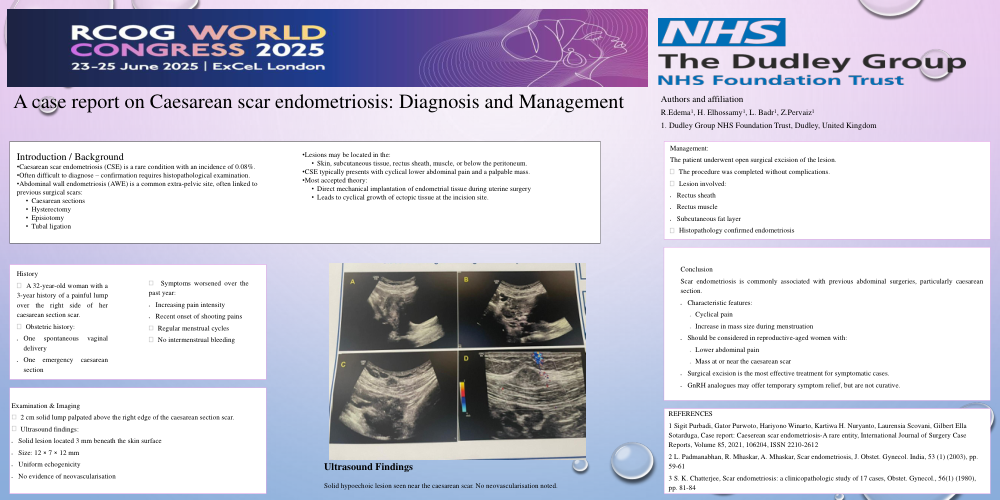
Examination: On examination, a 2cm solid lump above the right edge of the caesarean section scar was noted. Ultrasound suggested a solid lesion 3mm beneath the skin surface on the right side of the caesarean section scar with dimensions of 12 x 7 x 12 mm of uniform echogenicity with no neovascularization. Management: She underwent open surgical excision of the lesion without any complications. It involved the rectus sheath, muscle, and subcutaneous fat layer. Histopathology of the mass confirmed endometriosis
Conclusion Endometriosis in a scar is usually related to previous abdominal surgeries like caesarean section. The typical feature is the worsening of symptoms and increase in size during periods. It should be considered in women of reproductive age with cyclical lower abdominal pain and/or mass at the caesarean scar from previous delivery or following surgeries involving the lower abdomen. Surgical excision is considered the best treatment in symptomatic patients. Medical treatment with GnRH analogues provides temporary relief in symptoms.
REFERENCES
1 Sigit Purbadi, Gator Purwoto, Hariyono Winarto, Kartiwa H. Nuryanto, Laurensia Scovani, Gilbert Ella Sotarduga, Case report: Caeserean scar endometriosis-A rare entity, International Journal of Surgery Case Reports, Volume 85, 2021, 106204, ISSN 2210-2612
2 L. Padmanabhan, R. Mhaskar, A. Mhaskar, Scar endometriosis, J. Obstet. Gynecol. India, 53 (1) (2003), pp. 59-61
3 S. K. Chatterjee, Scar endometriosis: a clinicopathologic study of 17 cases, Obstet. Gynecol., 56(1) (1980), pp. 81-84