2,281 posters, 63 videos, 56 audios, 43 topics, 18 sessions, 6,174 authors, 2,323 institutions
ePostersLive by SciGen Technologies S.A. All rights reserved.
RCOG World Congress 2025
June 23 - 25, 2025 | ExCeL London, UK
EP.0372
Case report of coexisting endometriosis and well-differentiated neuroendocrine tumor of the appendix
Part of Topic
Endometriosis & uterine disorders
Case report of coexisting endometriosis and well-differentiated neuroendocrine tumor of the appendix
Dr Emina Ahmetlić Dr Maja Selimović Dr Asim Spahović dr Aida Đurđević
General Hospital “Prim dr Abdulah Nakaš,” Sarajevo, Bosnia and Herzegovina
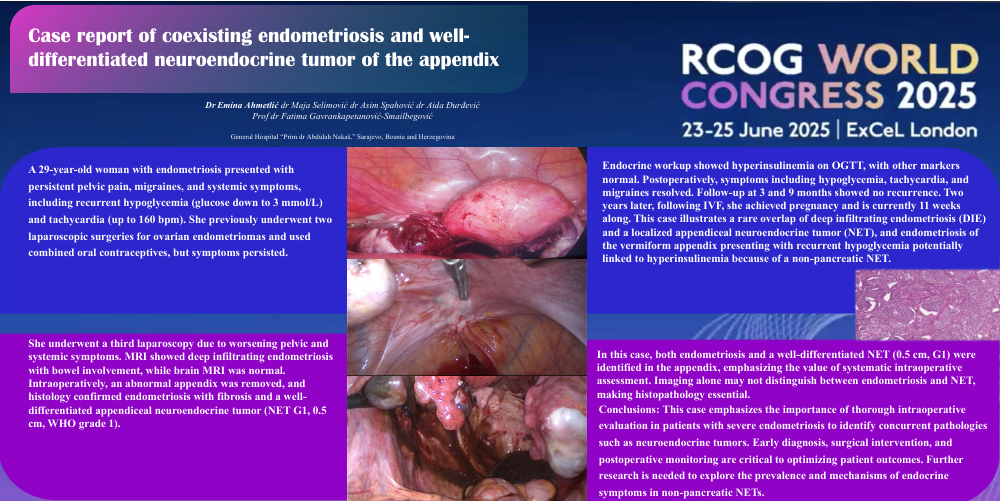
CASE REPORT: A 29-year-old woman with endometriosis presented with persistent pelvic pain, migraines, and systemic symptoms, including recurrent hypoglycemia (glucose down to 3 mmol/L) and tachycardia (up to 160 bpm). She previously underwent two laparoscopic surgeries for ovarian endometriomas and used combined oral contraceptives, but symptoms persisted.
She underwent a third laparoscopy due to worsening pelvic and systemic symptoms. MRI showed deep infiltrating endometriosis with bowel involvement, while brain MRI was normal. Intraoperatively, an abnormal appendix was removed, and histology confirmed endometriosis with fibrosis and a well-differentiated appendiceal neuroendocrine tumor (NET G1, 0.5 cm, WHO grade 1).
Endocrine workup showed hyperinsulinemia on OGTT, with other markers normal. Postoperatively, symptoms including hypoglycemia, tachycardia, and migraines resolved. Follow-up at 3 and 9 months showed no recurrence. Two years later, following IVF, she achieved pregnancy and is currently 11 weeks along. This case illustrates a rare overlap of deep infiltrating endometriosis (DIE) and a localized appendiceal neuroendocrine tumor (NET), and endometriosis of the vermiform appendix presenting with recurrent hypoglycemia potentially linked to hyperinsulinemia because of a non-pancreatic NET.
In this case, both endometriosis and a well-differentiated NET (0.5 cm, G1) were identified in the appendix, emphasizing the value of systematic intraoperative assessment. Imaging alone may not distinguish between endometriosis and NET, making histopathology essential.
Conclusions: This case emphasizes the importance of thorough intraoperative evaluation in patients with severe endometriosis to identify concurrent pathologies such as neuroendocrine tumors. Early diagnosis, surgical intervention, and postoperative monitoring are critical to optimizing patient outcomes. Further research is needed to explore the prevalence and mechanisms of endocrine symptoms in non-pancreatic NETs.