2,281 posters, 63 videos, 56 audios, 43 topics, 18 sessions, 6,174 authors, 2,323 institutions
ePostersLive by SciGen Technologies S.A. All rights reserved.
RCOG World Congress 2025
June 23 - 25, 2025 | ExCeL London, UK
EP.0368
Laparoscopic Sclerotherapy for Endometriomas: Evidence Review of an Alternative Treatment
Poster Presenter
Authors
Affiliations
Part of Topic
Endometriosis & uterine disorders
Laparoscopic Sclerotherapy for Endometriomas: Evidence Review of an Alternative Treatment
Introduction
Endometriomas represent a common manifestation of endometriosis, particularly in women of reproductive age. The standard treatment involves laparoscopic cystectomy (stripping), which although effective, can compromise ovarian reserve. As fertility preservation becomes increasingly prioritized, alternative therapies such as laparoscopic sclerotherapy have gained attention. This literature review evaluates published clinical trials on the efficacy, safety, and fertility outcomes of laparoscopic sclerotherapy as a conservative surgical approach..
Historical Background of Sclerotherapy
The use of sclerotherapy dates back to 1985, when Bean and Rodan employed ethanol to treat hepatic cysts. Its adaptation in gynecology emerged in the 1990s, primarily as ultrasound-guided procedures for ovarian endometriomas. Over time, agents like tetracycline, methotrexate, and ethanol have been trialed. Initial studies suggested favorable outcomes for recurrence and fertility preservation. In the 2010s, laparoscopic-guided sclerotherapy was introduced, offering direct visualization and precision. In the UK, it remains investigational, with the DIAMOND study currently evaluating its efficacy. ESHRE guidelines briefly mention sclerotherapy, highlighting improved oocyte yield without compromising pregnancy rates.
As the procedure is relatively new, only four clinical trials have been published to date.
Mechanism and Procedure of Laparoscopic Sclerotherapy
Laparoscopic sclerotherapy involves the aspiration of endometriomas under direct visualization, followed by the instillation of a sclerosing agent, typically 95% or 99%ethanol, retained for 10–15 minutes. The method minimizes trauma to the ovarian cortex, aiming to preserve ovarian reserve better than cystectomy. The laparoscopic route also reduces the risk of ethanol leakage and allows concurrent treatment of deep endometriosis
Methods
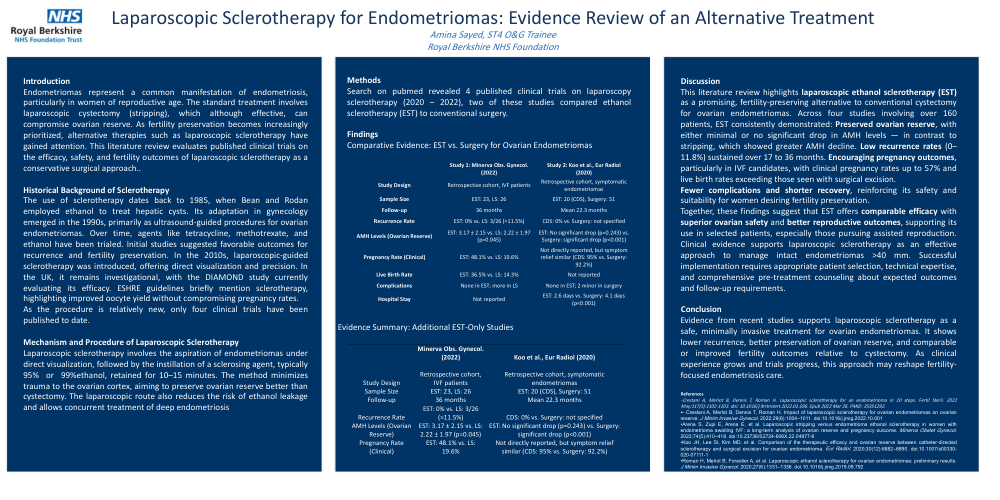
Search on pubmed showed 4 published clinical trials on laparoscopy sclerotherapy (2020 – 2022), two of these studies compared ethanol sclerotherapy (EST) to conventional surgery.
Discussion
This literature review highlights laparoscopic ethanol sclerotherapy (EST) as a promising, fertility-preserving alternative to conventional cystectomy for ovarian endometriomas. Across four studies involving over 160 patients, EST consistently demonstrated: Preserved ovarian reserve, with either minimal or no significant drop in AMH levels — in contrast to stripping, which showed greater AMH decline. Low recurrence rates (0–11.8%) sustained over 17 to 36 months. Encouraging pregnancy outcomes, particularly in IVF candidates, with clinical pregnancy rates up to 57% and live birth rates exceeding those seen with surgical excision.
Fewer complications and shorter recovery, reinforcing its safety and suitability for women desiring fertility preservation.
Together, these findings suggest that EST offers comparable efficacy with superior ovarian safety and better reproductive outcomes, supporting its use in selected patients, especially those pursuing assisted reproduction. Clinical evidence supports laparoscopic sclerotherapy as an effective approach to manage intact endometriomas >40 mm. Successful implementation requires appropriate patient selection, technical expertise, and comprehensive pre-treatment counseling about expected outcomes and follow-up requirements.
Conclusion
Evidence from recent studies supports laparoscopic sclerotherapy as a safe, minimally invasive treatment for ovarian endometriomas. It shows lower recurrence, better preservation of ovarian reserve, and comparable or improved fertility outcomes relative to cystectomy. As clinical experience grows and trials progress, this approach may reshape fertility-focused endometriosis care.
References
-Crestani A, Merlot B, Dennis T, Roman H. Laparoscopic sclerotherapy for an endometrioma in 10 steps. Fertil Steril. 2022 May;117(5):1102-1103. doi: 10.1016/j.fertnstert.2022.01.036. Epub 2022 Mar 26. PMID: 35351292.