Loading...

2,281 posters, 63 videos, 56 audios, 43 topics, 18 sessions, 6,174 authors, 2,323 institutions

ePostersLive by SciGen Technologies S.A. All rights reserved.

RCOG World Congress 2025

June 23 - 25, 2025 | ExCeL London, UK

EP.0361

COMPARATIVE STUDY ON EFFECT OF TWO AYURVEDA FORMULAS ON UTERINE FIBROID
Part of Topic

Endometriosis & uterine disorders

COMPARATIVE STUDY ON EFFECT OF TWO AYURVEDA FORMULAS ON UTERINE FIBROID: 
A Randomized Single-Blind Clinical Trial
S. M. D. N. P. Senaratna¹*, Y. A. U. D. Karunarathne²
¹Senior Registrar, Post Graduate Institute of Indigenous Medicine, University of Colombo, Sri Lanka
²Senior Lecturer Grade I/Consultant, Professorial Unit of Prasutitantra Stree roga, National Ayurveda Teaching Hospital, Borella, Sri Lanka
*Corresponding Author: S. M. D. N. P. Senaratna Email: nirmala.senaratna@gmail.com

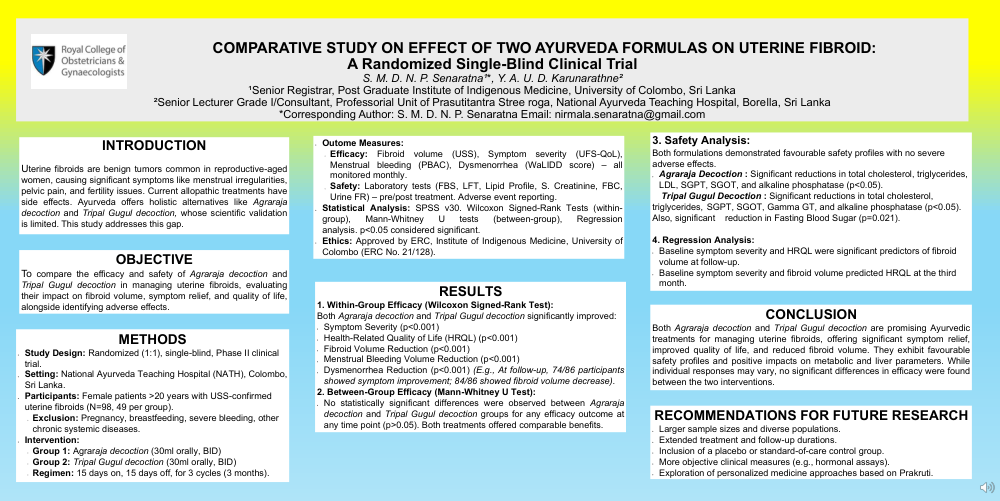
INTRODUCTION

Uterine fibroids are benign tumors common in reproductive-aged women, causing significant symptoms like menstrual irregularities, pelvic pain, and fertility issues. Current allopathic treatments have side effects. Ayurveda offers holistic alternatives like Agraraja decoction and Tripal Gugul decoction, whose scientific validation is limited. This study addresses this gap.

OBJECTIVE

To compare the efficacy and safety of Agraraja decoction and Tripal Gugul decoction in managing uterine fibroids, evaluating their impact on fibroid volume, symptom relief, and quality of life, alongside identifying adverse effects.

METHODS

·Study Design: Randomized (1:1), single-blind, Phase II clinical trial.
·Setting: National Ayurveda Teaching Hospital (NATH), Colombo, Sri Lanka.
·Participants: Female patients >20 years with USS-confirmed uterine fibroids (N=98, 49 per group).
oExclusion: Pregnancy, breastfeeding, severe bleeding, other chronic systemic diseases.
·Intervention:
oGroup 1: Agraraja decoction(30ml orally, BID)
oGroup 2: Tripal Gugul decoction(30ml orally, BID)
oRegimen: 15 days on, 15 days off, for 3 cycles (3 months).
·Outome Measures:
oEfficacy: Fibroid volume (USS), Symptom severity (UFS-QoL), Menstrual bleeding (PBAC), Dysmenorrhea (WaLIDD score) – all monitored monthly.
oSafety: Laboratory tests (FBS, LFT, Lipid Profile, S. Creatinine, FBC, Urine FR) – pre/post treatment. Adverse event reporting.
·Statistical Analysis: SPSS v30. Wilcoxon Signed-Rank Tests (within-group), Mann-Whitney U tests (between-group), Regression analysis. p<0.05 considered significant.
·Ethics: Approved by ERC, Institute of Indigenous Medicine, University of Colombo (ERC No. 21/128).

RESULTS

1. Within-Group Efficacy (Wilcoxon Signed-Rank Test):

Both Agraraja decoction and Tripal Gugul decoction significantly improved:

·Symptom Severity (p<0.001)
·Health-Related Quality of Life (HRQL) (p<0.001)
·Fibroid Volume Reduction (p<0.001)
·Menstrual Bleeding Volume Reduction (p<0.001)
·Dysmenorrhea Reduction (p<0.001) (E.g., At follow-up, 74/86 participants showed symptom improvement; 84/86 showed fibroid volume decrease).

2. Between-Group Efficacy (Mann-Whitney U Test):

·No statistically significant differences were observed between Agraraja decoction and Tripal Gugul decoction groups for any efficacy outcome at any time point (p>0.05). Both treatments offered comparable benefits.

3. Safety Analysis:

Both formulations demonstrated favourable safety profiles with no severe adverse effects.

·Agraraja Decoction : Significant reductions in total cholesterol, triglycerides, LDL, SGPT, SGOT, and alkaline phosphatase (p<0.05).

  Tripal Gugul Decoction: Significant reductions in total cholesterol, triglycerides,   SGPT, SGOT, Gamma GT, and alkaline phosphatase (p<0.05). Also, significant   reduction in Fasting Blood Sugar (p=0.021).

4. Regression Analysis:

·Baseline symptom severity and HRQL were significant predictors of fibroid volume at follow-up.
·Baseline symptom severity and fibroid volume predicted HRQL at the third month.

CONCLUSION

Both Agraraja decoction and Tripal Gugul decoction are promising Ayurvedic treatments for managing uterine fibroids, offering significant symptom relief, improved quality of life, and reduced fibroid volume. They exhibit favourable safety profiles and positive impacts on metabolic and liver parameters. While individual responses may vary, no significant differences in efficacy were found between the two interventions.

RECOMMENDATIONS FOR FUTURE RESEARCH

·Larger sample sizes and diverse populations.
·Extended treatment and follow-up durations.
·Inclusion of a placebo or standard-of-care control group.
·More objective clinical measures (e.g., hormonal assays).
·Exploration of personalized medicine approaches based on Prakruti.


Copyright © 2015-2026, ePostersLive® SciGen is a registered trademark of SciGen Technologies S.A. Patent pending.

This website and third-party tools we use rely on cookies for the best user experience. By selecting "I agree", you agree to cookie usage as described in our Privacy Policy.