2,281 posters, 63 videos, 56 audios, 43 topics, 18 sessions, 6,174 authors, 2,323 institutions
ePostersLive by SciGen Technologies S.A. All rights reserved.
RCOG World Congress 2025
June 23 - 25, 2025 | ExCeL London, UK
EP.0358
Cost-Benefit Analysis of Establishing an Endometriosis Center at Southend University Hospital
Poster Presenter
Part of Topic
Endometriosis & uterine disorders
Cost-Benefit Analysis of Establishing an Endometriosis Centre at Southend University Hospital
R. Nusrat 1, A. Shokouh – Amiri1, M. Hussain1, R. Saleem1. .
1 Southend university hospital NHS foundation trust , Southend –on-sea , UK.
INTRODUCTION/BACKGROUND :
§Endometriosis affects 1 in 10 women and often leads to delayed diagnosis and fragmented care. (1).
§This audit evaluates the financial feasibility of establishing a BSGE-accredited tertiary endometriosis centre at Southend University Hospital.
§By analysing cost differences between local and tertiary care, the study highlights potential savings, improved patient outcomes, and the long-term value of localized, multidisciplinary care.
OBJECTIVES/AIMS :
§ The aim of this study was to evaluate the Financial feasibility of establishing a British Society for Gynaecological Endoscopy (BSGE)-accredited tertiary endometriosis centre at Southend University Hospital.
§The analysis included a cost comparison of managing patients locally versus referring them to tertiary centres and assessed the potential cost savings and long-term benefits of localizing care.
DESIGN/METHODS :
§ This was a retrospective audit and quality improvement project analysing data from 104 patients with endometriosis treated at Southend University Hospital between January 2020 and December 2023.
§Patient data were collected from electronic records and coding databases.
§Costs were calculated for outpatient appointments, investigations (e.g., TVS, MRI, diagnostic
§laparoscopy), medical and surgical treatments, and referrals to tertiary centres.
§The cost of managing patients locally at Southend was compared with the cost of referring patients to tertiary centres (e.g., UCL, Cambridge).
CONCLUSIONS :
§ Establishing a BSGE-accredited tertiary endometriosis centre at Southend University Hospital is financially viable and could lead to significant cost savings by reducing reliance on external tertiary centres.
§The initial investment in infrastructure and staff training, estimated at £150,000–£200,000, could be offset within 5–7 years through reduced referral costs and increased local patient volumes.
§Additionally, localizing care would reduce waiting times, improve access to treatment, and enhance patient outcomes.
§Future steps should focus on developing a detailed business case to support accreditation and
§ensuring compliance with BSGE standards.
§This project highlights the importance of investing in local services to optimize resource utilization and deliver high-quality care for endometriosis patients
RESULTS :
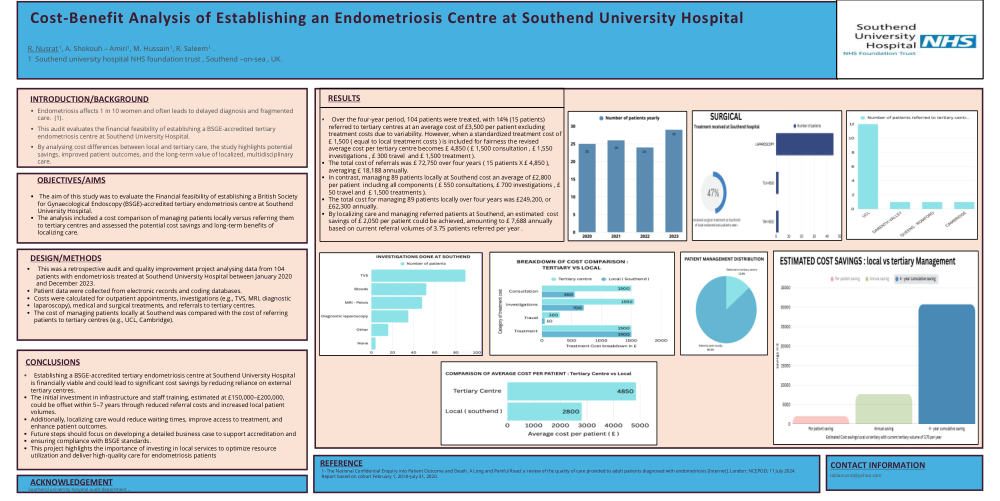
§Over the four-year period, 104 patients were treated, with 14% (15 patients) referred to tertiary centres at an average cost of £3,500 per patient excluding treatment costs due to variability. However, when a standardized treatment cost of £ 1,500 ( equal to local treatment costs ) is included for fairness the revised average cost per tertiary centre becomes £ 4,850 ( £ 1,500 consultation , £ 1,550 investigations , £ 300 travel and £ 1,500 treatment ).
§The total cost of referrals was £ 72,750 over four years ( 15 patients X £ 4,850 ), averaging £ 18,188 annually.
§In contrast, managing 89 patients locally at Southend cost an average of £2,800 per patient including all components ( £ 550 consultations, £ 700 investigations , £ 50 travel and £ 1,500 treatments ).
§The total cost for managing 89 patients locally over four years was £249,200, or £62,300 annually.
§By localizing care and managing referred patients at Southend, an estimated cost savings of £ 2,050 per patient could be achieved, amounting to £ 7,688 annually based on current referral volumes of 3.75 patients referred per year .