2,281 posters, 63 videos, 56 audios, 43 topics, 18 sessions, 6,174 authors, 2,323 institutions
ePostersLive by SciGen Technologies S.A. All rights reserved.
RCOG World Congress 2025
June 23 - 25, 2025 | ExCeL London, UK
EP.0356
Women with DIE treated by Laparoscopic Segmental Bowel Resection :Two-Year Symptom Outcomes
Poster Presenter
Authors
Affiliations
Part of Topic
Endometriosis & uterine disorders
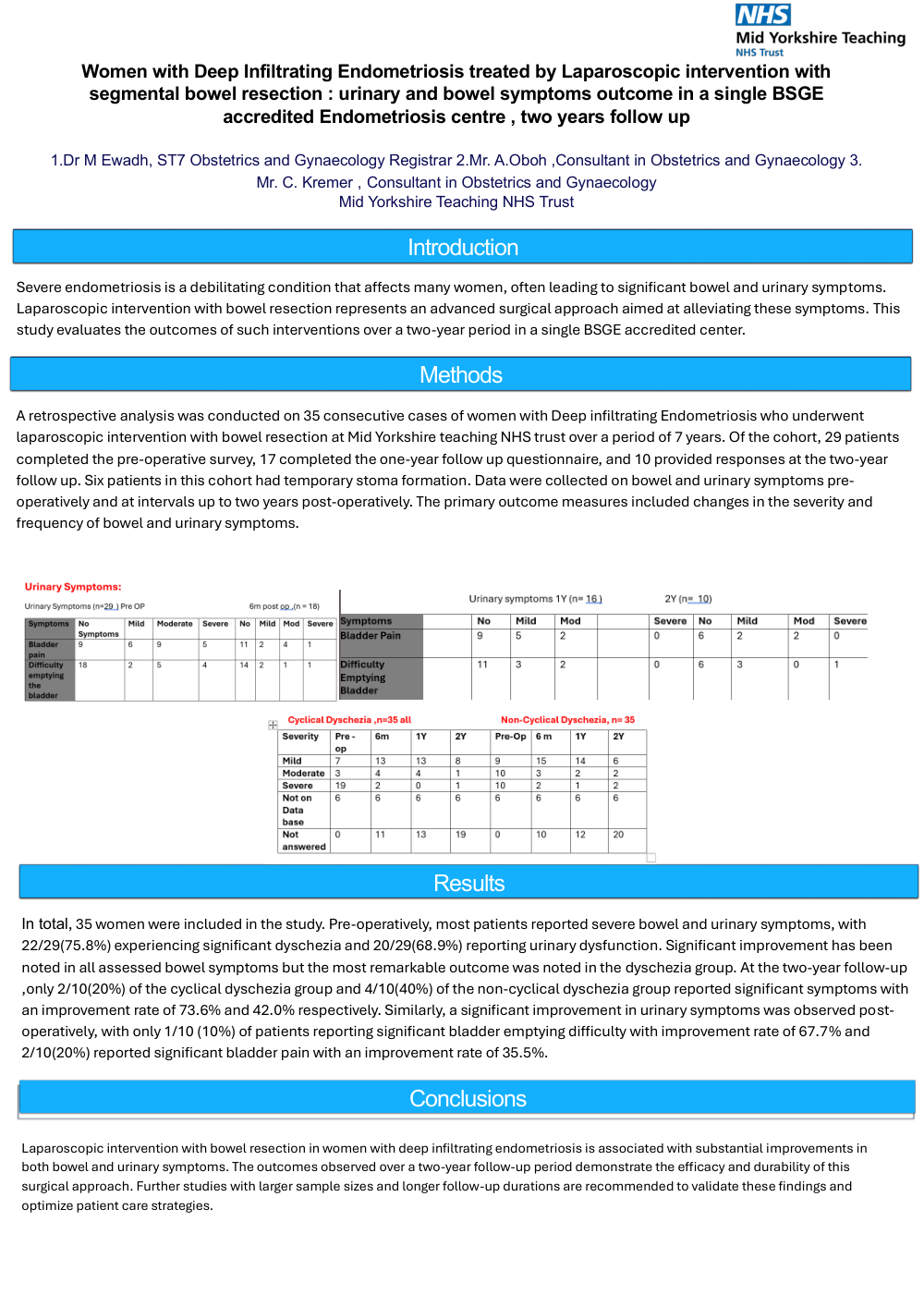
Women with Deep Infiltrating Endometriosis treated by Laparoscopic intervention with segmental bowel resection : urinary and bowel symptoms outcome in a single BSGE accredited Endometriosis centre , two years follow up 1.Dr M Ewadh, ST7 Obstetrics and Gynaecology Registrar 2.Mr. A.Oboh ,Consultant in Obstetrics and Gynaecology 3. Mr. C. Kremer , Consultant in Obstetrics and Gynaecology Mid Yorkshire Teaching NHS Trust
Introduction:
Severe endometriosis is a debilitating condition that affects many women, often leading to significant bowel and urinary symptoms. Laparoscopic intervention with bowel resection represents an advanced surgical approach aimed at alleviating these symptoms. This study evaluates the outcomes of such interventions over a two-year period in a single BSGE accredited center.
Method:
A retrospective analysis was conducted on 35 consecutive cases of women with Deep infiltrating Endometriosis who underwent laparoscopic intervention with bowel resection at Mid Yorkshire teaching NHS trust over a period of 7 years. Of the cohort, 29 patients completed the pre-operative survey, 17 completed the one-year follow up questionnaire, and 10 provided responses at the two-year follow up. Six patients in this cohort had temporary stoma formation. Data were collected on bowel and urinary symptoms preoperatively and at intervals up to two years post-operatively. The primary outcome measures included changes in the severity and frequency of bowel and urinary symptoms.
Results:
In total, 35 women were included in the study. Pre-operatively, most patients reported severe bowel and urinary symptoms, with 22/29(75.8%) experiencing significant dyschezia and 20/29(68.9%) reporting urinary dysfunction. Significant improvement has been noted in all assessed bowel symptoms but the most remarkable outcome was noted in the dyschezia group. At the two-year follow-up ,only 2/10(20%) of the cyclical dyschezia group and 4/10(40%) of the non-cyclical dyschezia group reported significant symptoms with an improvement rate of 73.6% and 42.0% respectively. Similarly, a significant improvement in urinary symptoms was observed postoperatively, with only 1/10 (10%) of patients reporting significant bladder emptying difficulty with improvement rate of 67.7% and 2/10(20%) reported significant bladder pain with an improvement rate of 35.5%.
Conclusion:
Laparoscopic intervention with bowel resection in women with deep infiltrating endometriosis is associated with substantial improvements in both bowel and urinary symptoms. The outcomes observed over a two-year follow-up period demonstrate the efficacy and durability of this surgical approach. Further studies with larger sample sizes and longer follow-up durations are recommended to validate these findings and optimize patient care strategies.