2,281 posters, 63 videos, 56 audios, 43 topics, 18 sessions, 6,174 authors, 2,323 institutions
ePostersLive by SciGen Technologies S.A. All rights reserved.
RCOG World Congress 2025
June 23 - 25, 2025 | ExCeL London, UK
EP.0344
Laparoscopic Endometriosis Excision Audit in Barbados
Poster Presenter
Authors
Affiliations
Part of Topic
Endometriosis & uterine disorders
Laparoscopic Endometriosis Excision Audit in Barbados
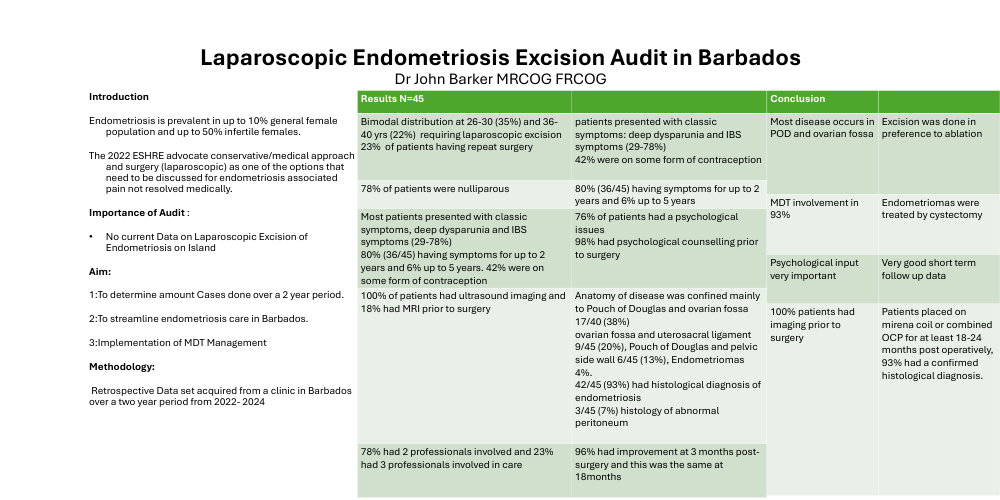
Endometriosis is prevalent in up to 10% general female population and up to 50% infertile females.
The 2022 ESHRE advocate conservative/medical approach and surgery (laparoscopic) as one of the options that need to be discussed for endometriosis associated pain not resolved medically.
Importance of Audit :
Aim:
1:To determine amount Cases done over a 2 year period.
2:To streamline endometriosis care in Barbados.
3:Implementation of MDT Management
Methodology:
Retrospective Data set acquired from a clinic in Barbados over a two year period from 2022- 2024
N-45
45 notes retrieved showing bimodal distribution at 26-30 (35%) and 36-40 yrs (22%) requiring laparoscopic excision, 23% of patients having repeat surgery.
78% of patients were nulliparous.
Most patients presented with classic symptoms, deep dysparunia and IBS symptoms (29-78%) with 80% (36/45) having symptoms for up to 2 years and 6% up to 5 years. 42% were on some form of contraception.
Clinical Examination was normal in 74% of patients with 51% showing deep dyspareunia.
76% of patients had a psychological issues and 98% had psychological counselling prior to surgery.
100% of patients had ultrasound imaging and 18% had MRI prior to surgery.
Anatomy of disease was confined mainly to Pouch of Douglas and ovarian fossa 17/40 (38%),ovarian fossa and uterosacral ligament 9/45 (20%), Pouch of Douglas and pelvic side wall 6/45 (13%), Endometriomas 4%. 42/45 (93%) had histological diagnosis of endometriosis and 3/45 (7%) histology of abnormal peritoneum.
78% had 2 professionals involved and 23% had 3 professionals involved in care.
96% had improvement at 3 months post-surgery and this was the same at 18months.
Conclusions : Most disease occurs in POD and ovarian fossa, Excision was done in preference to ablation, MDT involvement in 93% , Endometriomas were treated by cystectomy, Psychological input very important, Very good short term follow up data ,100% patients had imaging prior to surgery, Patients placed on mirena coil or combined OCP for at least 18-24 months post operatively, 93% had a confirmed histological diagnosis.