2,281 posters, 63 videos, 56 audios, 43 topics, 18 sessions, 6,174 authors, 2,323 institutions
ePostersLive by SciGen Technologies S.A. All rights reserved.
RCOG World Congress 2025
June 23 - 25, 2025 | ExCeL London, UK
EP.0336
Cabergoline: A Promising Therapy for Reducing Inflammatory Markers and Pain in Endometriosis
Poster Presenter
Authors
Ritu Kushwah, Tarang Gupta, Tushar Sehgal, Anju Singh, Archana Kumari, Reeta Mahey, Garima Kachhawa
Affiliations
Part of Topic
Endometriosis & uterine disorders
Cabergoline: A Promising Therapy for Reducing Inflammatory Markers and Pain in Endometriosis
Dr Ritu Kushwah1, Dr Garima Kachhawa1,Tarang Gupta1, Dr Tushar Sehgal2, Dr Anju Singh1, Dr Archana Kumari1, Dr Reeta Mahey1
1Department of Obstetrics and Gynaecology,2Department of Laboratory Medicine, All India Institute of Medical Sciences, New Delhi, India
Introduction
Aims and Objectives
PRIMARY OBJECTIVES
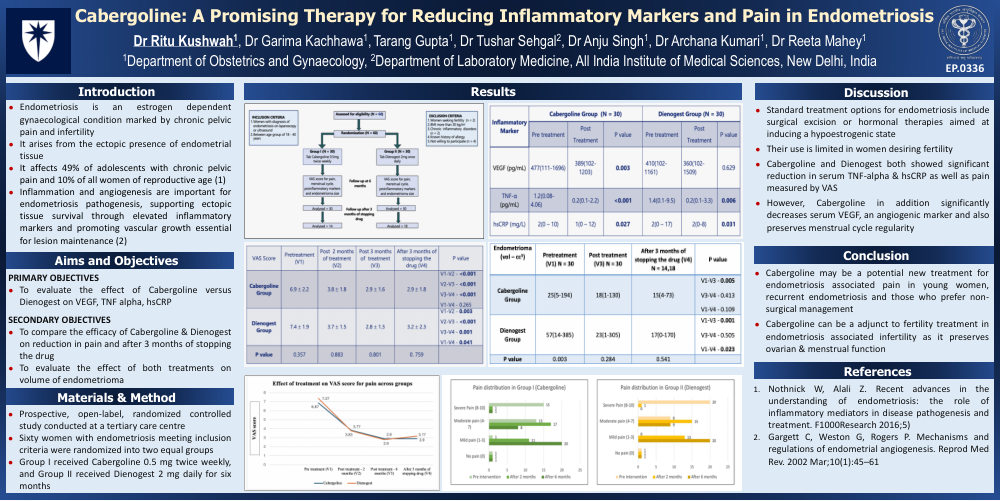
To evaluate the effect of Cabergoline versus Dienogest on VEGF, TNF alpha, hsCRP
SECONDARY OBJECTIVES
To compare the efficacy of Cabergoline & Dienogest on reduction in pain and after 3 months of stopping the drug
To evaluate the effect of both treatments on volume of endometrioma
Materials & Method
Discussion
Standard treatment options for endometriosis include surgical excision or hormonal therapies aimed at inducing a hypoestrogenic state
Their use is limited in women desiring fertility
Cabergoline and Dienogest both showed significant reduction in serum TNF-alpha & hsCRP as well as pain measured by VAS
However, Cabergoline in addition significantly decreases serum VEGF, an angiogenic marker and also preserves menstrual cycle regularity
Conclusion
Cabergoline may be a potential new treatment for endometriosis associated pain in young women, recurrent endometriosis and those who prefer non-surgical management
Cabergoline can be a adjunct to fertility treatment in endometriosis associated infertility as it preserves ovarian & menstrual function
References