2,281 posters, 63 videos, 56 audios, 43 topics, 18 sessions, 6,174 authors, 2,323 institutions
ePostersLive by SciGen Technologies S.A. All rights reserved.
RCOG World Congress 2025
June 23 - 25, 2025 | ExCeL London, UK
EP.0329
Validation and responsiveness of EHP-30 traditional Chinese version in endometriosis and adenomyosis
Part of Topic
Endometriosis & uterine disorders
Validation and responsiveness of EHP-30 traditional Chinese version in endometriosis and adenomyosis
Linda FUNG Wen Ying, Eva CHEUNG Chun Wai, Symphorosa CHAN Shing Chee, Alyssa WONG Sze Wai, Daljit Singh SAHOTA
Dept. of Obstetrics and Gynaecology, The Chinese University of Hong Kong, Prince of Wales Hospital, Hong Kong SAR
Objective
The EHP 30 Endometriosis Health Profile Questionnaire is useful to evaluate the health status of women suffering from endometriosis. We aim at validating the Chinese version of the EHP-30 to assess for use in patients with endometriosis and adenomyosis, and assessed the responsiveness of EHP-30 after medical and surgical therapy in this patient group.
Design
Prospective cohort study
Methods
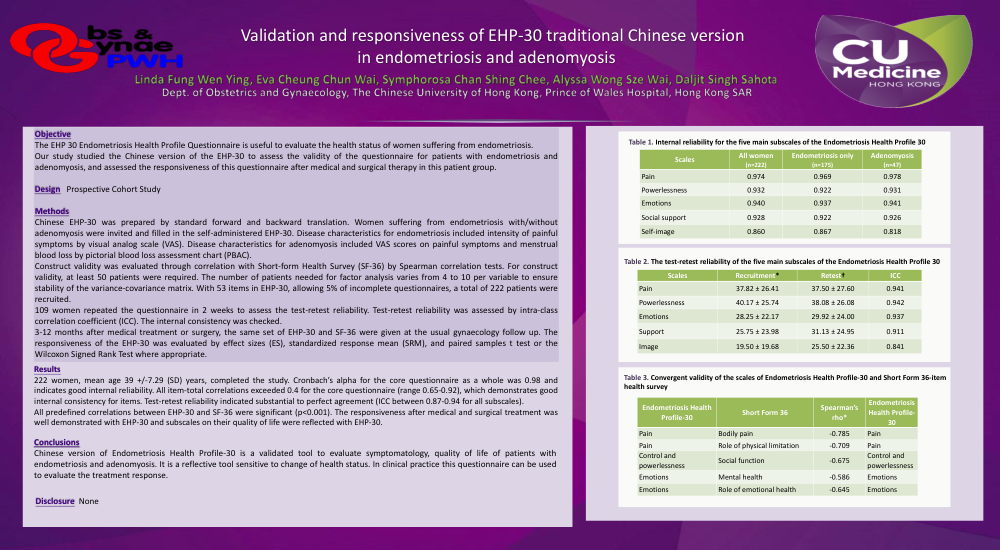
Chinese EHP-30 was prepared by standard forward and backward translation. Women suffering from endometriosis with/without adenomyosis were invited and filled in the self-administered EHP-30. Disease characteristics for endometriosis included intensity of painful symptoms by visual analog scale (VAS). Disease characteristics for adenomyosis included VAS scores on painful symptoms and menstrual blood loss by pictorial blood loss assessment chart (PBAC). Construct validity was evaluated through correlation with Short-form Health Survey (SF-36) by Spearman correlation tests. For construct validity, at least 50 patients were required. The number of patients needed for factor analysis varies from 4 to 10 per variable to ensure stability of the variance-covariance matrix. With 53 items in EHP-30, allowing 5% of incomplete questionnaires, a total of 222 patients were recruited.
109 women repeated the questionnaire in 2 weeks to assess the test-retest reliability. Test-retest reliability was assessed by intra-class correlation coefficient (ICC). The internal consistency was checked.
3-12 months after medical treatment or surgery, the same set of EHP-30 and SF-36 were given at the usual gynaecology follow up. The responsiveness of the EHP-30 was evaluated by effect sizes (ES), standardized response mean (SRM), and paired samples t test or the Wilcoxon Signed Rank Test where appropriate.
Results
222 women, mean age 39 +/-7.29 (SD) years, completed the study. Cronbach’s alpha for the core questionnaire as a whole was 0.98 and indicates good internal reliability. All item-total correlations exceeded 0.4 for the core questionnaire (range 0.65-0.92), which demonstrates good internal consistency for items. Test-retest reliability indicated substantial to perfect agreement (ICC between 0.87-0.94 for all subscales).
All predefined correlations between EHP-30 and SF-36 were significant (p<0.001). The responsiveness after medical and surgical treatment was well demonstrated with EHP-30 and subscales on their quality of life were reflected with EHP-30.
Conclusions
Chinese version of Endometriosis Health Profile-30 is a validated tool to evaluate symptomatology, quality of life of patients with endometriosis and adenomyosis. It is a reflective tool sensitive to change of health status. In clinical practice this questionnaire can be used to evaluate the treatment response.