2,281 posters, 63 videos, 56 audios, 43 topics, 18 sessions, 6,174 authors, 2,323 institutions
ePostersLive by SciGen Technologies S.A. All rights reserved.
RCOG World Congress 2025
June 23 - 25, 2025 | ExCeL London, UK
EP.0328
Ormeloxifene in Symptomatic Relief of Adenomyosis (AUB-A): A Longitudinal Interventional Study
Poster Presenter
Authors
Affiliations
Part of Topic
Endometriosis & uterine disorders
Ormeloxifene in Symptomatic Relief of Adenomyosis (AUB-A): A Longitudinal Interventional Study
Dr. Kubera Siddappa Nichanahalli
Dr. Sivani Bodapati, Mrs Anasuya Ram, JIPMER, Puducherry, INDIA
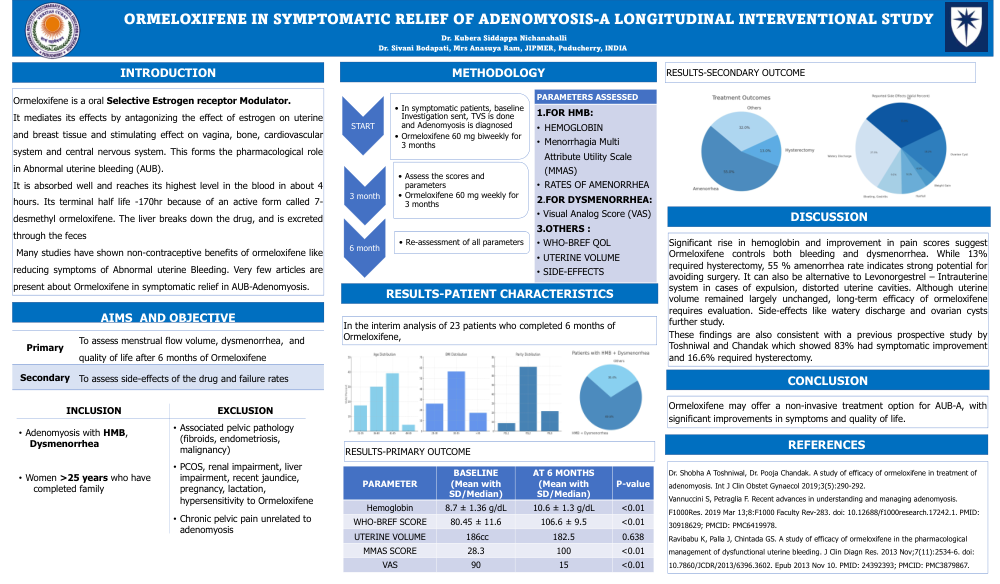
BACKGROUND: Adenomyosis is a benign uterine condition leading to abnormal bleeding, dysmenorrhea, and pelvic pain, which significantly affects quality of life. Ormeloxifene, a selective oestrogen receptor modulator (SERM) is primarily used in India as a contraceptive. It is found to reduce heavy menstrual bleeding due to its anti-estrogenic effects in many studies. However, limited research exists on its efficacy for treating Adenomyosis-associated AUB (AUB-A).
AIMS AND OBJECTIVE: Primary aim is to assess menstrual flow volume, dysmenorrhea, and quality of life after 6 months of Ormeloxifene. Secondary aim is to assess side-effects of the drug and failure rates.
METHODS: Longitudinal ongoing interventional study at a tertiary centre in south India. Symptomatic women who completed family diagnosed with AUB-A using TVS (MUSA criteria) were given Ormeloxifene 60 mg biweekly for the first 3 months, followed by 60 mg weekly for the next 3 months.
RESULTS: In the interim analysis of 23 patients, the majority were multiparous, tubectomised, obese patients aged 31 to 50 years, the majority 16 (69.6%) had both heavy menstrual bleeding (HMB) and dysmenorrhea.Haemoglobin levels significantly increased from 8.7 ± 1.36 g/dL to 10.6 ± 1.3 g/dL. Significant improvements were observed in Menorrhagia Multi-Attribute scale (MMAS), and Visual Analog Scale (VAS) for pain (p < 0.01). The WHO-BREF Quality of Life score improved from 80.45 ± 11.6 at baseline to 106.6 ± 9.5 after 6 months. No significant reduction in uterine volume was noted. Amenorrhea occurred in 11 (55%) of patients, and 3(13%) underwent hysterectomy due to persistent symptoms. The most reported side effect was watery discharge (26.1%), followed by functional ovarian cysts in 4 (18.2%) of patients.
CONCLUSION: Ormeloxifene may provide a non-invasive, medical treatment option for AUB-A, with significant improvements in symptoms and quality of life.