2,281 posters, 63 videos, 56 audios, 43 topics, 18 sessions, 6,174 authors, 2,323 institutions
ePostersLive by SciGen Technologies S.A. All rights reserved.
RCOG World Congress 2025
June 23 - 25, 2025 | ExCeL London, UK
PP.0111
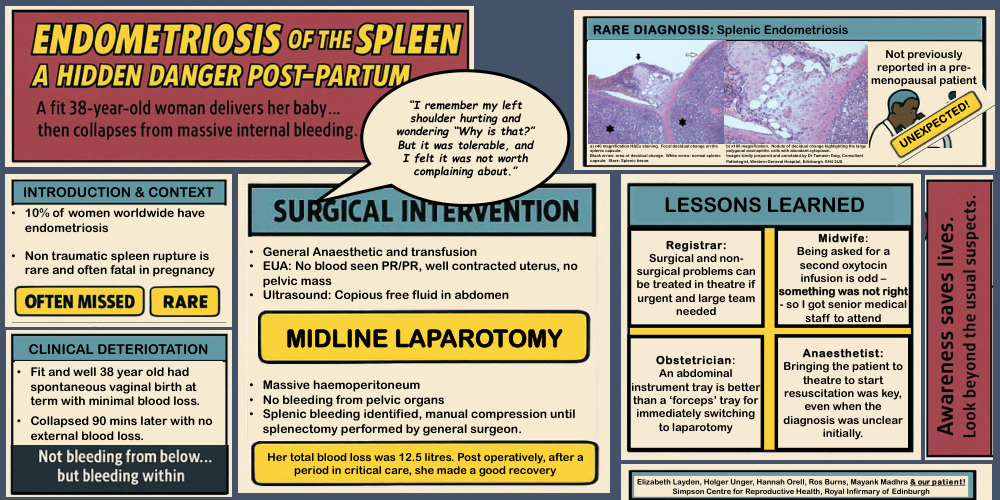
Endometriosis of the spleen presenting with massive haemoperitoneum immediately post-partum
Poster Presenter
Authors
Elizabeth Layden, Holger Unger, Hannah Orell, Rosamunde Burns, Mayank Madhra
Affiliations
Simpson Centre for Reproductive Health, Royal Infirmary of Edinburgh, Department of Obstetrics and Gynaecology, Royal Darwin Hospital, Department of Anaesthesia and Pain Medicine, Royal Infirmary of Edinburgh
Part of Topic
Endometriosis & uterine disorders
Endometriosis of the spleen presenting with massive haemoperitoneum immediately post-partum
Objective:
Non-traumatic splenic rupture in pregnancy or the puerperium is a rare event and is associated with high maternal and fetal mortality. Approximately 10% of women worldwide have endometriosis.
This case report describes a very rare but life-threatening presentation of endometriosis in an obstetric context.
Case report:
A previously fit and well 38-year-old woman had a spontaneous vaginal delivery at term with minimal blood loss, after an uneventful antenatal course.
At around 90 minutes postpartum, she acutely deteriorated and collapsed, secondary to hypovolaemic shock. An obstetric source of the bleeding was excluded.
A midline laparotomy identified a massive haemoperitoneum, secondary to non-traumatic splenic rupture, which was managed with splenectomy. Her total blood loss was 12.5 litres. Post operatively, after a period in critical care, she made a good recovery.
Histopathology confirmed endometriosis of the splenic capsule.
Discussion:
Unusually, the splenic rupture was found to be secondary to splenic endometriosis; a very rare diagnosis.
While in this case of atraumatic splenic rupture (ASR) both mother and baby survived, this is often not the case. Situational and human factors contributed to the good outcome.
Maternal mortality due to non-traumatic splenic rupture is high due to the combination of late diagnosis, lack of clinical awareness of the condition, the ability of otherwise young fit women to compensate for haemorrhage, and late recourse to laparotomy.
Conclusions:
This is the first described case of splenic endometriosis associated ASR. There have however been isolated cases of bowel endometriosis causing non-iatrogenic perforation and haemorrhage.
ASR often occurs following an infiltrative or inflammatory process such as malaria, mononucleosis or malignancy. Pregnancy itself is a time of physiological and endocrinological changes which may predispose to non-traumatic splenic rupture. Splenic rupture can also occur in the context of pregnancy-related disorders such as pre-eclampsia and HELLP syndrome as there is concomitant hypertension with endothelial and platelet dysfunction.
The endometriotic changes class this case as an ASR rather than a spontaneous splenic rupture (SSR), but it is unclear how much this contributed to the rupture, and this uncertainty pervades many ASR/SSR events.
It is feasible to imagine an endometriotic lesion weakening the splenic capsule, or causing the tethering to the abdominal wall seen at laparotomy in conjunction with the endocrine-driven vascular changes in pregnancy and physical exertion of vaginal birth culminating in an atraumatic splenic rupture.